Live data from Hacker News

Suddenly, It Seems, Water Is Everywhere in Solar System

nytimes.com

51–60 of 101 posts

Re: Suddenly, It Seems, Water Is Everywhere in Solar System

#51

Earlier quoted context omitted.

"Yeah I'll have a quart of Coke" certainly sounds weird. It is strange now that I think about it that we have imperial measurements for milk but metric measurements for sugary drinks/beer.

Beer and soda bottled or canned for individual servings still use imperial units (12oz/16oz/20oz). Oddly, water bottled for such has mostly moved over to metric. Keg beer also still uses imperial.

In Finland you can always order 0,568 liter beer. (Imperial pint) Or traditional large beer which is 0,5 liter or euro beer which is 0,4 liter. You decide.

Re: Suddenly, It Seems, Water Is Everywhere in Solar System

#52
Growing up this was a huge question that nobody knew the answer to. I don't remember the first discovery of water but I do remember reading one after another water finding. Back then water = life and if we found water it was very likely we would find some form of life. I've already read articles talking about microbial life but I think we will soon discover a variety of living forms.

That being said I don't think our solar system contains a more advanced being than humans. But what life, in some form, demonstrates is that it is possible, in some place very far away, there are living beings as advanced or more than we are. I would really love to be alive to meet them.

Re: Suddenly, It Seems, Water Is Everywhere in Solar System

#53
post #28

Does anyone else think NASA should reconsider their plans for a manned mission to Mars? With Europe, Ceres, Enceladus, Ganymede and many more promising moons out there it seems kind of a waste to spend time, effort and capital in Mars now.

There is exploration and there is colonization, which to some degree are orthogonal and to some degree complementary to each other, but they are not the same thing. Manned missions to Mars would mostly be about colonization, though exploration would be a significant side benefit. Mars is by far the most promising candidate for colonization (with the potential for using local resources to enable an early level of significant self-sufficiency, increasing over time) which would help kickstart our capabilities in interplanetary spaceflight in general, both manned and unmanned.

Re: Suddenly, It Seems, Water Is Everywhere in Solar System

#54
post #25

Earlier quoted context omitted.

It's surprising (water is perceived to be scarce) because: - oxygen just as readily binds to everything else, to form metal oxides (the well-known rust on Mars) or silicates (rock) or just CO2 (Venus) - hydrogen is so light it readily escapes into space from anything smaller than Earth - H2O as solid ice is common anyway, but not as liquid water, which is more relevant for potential habitability and life. The conditi…

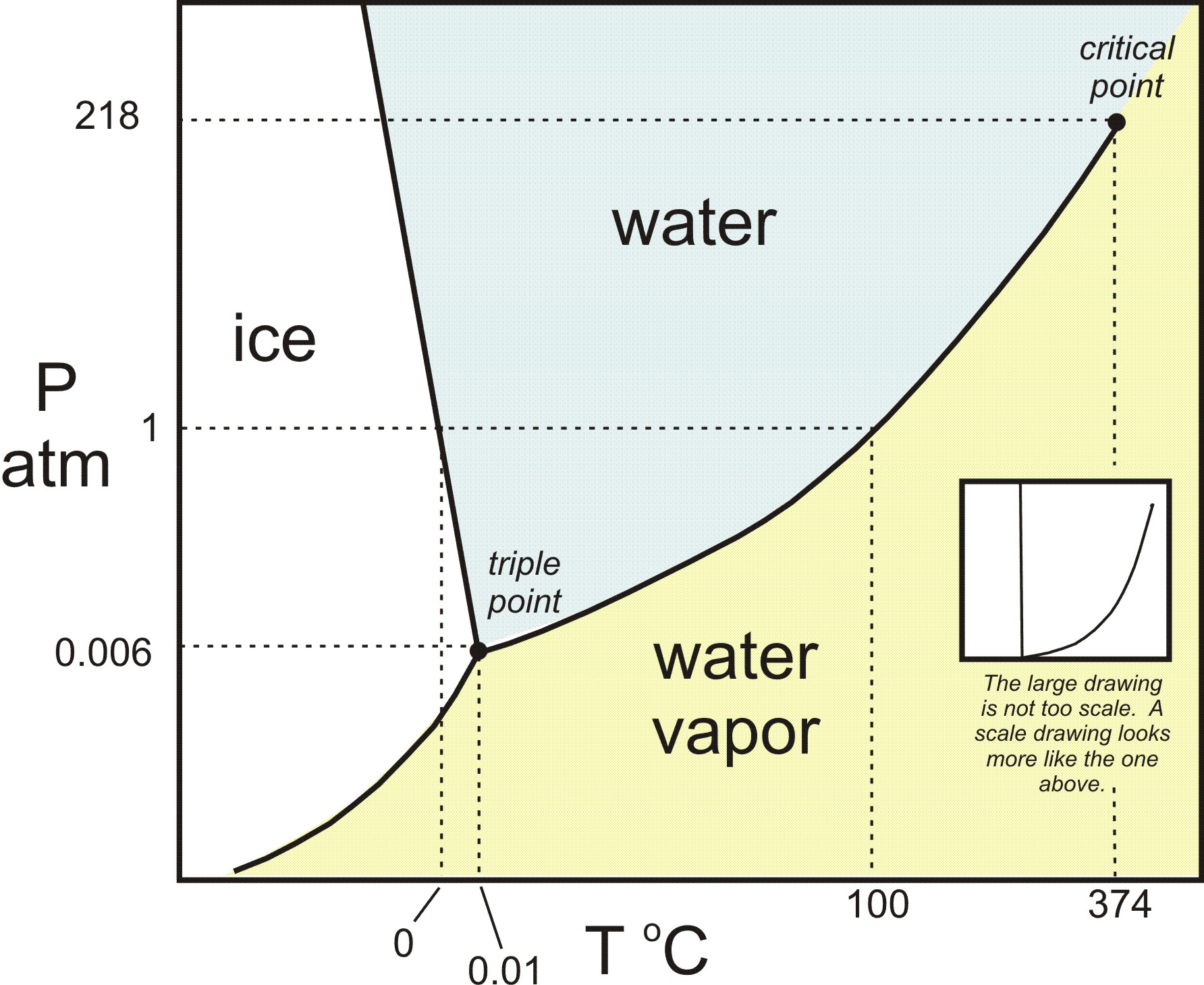
If there is both vapor and ice, there must always be at least some water. If water is plentiful, space is cold, and planets are hot, liquid water should be common, regardless of how narrow the temperature conditions for it are. All temperatures from cold space to molten rock are well represented on planets.

That's not true at all. It depends on the pressure.

http://d32ogoqmya1dw8.cloudfront.net/images/research_educati...

Re: Suddenly, It Seems, Water Is Everywhere in Solar System

#55
post #28

Does anyone else think NASA should reconsider their plans for a manned mission to Mars? With Europe, Ceres, Enceladus, Ganymede and many more promising moons out there it seems kind of a waste to spend time, effort and capital in Mars now.

They are completely separate missions. Mars is about sending humans somewhere other than the moon. It's less about scientific discovery and more about engineering and exploration discovery - we're doing it to learn about Mars sure, but moreso we're doing it to see if we can.

Mars is the next step in humanity's long term (hundred of thousands of years) survival. If we ever intend not to be at the mercy of gravity, we have to get off earth. We've been to the moon, which is gravitationally constrained to earth, and is only a three day journey (with many chances for safe aborts). We've conquered LEO and now know more about our planet than we could have dreamed up 20 years ago. Mars is a completely different challenge, and by going to Mars we'll develop the first bits of technology that will help us off our deathtrap of a cradle.

These two missions can coexist. We haven't developed the technology to send humans that far out into the solar system so we should continue to send probes.

Re: Suddenly, It Seems, Water Is Everywhere in Solar System

#56
post #2

It's not too much of a surprise, both elements that go into water are plentiful and not particularly heavy, and both want to bind to something.

You're misunderstanding the relevance here. Water the molecule is common throughout the solar system, typically as ice. It makes up a significant fraction of the mass of many of the moons of outer planets. It's a common component of comets and other minor planetary bodies. Titan, for example, is about half water ice, but it is so cold there that it is effectively a rock.

What we've been learning is that there is water ice in some places we didn't necessarily expect it before (such as in the form of permafrost underlying much of the Martian surface) and most importantly that liquid water is not as uncommon as we once thought. Liquid water is what's most interesting from the point of view of looking for environments that can support life forms. Previously we thought that the presence of liquid water required not only the presence of water as a material but also overall planetary temperatures in a temperate range, the so called "habitable zone". Which, as it turns out, is a fairly narrow zone. But we've learned that there seem to be numerous circumstances that allow the existence of substantial quantities of liquid water in conditions that otherwise would not support it. Europa, for example, has frigid surface temperatures (150 to 200 degrees C below freezing) but it has a sub-surface ocean due to tidal interactions with its neighbors. That sort of thing seems to be much more common than we knew previously.
Re: Suddenly, It Seems, Water Is Everywhere in Solar System

#57

Earlier quoted context omitted.

Don't we already have lots of autonomous subs on earth? As long as they can survive the trip, just put some new sensors in and go.

How would you get data back? I'd imagine you'd have to have a surface relay, to a moon-orbiting satellite, then back to earth.

They come to the surface, then get a gps fix (err) and then is picked up by the boat then the data uploaded..... Ok its going to need some minor modifications.

Re: Suddenly, It Seems, Water Is Everywhere in Solar System

#58

Has anyone thought much about an (admittedly near impossible) probe to burrow and submarine around in the oceans of some of the juicier Galilean and Saturnian moons?

Georgia Tech had a team in Antarctica recently doing field tests of robots designed to explore under very thick ice sheets, specifically to prepare for a Europa mission. http://schmidt.eas.gatech.edu/simple/

I work on this project under Bill Stone's company Stone Aerospace [1]. One of the projects, VALKYRIE [2], is a laser powered cryobot to melt through ice in order to launch a vehicle in the water underneath. ARTEMIS is the AUV for SIMPLE, and is the third generation following the AUVs DEPTHX & ENDURANCE. VALKYRIE has been field tested and ARTEMIS goes to Antarctica this fall.

[1] http://www.stoneaerospace.com/

[2] http://www.wired.com/2012/04/bill-stone-laser-powered-europa...

Re: Suddenly, It Seems, Water Is Everywhere in Solar System

#59

Growing up this was a huge question that nobody knew the answer to. I don't remember the first discovery of water but I do remember reading one after another water finding. Back then water = life and if we found water it was very likely we would find some form of life. I've already read articles talking about microbial life but I think we will soon discover a variety of living forms. That being said I don't think our…

> That being said I don't think our solar system contains a more advanced being than humans.

I can't imagine there would be any real debate over that point.

Re: Suddenly, It Seems, Water Is Everywhere in Solar System

#60
post #9

Fascinating! However, I get the cringes every time an article about space exploration uses those atavistic units like Royal Hangnails (length), Princely Bladders (volume), Regal Farts (speed) and Fornicating Fever (temperature) for measurement. Hasn't the metric system arrived yet on planet USA?

While I'm an American engineer who prefers working in metric, since this is a space-related article I have to point you to this: https://s-media-cache-ak0.pinimg.com/736x/69/ae/01/69ae0104b...

Ignoring the idiotic patriotism, that image is incorrect: Russia, China, and India have all placed landers on the moon.
Post reply on HN