Live data from Hacker News

VMWare Taken to Court Over GPL Violation

sfconservancy.org

41–50 of 299 posts

Re: VMWare Taken to Court Over GPL Violation

#41
post #3
post #2

Is there any information about why VMware thinks they are not bound by the GPL? Curious whether they have a technical justification, rather than simply being a blatant licensing violation.

This is just speculation but I suspect this is a matter of being caught with their pants down. They violated the GPL, but to comply with the license would mean that they'd have to release a lot of code that they don't want to release. From the page, it seems like there's been ongoing negotiation, so I am guessing there's been a lot of stalling.

> They violated the GPL, but to comply with the license would mean that they'd have to release a lot of code that they don't want to release.

Well they could replace the component with proprietary (so there is not license to comply with), stop releasing the old version and then probably settle to pay fines or damages.

In other words the legal outcome of GPL violations is not necessarily being forced to release the rest of the code as GPL.

Re: VMWare Taken to Court Over GPL Violation

#42

Any litigation of the GPL is more than likely more dangerous for the GPL than it is for the companies. A relaxing of the understood requirements of using and distributing GPL code could cause an avalanche of fall out from formerly protected code becoming less protected. If I was this organization I would only risk a lawsuit of something that would have profound positive consequences for open source. VMware's risk is…

The GPL has been tested in courts all over the world. VMWare is insane to continue violating it after being informed of the problems and to then refuse cooperation.

They'll probably pay up and drop dead once someone mumbles injunction.

Re: VMWare Taken to Court Over GPL Violation

#44
post #33

It's a german lawyer suing in a german court for a german client. How can I donate in EUR without the money going through USD? Edit: "[The USD] is our currency, but it's your problem.", John Bowden Connally, Jr. Obviously here are people who like it that way.

If your country participates in SWIFT a wire transfer should be possible, see http://sfconservancy.org/donate/

Re: VMWare Taken to Court Over GPL Violation

#45
post #7
post #2

Is there any information about why VMware thinks they are not bound by the GPL? Curious whether they have a technical justification, rather than simply being a blatant licensing violation.

I'm not fully up-to-date on this case, but there is a bit of wiggle room on what counts as a derivative work, even in kernelspace. My favorite example is OpenAFS. Development of the AFS kernel module started in 1983, so the code is a decade older than Linux itself. So it's hard to argue that openafs.ko is a derivative work of Linux, and since it continues to run on several kernels other than Linux (Darwin, Solaris, N…

> I think the remaining Linux parts mostly exist as hardware drivers, and VMware is providing the core kernel routines like scheduling and memory management and "world" management (equivalent to process management, but it's a hypervisor).

That description of vmkernel reminds me of Xen's hypervisor (dom0 handling hardware access, providing drivers but otherwise still sitting "above" the hypervisor), one technical difference I'm aware of is that Xen's hypervisor is the first piece of code loaded by the bootloader.

But does that even count as a technical difference once the system is running? Does vmkernel effectively do the same thing Xen does even though it loads dynamically via the kernel module interface after the Linux kernel boots?

I don't know much at all about how each of these common hypervisors (vmkernel, KVM, Xen, Hyper-V) interact with their "driver domain", and certainly I'm in no position to say whether any technical distinction in the way they each load or work will matter legally, but I've been interested in the vmkernel situation for a long time so I'll be watching closely.

I'm also reminded that there seem to be several proprietary versions of Xen's (otherwise GPL'd) hypervisor that bolt on closed source features, perhaps they'll end up in a similar situation as VMWare if this goes badly for them?

Re: VMWare Taken to Court Over GPL Violation

#46
post #4

I'm surprised it took this long. I can't really blame them, after 15 years of ignoring the GPL, they probably figured nobody would ever come up with the financial resources to actually go after them. This is going to take years to come to a resolution and millions and millions of dollars in lawyers fees.

I doubt that it'll come to that. There are some really nasty consequences of being found to violate the GPL:

  4. You may not copy, modify, sublicense, or distribute the
  Program except as expressly provided under this License.
  Any attempt otherwise to copy, modify, sublicense or
  distribute the Program is void, and will automatically
  terminate your rights under this License...
From what I understand, there is no obvious way to re-gain a license to GPL'd code once it's been terminated (short of asking every single individual contributor). There is the distinct possibility that VMWare could be enjoined from using Linux in any way if they are ruled against (and it sticks on appeal).

Re: VMWare Taken to Court Over GPL Violation

#47
post #10
post #7

Earlier quoted context omitted.

I'm not fully up-to-date on this case, but there is a bit of wiggle room on what counts as a derivative work, even in kernelspace. My favorite example is OpenAFS. Development of the AFS kernel module started in 1983, so the code is a decade older than Linux itself. So it's hard to argue that openafs.ko is a derivative work of Linux, and since it continues to run on several kernels other than Linux (Darwin, Solaris, N…

From the wording in the link it sounds like they include modified GPL code and don't publish that, not that they are expected to open-source ESXi (or whatever it is called right now) entirely: > In 2011, Conservancy discovered that VMware had failed to provide nor offer any source code for the version of BusyBox included in VMware's ESXi products (as required by BusyBox's license, GPLv2).

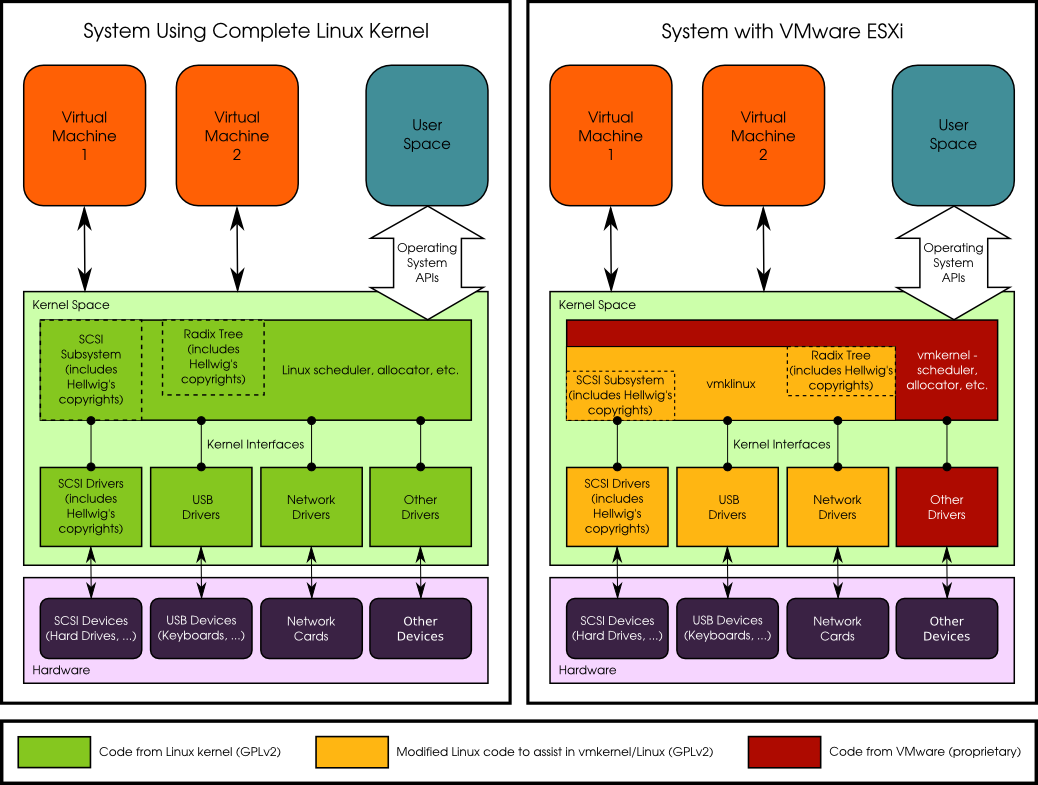
The FAQ implies the lawsuit is relating to the Linux kernel: http://sfconservancy.org/linux-compliance/vmware-lawsuit-faq...

> This case is specifically regarding a combined work that VMware allegedly created by combining their own code (“vmkernel”) with portions of Linux's code, which was licensed only under GPLv2. As such, this, to our knowledge, marks the first time an enforcement case is exclusively focused on this type of legal question relating to GPL. However, there are so many different ways to make combined and/or derivative works that are covered by GPL that no single case could possibly include all such issues.

Re: VMWare Taken to Court Over GPL Violation

#48
post #4

I'm surprised it took this long. I can't really blame them, after 15 years of ignoring the GPL, they probably figured nobody would ever come up with the financial resources to actually go after them. This is going to take years to come to a resolution and millions and millions of dollars in lawyers fees.

I doubt that it'll come to that. There are some really nasty consequences of being found to violate the GPL: 4. You may not copy, modify, sublicense, or distribute the Program except as expressly provided under this License. Any attempt otherwise to copy, modify, sublicense or distribute the Program is void, and will automatically terminate your rights under this License... From what I understand, there is no obvious…

This is the way I understand the license as well. That's one of the reasons the GPL3 has language to the effect of regaining the license: http://www.gnu.org/copyleft/gpl.html#section8

Even then, a copyright-holder can still permanently terminate your rights if they so choose and notify you of such termination.

Re: VMWare Taken to Court Over GPL Violation

#49
post #12
post #7

Earlier quoted context omitted.

I'm not fully up-to-date on this case, but there is a bit of wiggle room on what counts as a derivative work, even in kernelspace. My favorite example is OpenAFS. Development of the AFS kernel module started in 1983, so the code is a decade older than Linux itself. So it's hard to argue that openafs.ko is a derivative work of Linux, and since it continues to run on several kernels other than Linux (Darwin, Solaris, N…

The issue is that there's linking, not merely calling from. As for "what came first"- the license (which is a legal contract) specifies what is and isn't allowed. The LGPL would work in the way you are saying that VMWare might like it to work- where linking isn't the same as deriving. The fact that these two licenses exist demonstrates that distinction clearly. The issue will be whether or not a judge understands the…

"Linking" isn't really a legal term either; it doesn't occur either in copyright law (of course), nor does it occur in the text of the GPLv2. It's true that in non-legally-binding prose, the FSF describes the GPLv2 as prohibiting linking with proprietary apps, but the license itself doesn't draw that line. The FSF may have intended to draw that distinction with the LGPL, but that doesn't necessarily mean that it's there in a legally-binding fashion.

("Derivative work" does occur in both copyright law and the text of the GPL contract, which is why the time argument is relevant. US copyright law specifically says, "A 'derivative work' is a work based upon one or more preexisting works." So unless you can argue that OpenAFS has become "based upon" Linux, it's not a derivative work; Linux is clearly not preexisting.)

Are you allowed to write and sell a proprietary LD_PRELOAD for a GPL'd app, that only intercepts standard POSIX functions and doesn't mess with internal symbols at all?

Are you allowed to distribute that library, the app, and a wrapper script? Are they "reasonably considered independent and separate works in themselves", or distribution "as part of a whole" (GPLv2 sect. 2)?

On the flip side, if you sell a virtual appliance that includes the GNU userspace (GPL) and some proprietary binaries, is that considered distribution "as part of a whole" (the appliance), and are you obligated to make your code available under the GPL? Even though there's no linking involved, it's not clear to me whether your code can be "reasonably considered independent and separate" if it's only distributed as part of the appliance.

I think that informed people in good faith can come to different conclusions about what they "reasonably consider" independent and separate. This isn't as obvious as, say, copying-and-pasting glibc's implementation of DNS resolution into your proprietary libc.
Re: VMWare Taken to Court Over GPL Violation

#50
I very much doubt the accuracy of their claims that vmkernel is largely a copy of linux (http://sfconservancy.org/linux-compliance/linux-vs-vmkernel_...)

Mostly since in many of those drivers, it performs better than linux, but also because vmware did not hire idiots, (and non-idiots know not to ever use GPL code).

Source: worked there a while ago.

Post reply on HN