Live data from Hacker News

FCC Chairman: This Is How We Will Ensure Net Neutrality

wired.com

421–430 of 437 posts

Re: FCC Chairman: This Is How We Will Ensure Net Neutrality

#421
post #371

Earlier quoted context omitted.

This I think is the difference. If Comcast starts throttling Netflix in my area there would be a huge public outcry...but there is no other option. None. I Can't just "switch" providers (jesus even if I wanted just to cancel, Comcast gives me hell). And even if we all get on twitter/facebook/LastWeekTonight Comcast will not care - they have no incentive to care because, again, there's no other option.

I said above that that I do support net neutrality for any location with only one ISP. At the same time, the government should make it easier for new ISPs to open, by relaxing the regulations. Remember the days when a college kid could run an ISP out of their basement?

So how do we create that if/then statement? If only one ISP in a location, then Net Neutrality? What happens if the location does get opened up to multiple providers? Do the new providers not have to follow the neutrality rules?

As an aside, as anyone been able to show what it would actually cost providers to adhere to a net neutrality standard?
Re: FCC Chairman: This Is How We Will Ensure Net Neutrality

#422
post #168

Earlier quoted context omitted.

Ah yes, that explains why radio stations and OTA TV channels don't exist anymore... Oh wait

Don't forget amateur radio and amateur television. Giving the general public parts of the spectrum to broadcast freely is hardly "shunning".

You're missing my point.

On the web anyone can make a website and get popular enough to compete with the big players.

Can you make an OTA TV channel (whatever the hell that is) that will get more viewers than Fox News?

I could give you examples of mom and pop websites that surpass big corp websites in views. Can you give me an example of a TV or Radio station that surpasses the big 3 (4? 5?) in views?

The answer is no. The reason is because OTA and amateur radio and television are a different stratum than "regular channels".

But online, all websites are in the same stratum. Until the FCC gets on it. I hope this clarifies my point.

Re: FCC Chairman: This Is How We Will Ensure Net Neutrality

#423
post #208

Why are libertarians so pro- free market when this is a perfect example of how the 'unregulated free market' has no problem manipulating in the name of greed and control at the expense of consumers? This seems to be strong evidence that government is better at keeping trade free than an 'unregulated free market'?

Not to dive too off topic, but the telecom industry has been heavily regulated and in no way represents a free market. Through franchise fees, fighting public right of way sharing, and other forms of lobbying these large corporations have used law and regulation to their favor. This is not a position libertarians support and it is not a market anyone would point at and call "unregulated" in any sense of the term.

The telecom industry was actually one of the most famous examples of unregulated monopolies, Ma Bell... used in economics textbooks.

So your choice is: big business squelching competition directly or big business squelching competition through lobbying.

The problem still goes back to unchecked unregulated big businesses forcing themselves on the country with their market share and giant wealth.

Re: FCC Chairman: This Is How We Will Ensure Net Neutrality

#424

Why are libertarians so pro- free market when this is a perfect example of how the 'unregulated free market' has no problem manipulating in the name of greed and control at the expense of consumers? This seems to be strong evidence that government is better at keeping trade free than an 'unregulated free market'?

>This seems to be strong evidence that government is better at keeping trade free than an 'unregulated free market'? X isn't perfect, so Y must be better? That makes no sense. I'm pro-free market because I go into the grocery store and see an entire row of bread. In communism, there is an entire row of people waiting for bread. Free market == abundance, government == rationing. I use communism as the example because…

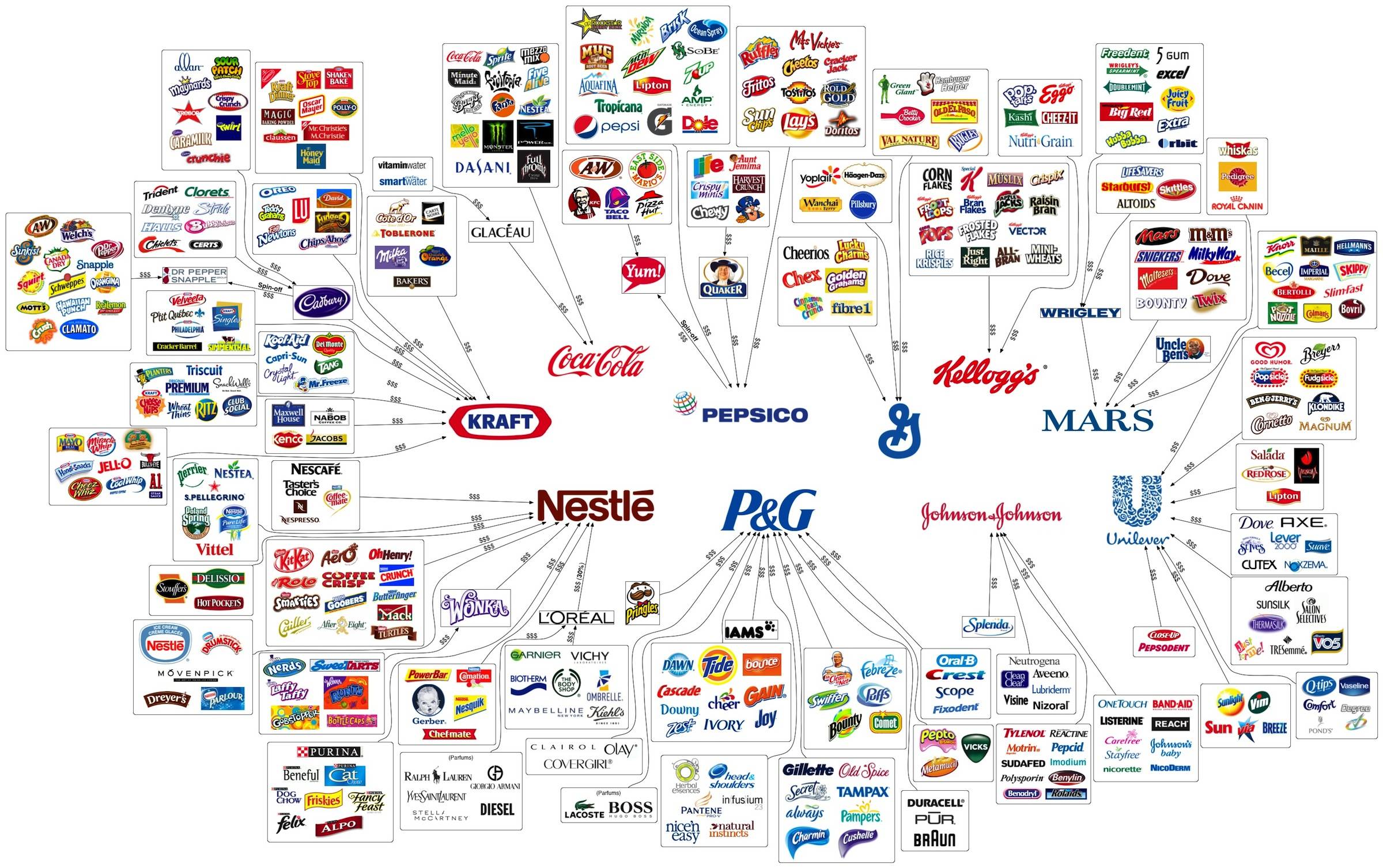
Is this the bread 'choice' you're talking about?

http://i.imgur.com/pnMMj.jpg

Every thing in the supermarket is created by a small amount of companies. The rest is all marketing.

Unregulated free market doesn't stay free for long because competition is rapidly consolidated, squashed, or absorbed by larger fish into mega monopolies.

A free market is just as crazy as communism as both have the end result of a small group of people controlling the market.

Re: FCC Chairman: This Is How We Will Ensure Net Neutrality

#425

Earlier quoted context omitted.

By that logic, laws would be created by a free market in law (polycentric court system).

A "free market in law" is either (a) not a free market (as participation in a transaction is not fully voluntary for all participants), or (b) not law. Most likely, both.

> as participation in a transaction is not fully voluntary for all participants

What transaction are you referring to not being voluntary? Transactions in the economic sense are by definition voluntary. Without a monopoly on law, people hire courts of their choosing to settle disputes. They are not compelled by a third party to settle disputes in the third party's court. Most importantly, they are not compelled by a third party to use the third party's law. They may each have their own laws even.

More about polycentric law: http://www.tomwbell.com/writings/JurisPoly.html

Re: FCC Chairman: This Is How We Will Ensure Net Neutrality

#426

Earlier quoted context omitted.

The main concern seemed to be weather or not it was on the burden of the state to prove illegal content before blocking or if it was on the user to prove their content is legal to prevent blocking.

Not sure why it would be different in this case - the general common law rule is that doing a thing is de facto permitted unless a law says otherwise.

> the general common law rule is that doing a thing is de facto permitted unless a law says otherwise.

Sure but if the law is vague than the enforcement can be broad or narrow depending on case law and the interpretation of judges.

It is less risky to run a business in an area where the law is more clear cut.

Re: FCC Chairman: This Is How We Will Ensure Net Neutrality

#427

Earlier quoted context omitted.

A "free market in law" is either (a) not a free market (as participation in a transaction is not fully voluntary for all participants), or (b) not law. Most likely, both.

> as participation in a transaction is not fully voluntary for all participants What transaction are you referring to not being voluntary? Transactions in the economic sense are by definition voluntary. Without a monopoly on law, people hire courts of their choosing to settle disputes. They are not compelled by a third party to settle disputes in the third party's court. Most importantly, they are not compelled by a…

> Transactions in the economic sense are by definition voluntary.

No, they aren't, which is why we distinguish with the term "free market" the platonic ideal of an economic situation in which all transactions are fully voluntary.

> They may each have their own laws even.

If each party may have their own laws, those aren't actually "laws" in any meaningful sense.

> More about polycentric law: http://www.tomwbell.com/writings/JurisPoly.html

I find it interesting that that article highlights exactly why the historical systems described as polycentric legal systems (which are not, in any meaningful sense, a "free market of laws") tend toward natural monopoly and solidification into state law, apparently without realizing it, stating that defectors from such a system "would then have to either accept the jurisdiction of its courts or suffer ostracism from the community of law-abiding folk."

Of course, that effect not only applies to accepting some of the available choices in a polycentric system, but also accepting both the particular "law" (a rule system that becomes binding retroactively only after a dispute occurs and a forum chosen is hardly "law" in the normal sense, but...) and particular courts preferred by the most powerful groups in the community.

Re: FCC Chairman: This Is How We Will Ensure Net Neutrality

#428
post #315

Earlier quoted context omitted.

The main concern seemed to be weather or not it was on the burden of the state to prove illegal content before blocking or if it was on the user to prove their content is legal to prevent blocking.

I imagine it would be the burden of the ISP to prove illegal content before blocking. They're the ones doing the blocking, and if they block the wrong stuff, they're the ones going to court.

> I imagine it would be the burden of the ISP to prove illegal content before blocking.

More likely, it would be their burden to do so after blocking, when a violation of the no-blocking-lawful-content rule was alleged.

Re: FCC Chairman: This Is How We Will Ensure Net Neutrality

#429
post #172

Earlier quoted context omitted.

I suspect it might possibly be the same. Public sentiment is pretty strong about it, and it would be easy for the Republicans to take the angle of "freedom for small businesses and the free market" or whatever.

Public sentiment on the right is definitely not in favor of net neutrality... In Romney's own words: It is not the role of any government to “manage” the Internet. The Internet has flourished precisely because government has so far refrained from regulating this dynamic and essential cornerstone of our economy. I would rely primarily on innovation and market forces, not bureaucrats, to shape the Internet and maximize…

That's because they've spun it as "Obama trying to control the Internet" or whatever. Most rank-and-file conservatives didn't even know what it was until the GOP Powers That Be decided to take up the crusade.

Re: FCC Chairman: This Is How We Will Ensure Net Neutrality

#430

Earlier quoted context omitted.

> as participation in a transaction is not fully voluntary for all participants What transaction are you referring to not being voluntary? Transactions in the economic sense are by definition voluntary. Without a monopoly on law, people hire courts of their choosing to settle disputes. They are not compelled by a third party to settle disputes in the third party's court. Most importantly, they are not compelled by a…

> Transactions in the economic sense are by definition voluntary. No, they aren't, which is why we distinguish with the term "free market" the platonic ideal of an economic situation in which all transactions are fully voluntary. > They may each have their own laws even. If each party may have their own laws, those aren't actually "laws" in any meaningful sense. > More about polycentric law: http://www.tomwbell.com/w…

> I find it interesting that that article highlights exactly why the historical systems described as polycentric legal systems (which are not, in any meaningful sense, a "free market of laws") tend toward natural monopoly and solidification into state law, apparently without realizing it, stating that defectors from such a system "would then have to either accept the jurisdiction of its courts or suffer ostracism from the community of law-abiding folk."

Huh? Law is enforced whether polycentric or monopolistic. I don't see what that has to do with the evolution of monopolistic statutory law.

Post reply on HN