Live data from Hacker News

Almost Everything in “Dr. Strangelove” Was Based on Fact

newyorker.com

71–80 of 164 posts

Re: Almost Everything in “Dr. Strangelove” Was Based on Fact

#71
post #25

Earlier quoted context omitted.

> we reached the point of having an astrologist in the loop for international decisions. I'm a little bit curious, did you mean to say astronomer or does the US government have an astrologist advisor?

Meet Joan Quigley. White House astrologer to the Reagan White House. http://en.wikipedia.org/wiki/Joan_Quigley

This makes me realize that there is probably a lot more that I missed in "Stranger in a Strange Land", just by virtue of my age and not having been born in the USA.

Re: Almost Everything in “Dr. Strangelove” Was Based on Fact

#72
post #11

Kind of a link-bait headline from the New Yorker. "There were glaring weaknesses in America's nuclear security during the cold war, some of which were used as the basis for the movie." True. " Almost everything ... uh ... first thing that came to mind is whether a nuke was dropped with a soldier riding it like a horse. No? So what else... This topic was covered earlier and in a more comprehensive manner by Wired IIRC…

Actually, there was at least one incident that is pretty similar (although not identical) to that scene:

"The task was doomed from the start; later testimony indicated Kulka had no idea where to find the locking pin in the large and complicated bomb-release mechanism. After a tense 12 minutes searching for the pin, the bombardier decided, correctly, that it must be high up in the bomb bay and invisible because of the curvature of the bomb. A short man, he jumped to pull himself up to get a look at where he thought the locking pin should be. Unfortunately, he evidently chose the emergency bomb-release mechanism for his handhold. The weapon dropped from its shackle and rested momentarily on the closed bomb-bay doors with Captain Kulka splayed across it in the manner of Slim Pickens in Dr. Strangelove. Kulka grabbed at a bag that had providentially been stored in the bomb bay, while the more-than-three-ton bomb broke open the bomb-bay doors and fell earthward. The bag Kulka was holding came loose, and he found himself sliding after the bomb without his parachute. He managed to grab something-he wasn't sure what-and haul himself to safety. Moments later the plane was rocked by the shock wave of the blast when the bomb hit the ground."

http://io9.com/5904633/in-1958-america-accidentally-dropped-...

NB Of course, only the chemical explosives in the bomb exploded.

Re: Almost Everything in “Dr. Strangelove” Was Based on Fact

#73
post #8

Young folks today just don't believe how downright surreal (and scary) the cold war was to live through. Look, just read this wikipedia entry about the British Blue Peacock nuclear device, and boggle: http://en.wikipedia.org/wiki/Blue_Peacock Yes. It's a chicken-heated atomic landmine. Not a joke: it was a Real Thing. And so was this: http://en.wikipedia.org/wiki/Davy_Crockett_%28nuclear_device... The M-29 Davy Crock…

To be fair, the use of chickens in this project would have been perfectly reasonable. The chickens simply act as a heat source to protect the mechanism, they do not power it. An engineer today would likely make use of the thermoelectric effect to generate heat through electricity. Why use chickens instead? A few reasons might be: Materials were not as advanced then, so an electric mechanism would have been less reliable and more prone to failure; an electric mechanism would require its own power source, which could create its own problems; an electric solution could generate noise or otherwise be observable; a chicken is sufficient.

Why would chickens be sufficient? In winter the temperature a small distance underground is reliably stable, and warmer than temperature above ground. They likely would have been able to get a good idea of what the operating temperature would be and what they would need to offset it. Luckily, the heat output of a chicken is also reliably measured/estimated.

On the other hand, the whole notion of creating a nuclear mine is completely bad. No way to justify that.
Re: Almost Everything in “Dr. Strangelove” Was Based on Fact

#74

Earlier quoted context omitted.

Meet Joan Quigley. White House astrologer to the Reagan White House. http://en.wikipedia.org/wiki/Joan_Quigley

This makes me realize that there is probably a lot more that I missed in "Stranger in a Strange Land", just by virtue of my age and not having been born in the USA.

"Stranger" was published in 1961, 20 years before Reagan, but still has many good insights on social and political patterns in the US. For a more dated, but more detailed and insightful view by a stranger, try: https://en.wikipedia.org/wiki/Democracy_in_America

Re: Almost Everything in “Dr. Strangelove” Was Based on Fact

#75
post #8

Young folks today just don't believe how downright surreal (and scary) the cold war was to live through. Look, just read this wikipedia entry about the British Blue Peacock nuclear device, and boggle: http://en.wikipedia.org/wiki/Blue_Peacock Yes. It's a chicken-heated atomic landmine. Not a joke: it was a Real Thing. And so was this: http://en.wikipedia.org/wiki/Davy_Crockett_%28nuclear_device... The M-29 Davy Crock…

That’s pretty amazing

Re: Almost Everything in “Dr. Strangelove” Was Based on Fact

#76

I toured Stalin's secret bunker this summer in Moscow where USSR'S top generals held up during the entire Cuban Missile Crisis. This bunker was the control center for the Soviet's nuclear arsenal at the time. According to the guide, the top leaders debated back and forth whether to preemptively strike the United States. The entire thing was surreal - complete with a freighting nuclear attack simulation (America strik…

That looks really interesting

Re: Almost Everything in “Dr. Strangelove” Was Based on Fact

#77
post #9
post #2

This is also true for Enemy of the State. Watch it again. Your jaw will hit the floor: http://www.imdb.com/title/tt0120660/

You are right. I just watched it the other night and I was blown away by the accuracy at which the movie portrayed surveillance and even wondered if that movie was giving out more information than what the government wants out nowadays compared to back then. We were more skeptical that these things existed back then, but now that we know they do it makes that movie dead on.

I remember watching this film, just a few years after it came out and thinking, "All of this is technically possible ... but they probably wouldn't go that far, or have the infrastructure in place". Now I know better.

I was indeed recently pondering I should watch it again, just to see what my reaction would be.

Re: Almost Everything in “Dr. Strangelove” Was Based on Fact

#78
post #34

Earlier quoted context omitted.

After WW2, the Turks were the largest standing army in NATO, had performed excellently in the Korean War, were a linchpin between Europe and the Near East, and had a longstanding historical antipathy towards Russia. Basically, the Pentagon trusted the Turks to be more effective war fighters than anyone else in NATO at the time, and to be able to get to any particular front line faster than any other ally. Eventually,…

Did you mean "remilitarization" ?

I did indeed, thanks. :)

Re: Almost Everything in “Dr. Strangelove” Was Based on Fact

#79
post #8

Young folks today just don't believe how downright surreal (and scary) the cold war was to live through. Look, just read this wikipedia entry about the British Blue Peacock nuclear device, and boggle: http://en.wikipedia.org/wiki/Blue_Peacock Yes. It's a chicken-heated atomic landmine. Not a joke: it was a Real Thing. And so was this: http://en.wikipedia.org/wiki/Davy_Crockett_%28nuclear_device... The M-29 Davy Crock…

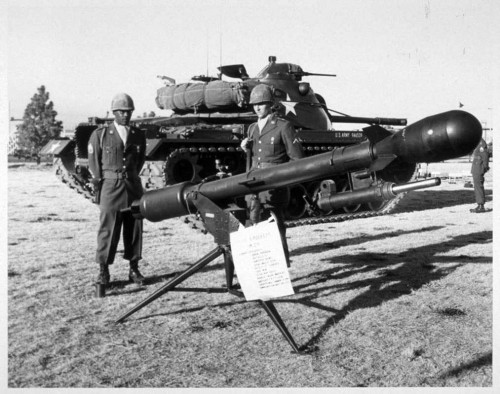
This is my favourite picture of the Davy Crockett:

http://blog.nuclearsecrecy.com/wp-content/uploads/2012/07/Da...

Re: Almost Everything in “Dr. Strangelove” Was Based on Fact

#80
“This is absolute madness, Ambassador,” President Merkin Muffley says in the film, after being told about the Soviets’ automated retaliatory system. “Why should you build such a thing?”

In the case of the Russian "Dead Hand", one of the stated purposes was to reduce the potential for nuclear war, by allowing the command-and-control structure to delay the decision about retaliation until it is clear that a possible attack is, in fact, a real attack.

If you think "I have 30 seconds to decide whether to launch a retaliatory strike", you're far more likely to make a bad decision than if you think "I don't need to do anything, because if the blips on our radar are ICBMs then a retaliatory strike will happen after I'm dead".

Post reply on HN