Live data from Hacker News

Inside San Francisco's housing crisis

vox.com

131–140 of 185 posts

Re: Inside San Francisco's housing crisis

#131
post #122
post #119

Earlier quoted context omitted.

um, they don't actually try, and nothing you've found disproves that. But one letter was sent!

There's actually quite a lot of material out there about Google wanting to build more housing. http://www.mv-voice.com/print/story/2012/07/13/google-housin... http://www.mv-voice.com/news/2010/02/16/google-pressures-cit... http://www.mv-voice.com/news/2008/06/18/google-hotel-falls-t... And that's just one website. There's lots out there. It hasn't happened, but not because Google hasn't tried. What do you expect them…

The same amount of effort as when lobbying for something they actually want. As I said above. See eg twitter for tax breaks, or the $16m google spent lobbying the US alone in 2013 [1]. Or the ceo going to council meetings and being actively involved. Or any of a dozen things you could think of yourself that would demonstrate google actually investing some effort into housing. Or transport.

But no -- your links show they sent a letter. You even found a second article mentioning what appears to be the same letter from David Radcliffe. You've searched the local mountain view papers and there's three whole mentions of google "working" for more housing dating all the way back to 2008... but they sent a letter. (Note they couldn't even be bothered to send someone representing the company to show up to testify at the meeting regarding their letter.)

They're working overtime on this.

[1] https://www.opensecrets.org/lobby/clientsum.php?id=D00002200...
Re: Inside San Francisco's housing crisis

#132
post #91

Earlier quoted context omitted.

> The city doesn't know how to police this. How would you build a law or tax around regulating this behavior? New York may attempt a pied-a-terre tax, but no one really knows how to deal with this issue of vacant housing units held as investments. Technologically, it's easy to track who is doing what where at all times. But legally, there are a lot of issues around privacy with policing this if foreign buyers are tak…

It would have to be a statewide ballot proposition, and you'd be up against the entire real estate industry, which has large parts of the California State Legislature in its hands. They would spend enormous amounts of money to mis-market it in poor political advertising. Perversely, two-thirds of the financial benefits of Prop. 13 and its tax freeze went to commercial interests even though it was sold as a way to kee…

> These are people who may not intend to actually live in the Bay Area, yet they buy up homes without even seeing them.

A higher property tax with a "homestead exemption", i.e. for those who live in the property they own, would serve to counter-act absentee owners.

As you sort of allude to, the tax structure and Prop 13 incentive is to buy and hold, regardless of occupancy.

Re: Inside San Francisco's housing crisis

#133
post #126

Something that jumped at me in the beginning, about the soup kitchen line: Some carry iPods and smartphones, others come in suits. Am I wrong to assume that somebody that can afford a smartphone and accompanying plans (which are not that cheap) and other gadgets like iPod, which probably means they own a computer and a broadband internet connection too - usually aren't so poor that they would literally starve without…

Some smartphones are under $200 with pay as you go plans. Also, it's getting harder to get a feature phone now. People keep them for years, for what could be People make judgement calls about what they need, and a smartphone is probably just as essential to someone seeking employment in the city as a working car is for someone looking for a job in the suburbs. Even if you need to take it to the soup kitchen.

Re: Inside San Francisco's housing crisis

#134

Why don't these people just move to more affordable places?

Many may interpret this as victim blaming but I think it's a valid question: why have we as a country/culture become so much more resistant to moving? I know I've read more comprehensive literature on this before a but a quick google brought up these starting points: http://www.slate.com/blogs/moneybox/2013/05/11/declining_ame... http://www.theatlantic.com/business/archive/2012/03/generati... I understand that we dev…

I personally seriously don't get it. I mean, the article describes a guy who is out of job, fails to find a job anywhere around after multiple attempts, but it still adamant on remaining in a city where, for example, I - being fully employed and pretty handsomely paid professional - would not live because prices there are freaking insane. Why? I'm not even saying move to Arizona desert or something - but even moving to San Jose - which is not exactly the middle of nowhere either - would be cheaper. And moving further from the epicenter of crazy would make it even better. I mean, I get it if you have to commute to a job, or want to keep close to an active job market. But for that poor person, there's no job market to talk about in SF. Why he insisted on staying in SF and spending all his savings on his landlord, and after getting that wonderful deal and losing all his money - still wanting more of it? Please explain it to me, I can't understand it. I, personally, wouldn't want to live in SF, for a number of reasons, but I get it when some people do. There's a lot of nice things in the city (not like a short BART ride wouldn't get you there... but I digress) but if it just doesn't make sense for you to live there and you can't afford any of the nice things anyway and it brings you only suffering - why?

Re: Inside San Francisco's housing crisis

#135
post #70

"...tech growth in cities like Seattle has been the same to San Francisco relative to its size, but the rise in the cost of living is less than a third of that experienced in San Francisco. This is largely attributed to the city building more housing to meet demand." This seems to be the root of the problem. So much of the blame gets put on tech companies or the rich getting richer, but no one blames the elected offi…

Seattle has 3X the land mass of San Francisco, but yeah, they also do build a lot more housing.

Also, Seattle Metro has buildable land much closer than Livermore, Brentwood, and Morgan Hill.

Re: Inside San Francisco's housing crisis

#136

I was the person who wrote that super-long take on the San Francisco housing crisis in spring on TechCrunch. http://www.techcrunch.com/2014/04/14/sf-housing/ I'll just say this. It's four issues compounded. 1) Growth controls enacted in the 1960s and 1970s: Beginning in the late 1960s, the California Supreme Court started making a series of anti-development rulings: for example, one decision ruled that cities didn't…

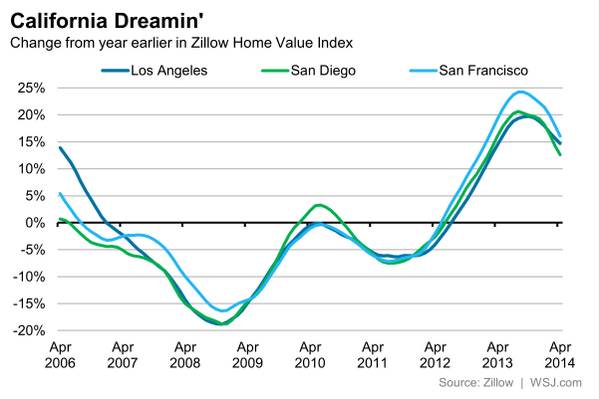
Curious what you think of this chart of home prices showing Los Angeles, San Diego, and San Francisco moving almost in lock step: https://pbs.twimg.com/media/BolI6BiIMAAgpWT.png

To me it seems like this seem would to imply statewide factors exert more influence than local ones (tech jobs, city zoning, etc).

Re: Inside San Francisco's housing crisis

#137

Earlier quoted context omitted.

Many may interpret this as victim blaming but I think it's a valid question: why have we as a country/culture become so much more resistant to moving? I know I've read more comprehensive literature on this before a but a quick google brought up these starting points: http://www.slate.com/blogs/moneybox/2013/05/11/declining_ame... http://www.theatlantic.com/business/archive/2012/03/generati... I understand that we dev…

places where greater opportunity exists like where? You might as well ask why tech companies don't set up elsewhere and start their own little versions of Silicon Valley instead of spending $$$ to headquarter in SF.

North Dakota? http://www.aei-ideas.org/wp-content/uploads/2014/10/walmart.... [1]

Don't know how the prices are there but doubtfully it's worse than in SF, and the pay seems to be about double of what the same pays in SF.

[1] http://www.aei-ideas.org/2014/10/north-dakota-sets-more-oil-...

Re: Inside San Francisco's housing crisis

#138
post #126

Something that jumped at me in the beginning, about the soup kitchen line: Some carry iPods and smartphones, others come in suits. Am I wrong to assume that somebody that can afford a smartphone and accompanying plans (which are not that cheap) and other gadgets like iPod, which probably means they own a computer and a broadband internet connection too - usually aren't so poor that they would literally starve without…

This is a common thought, but it can be awfully misleading.

First, anything that doesn't have a recurring charge -- like the suit and the iPod -- is something that may well have been bought when they had a higher income level.

Second, if you're looking for work today -- even outside of the tech sector -- not having a phone is very often not an option. Prospective employers need to be able to reach you and vice-versa, and if you're a temp worker or day laborer you need to be able to get that phone message very fast. If you're homeless a mobile phone may be your only realistic option.

Why not a cheaper phone than a smartphone? Even if you're poor, you may still want email and text messages and web browsing; email is close to a necessity in America today, web browsing is immensely useful, and that smartphone may also be your only source of entertainment. I think HN-ers may also tend to think of "smartphone" as implying "$200+ device and $100/mo bill," but it's pretty easy to get a $50 Android or Lumia phone and a $50-60/mo plan these days.

Last but not least, IIRC the article suggested the "suits and smartphones" types were people who weren't homeless yet, but whose rents had increased to a point where they were having trouble affording food. Someone making $20 an hour, way over minimum wage, would gross about $40K a year and net about $2500 a month -- they'd be lucky if "only" 75% of that was going to rent (assuming they'd started renting a few years ago when that was remotely possible). But they'd be making way too much to qualify for any government assistance like food stamps (SNAP).

Re: Inside San Francisco's housing crisis

#139
post #131
post #122

Earlier quoted context omitted.

There's actually quite a lot of material out there about Google wanting to build more housing. http://www.mv-voice.com/print/story/2012/07/13/google-housin... http://www.mv-voice.com/news/2010/02/16/google-pressures-cit... http://www.mv-voice.com/news/2008/06/18/google-hotel-falls-t... And that's just one website. There's lots out there. It hasn't happened, but not because Google hasn't tried. What do you expect them…

The same amount of effort as when lobbying for something they actually want. As I said above. See eg twitter for tax breaks, or the $16m google spent lobbying the US alone in 2013 [1]. Or the ceo going to council meetings and being actively involved. Or any of a dozen things you could think of yourself that would demonstrate google actually investing some effort into housing. Or transport. But no -- your links show t…

Just to be clear, your position is that Google should invest many millions into things that aren't business concerns at all for them. At a time when they get massive amounts of blowback for any attempt to be involved in local politics.

Is that right?

Re: Inside San Francisco's housing crisis

#140
post #78

There is a interesting anti-correlation between this and Prop G. Prop G will be a retroactive tax applied to anyone who bought a multi unit building in SF in the last few years who would sell it the next few years. Tenants have no problem pushing this bill stating that buying a building does not entitle you to a lifelong contract and that 'things can change' which will negatively effect you. So even though you bought…

Meh. The newer landlords will realize what the rest of us have know for years. You'd be crazy to be a landlord in SF. Which, of course, is part of the problem.

Which is why massive new rental buildings are coming up? NEMA, One Rincon Hill Tower Two, etc.
Post reply on HN