Live data from Hacker News

Bilingual brains: Variety makes you mentally fit

economist.com

51–57 of 57 posts

Re: Bilingual brains: Variety makes you mentally fit

#51
post #50
post #47

Earlier quoted context omitted.

Aside from English, they're all closely related languages (Hindi, Marathi, Gujarati). I wouldn't really expect knowing related languages to give the same payoff as say knowing languages from different groups or families of languages.

Let's take three families of languages: ((Japanese, Mandarin, Cantonese), (Hindi, Marathi, Gujarati), (English, French, Italian, German, Dutch, Latin)) Are you saying that knowing one from each set is more beneficial than knowing three from any one set?

I wouldn't group them like that, English/German/Dutch are Germanic languages, while French/Italian/Latin are Romance. Japanese also a bit removed from Mandarin/Cantonese. But, yes, I would argue that knowing unrelated languages broadens ones perspective far more than knowing similar ones.
Re: Bilingual brains: Variety makes you mentally fit

#52
post #50
post #47

Earlier quoted context omitted.

Aside from English, they're all closely related languages (Hindi, Marathi, Gujarati). I wouldn't really expect knowing related languages to give the same payoff as say knowing languages from different groups or families of languages.

Let's take three families of languages: ((Japanese, Mandarin, Cantonese), (Hindi, Marathi, Gujarati), (English, French, Italian, German, Dutch, Latin)) Are you saying that knowing one from each set is more beneficial than knowing three from any one set?

Japanese isn't even remotely related to Mandarin and Cantonese. It's a language isolate.

Re: Bilingual brains: Variety makes you mentally fit

#53
post #6

My "nights and weekends" project for the past few years has been writing iOS language learning apps. The niche that I'm looking to fill is to create enough "games/drills" to help alleviate the incredible repetition needed to learn another language. Anyway, I'm looking for suggestions so I can find my niche in a really crowed market... https://itunes.apple.com/us/app/h4-spanish-lite/id388918463?... I'd really apprecia…

I'm no expert in teaching languages but I may be one in learning languages (5 foreign languages so far). I can say that I only really "get" a language when I can start reading on my own (news and such). The approach I'd love to see in a language is one of progressively more difficult texts. At the very beginning, it's very hard to find texts I can grasp, given limited vocabulary. A collection of interesting texts tha…

http://www.newsinlevels.com/ is the perfect news site for English learners based on your suggestion. They present the same news item in three different levels so you can start with the easiest one and progress to the harder two to grasp the usage on your own. We use it for our son, it makes wonders.

Re: Bilingual brains: Variety makes you mentally fit

#54
post #50

Earlier quoted context omitted.

Let's take three families of languages: ((Japanese, Mandarin, Cantonese), (Hindi, Marathi, Gujarati), (English, French, Italian, German, Dutch, Latin)) Are you saying that knowing one from each set is more beneficial than knowing three from any one set?

Japanese isn't even remotely related to Mandarin and Cantonese. It's a language isolate.

It's unclear if it's an isolate:

http://en.wikipedia.org/wiki/Language_isolate

http://en.wikipedia.org/wiki/Japonic_languages

Also from http://en.wikipedia.org/wiki/Japanese_language: "During the Heian period (794–1185), Chinese had a considerable influence on the vocabulary and phonology of Old Japanese."

I think that qualifies as somewhat related?

Re: Bilingual brains: Variety makes you mentally fit

#55
post #54

Earlier quoted context omitted.

Japanese isn't even remotely related to Mandarin and Cantonese. It's a language isolate.

It's unclear if it's an isolate: http://en.wikipedia.org/wiki/Language_isolate http://en.wikipedia.org/wiki/Japonic_languages Also from http://en.wikipedia.org/wiki/Japanese_language : "During the Heian period (794–1185), Chinese had a considerable influence on the vocabulary and phonology of Old Japanese." I think that qualifies as somewhat related?

Just because a language borrows significant amounts of vocabulary from a language, it doesn't mean that it's related to that language. Take, for instance, English. Neither the fact that English has borrowed significant amounts of vocabulary from the various Romance languages (French, Spanish, Italian, Portuguese, &c.) nor that Norman French had a large effect on the language's orthography and phonology make it a Romance language: English, in spite the many, many outside influences upon it, is still solidly a Germanic language. About the only odd thing about English is its lack of V2 word order, and there are still _plenty_ of vestiges of it.

The same goes for the influence of Chinese on Japanese, only more so: Chinese and Japanese aren't remotely related.

As far as Japanese being an isolate, please keep in mind that the Ryukyuan languages are practically dead and all the other Japonic language are long since dead. There's some _very_ scant evidence that it might be part of the hypothetical Altaic group of languages, but the evidence is weak at best, and only marginally more plausible than the Nostratic hypothesis.

Re: Bilingual brains: Variety makes you mentally fit

#56
post #51
post #50

Earlier quoted context omitted.

Let's take three families of languages: ((Japanese, Mandarin, Cantonese), (Hindi, Marathi, Gujarati), (English, French, Italian, German, Dutch, Latin)) Are you saying that knowing one from each set is more beneficial than knowing three from any one set?

I wouldn't group them like that, English/German/Dutch are Germanic languages, while French/Italian/Latin are Romance. Japanese also a bit removed from Mandarin/Cantonese. But, yes, I would argue that knowing unrelated languages broadens ones perspective far more than knowing similar ones.

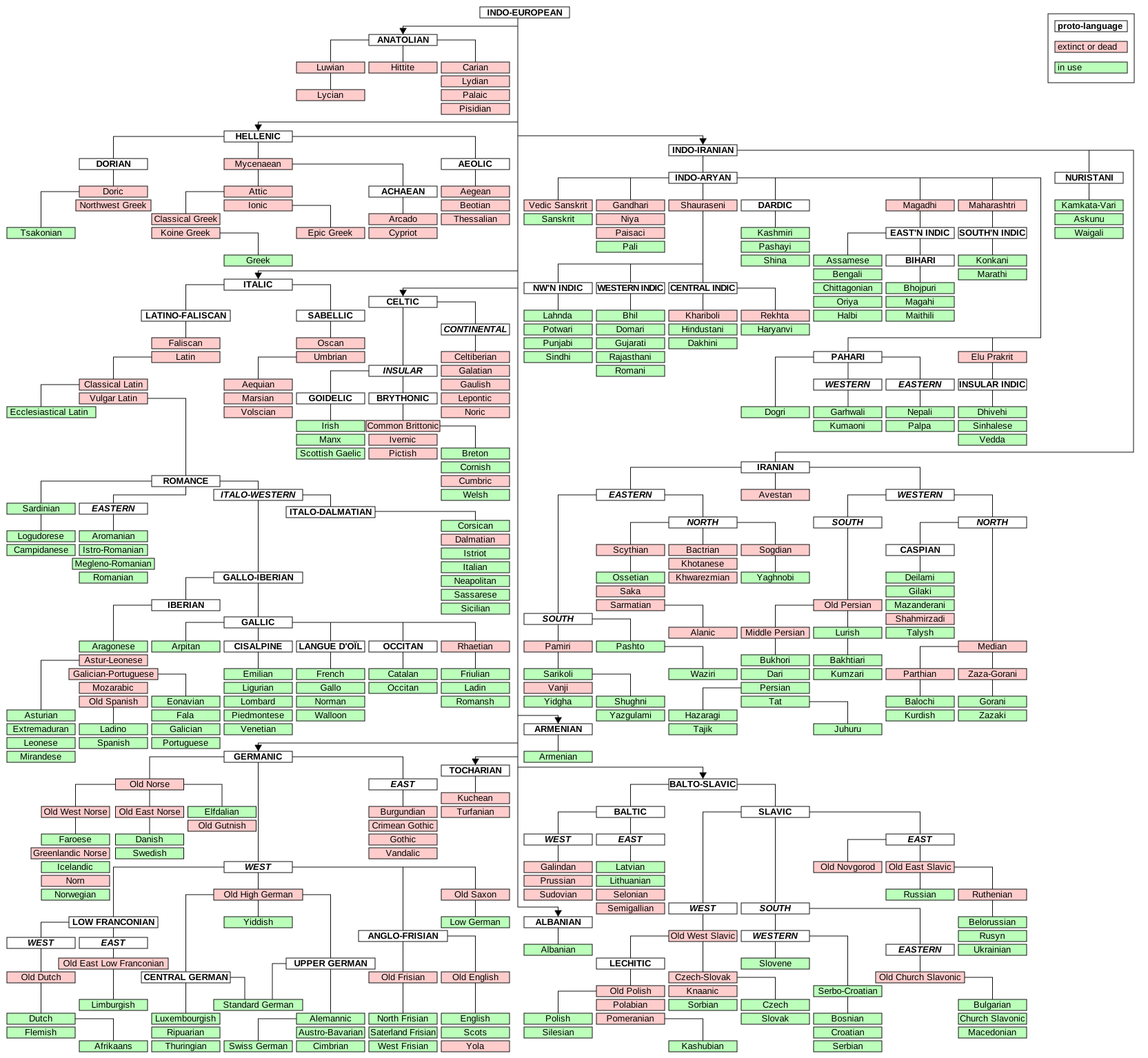
Interesting. I was looking at:

http://upload.wikimedia.org/wikipedia/commons/4/4f/IndoEurop...

There are subdivisions like Germanic and Romance in the language family which do seem sufficiently far apart. However, there are quite a few subdivisions that seem very closely related.

I wonder if there is a way to draw entirely new subdivisions based on benefits of knowing languages from each subdivision.

Also, intuitively, what you say about knowing unrelated languages makes sense. I am curious however, if you had some deeper insight or knowledge into why (if true) this might be?

Re: Bilingual brains: Variety makes you mentally fit

#57
post #42
post #37

Earlier quoted context omitted.

As someone who spent years studying and teaching languages, my single biggest advice is to remember that learning a language is not simply a matter of learning words . Don't fall into the trap of throwing a dictionary full of words into an SRS and hoping for the best. Focus on input, not production. Include phonetic training. Make the user distinguish between each minimal pair in the language, possibly even every sin…

>Make the user distinguish between each minimal pair in the language, possibly even every single syllable in the language I have so much trouble spelling words like definately^W definitely, because they sound the same to me ;)

With regards to definite, I found the tie to "finite" helpful.
Post reply on HN