The Larch Environment
larchenvironment.com
The Larch Environment
1–10 of 65 posts
Re: The Larch Environment
#2Neat! This reminds me of "Usable Live Programming" by Sean McDirmid: http://research.microsoft.com/en-us/people/smcdirm/liveprogr...
Re: The Larch Environment
#3This is the 3rd or 4th time I've seen a proposal for visual programming environments (e.g. see http://cs.brown.edu/~spr/codebubbles/*, LightTable, this one, probably others) and I'm not sure why they don't take off. On the one hand, they seem incredibly useful and I really like Code Bubbles' approach to automatically pulling in relevant code (http://cs.brown.edu/~spr/codebubbles/bubbles01.gif). On the other hand, none of the projects seems to have significant traction (though LightTable seems to be growing). Are existing environments good enough? Is there an impedance mismatch between existing languages and visual code-design/programming?
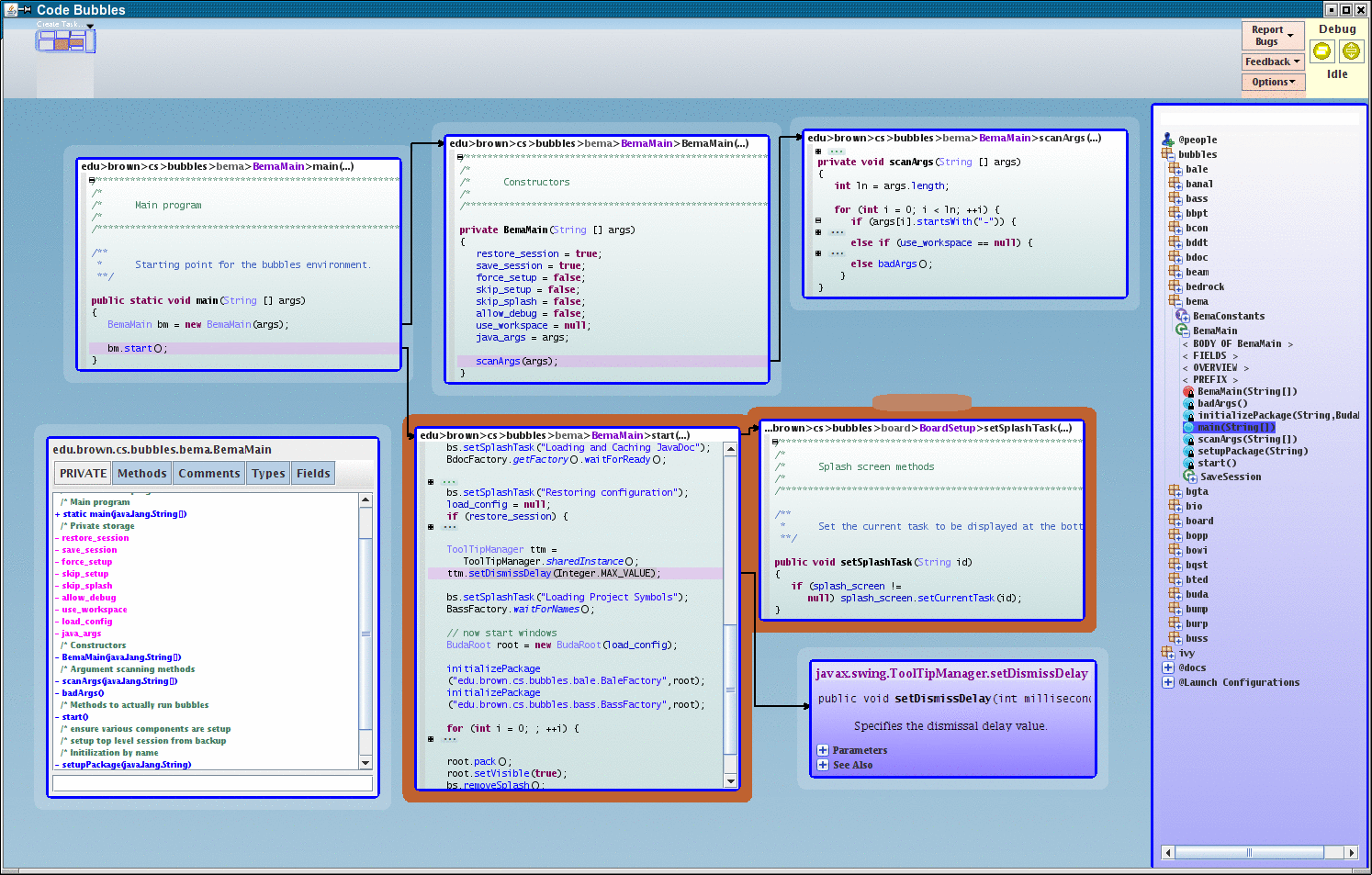
* I really thought CodeBubbles was clever and I'm sorry that it appears to be defunct...
Re: The Larch Environment
#4This is the 3rd or 4th time I've seen a proposal for visual programming environments (e.g. see http://cs.brown.edu/~spr/codebubbles/* , LightTable, this one, probably others) and I'm not sure why they don't take off. On the one hand, they seem incredibly useful and I really like Code Bubbles' approach to automatically pulling in relevant code ( http://cs.brown.edu/~spr/codebubbles/bubbles01.gif ). On the other hand,…
I think people are still underestimating the complexity and raw hard work involved in making these visuals scale.
I also think it's inevitable in the long run, but developing them properly still has similar complexity as building IDE plugins except now having the IDE replaced with a 'language plus some form of IDE.'
LightTable really seemed to be on the right track there, but from what I can tell it has fallen prey to the curse of Lisp with Chris seemingly moving on to an even more awesome language project instead of putting in the hard (and probably quite boring) work to get visual augmentation to the masses.
Re: The Larch Environment
#5This is the 3rd or 4th time I've seen a proposal for visual programming environments (e.g. see http://cs.brown.edu/~spr/codebubbles/* , LightTable, this one, probably others) and I'm not sure why they don't take off. On the one hand, they seem incredibly useful and I really like Code Bubbles' approach to automatically pulling in relevant code ( http://cs.brown.edu/~spr/codebubbles/bubbles01.gif ). On the other hand,…
I think people are still underestimating the complexity and raw hard work involved in making these visuals scale. I also think it's inevitable in the long run, but developing them properly still has similar complexity as building IDE plugins except now having the IDE replaced with a 'language plus some form of IDE.' LightTable really seemed to be on the right track there, but from what I can tell it has fallen prey t…
Can you elaborate as to what you think happened to LightTable? What is this "curse of Lisp" that you speak of?
Re: The Larch Environment
#6This is the 3rd or 4th time I've seen a proposal for visual programming environments (e.g. see http://cs.brown.edu/~spr/codebubbles/* , LightTable, this one, probably others) and I'm not sure why they don't take off. On the one hand, they seem incredibly useful and I really like Code Bubbles' approach to automatically pulling in relevant code ( http://cs.brown.edu/~spr/codebubbles/bubbles01.gif ). On the other hand,…
I think people are still underestimating the complexity and raw hard work involved in making these visuals scale. I also think it's inevitable in the long run, but developing them properly still has similar complexity as building IDE plugins except now having the IDE replaced with a 'language plus some form of IDE.' LightTable really seemed to be on the right track there, but from what I can tell it has fallen prey t…
LightTable started from Clojure. Larch is based on Python.
Neither is based on Mathematica.
edit: What I mean is that iPython Notebooks are one of the few toolkits that are starting to take hold in academia in applications where Mathematica rules. Nobody in "serious number crunching academia" uses Clojure.
Re: The Larch Environment
#7Visual programming is very established in contemporary music. Max/MSP and SuperCollider are state of the art, with dozens of papers written on it. I do not get why those languages are not used outside a very litte academic hipster music community.
Re: The Larch Environment
#8Visual programming is very established in contemporary music. Max/MSP and SuperCollider are state of the art, with dozens of papers written on it. I do not get why those languages are not used outside a very litte academic hipster music community.
[deleted]
Re: The Larch Environment
#9This is the 3rd or 4th time I've seen a proposal for visual programming environments (e.g. see http://cs.brown.edu/~spr/codebubbles/* , LightTable, this one, probably others) and I'm not sure why they don't take off. On the one hand, they seem incredibly useful and I really like Code Bubbles' approach to automatically pulling in relevant code ( http://cs.brown.edu/~spr/codebubbles/bubbles01.gif ). On the other hand,…
Have you tried Unreal Engine 4's Blueprint[1]?
It's probably the first visual programming that "made sense" to me. Its use is limited to UE4 games, of course, but I think its design would be suitable for more general use.
Re: The Larch Environment
#10Confession: I watched with interest until he added the reset button. At this point, he silently starts making classic textual changes. A non-obvious but quite bad thing is that it required simultaneous multiple edits in disparate parts of the file - each of which required expert knowledge of the libraries, the language, and the file itself. This is why visual programming environments suck - because in the end, you still have to know exactly what to do, and you have to do it simultaneously, without feedback. These kinds of things will continue to fail until you can add a reset button incrementally and visually.