Live data from Hacker News

It Is Not About the Money, Silly, It Is All About the Time

jacquesmattheij.com

81–90 of 123 posts

Re: It Is Not About the Money, Silly, It Is All About the Time

#81
post #71
post #61

One things I don't see mentioned is the use of a mortgage as kind of a forced savings plan. For a bunch of reasons, it is really hard for people to plan/save for the future. That's why there is thousands of years of parables and social convention exhorting people to save and not be in debt (i.e. if it was easy to do, everyone would do it). Buying a larger-than-strictly-necessary house with a mortgage is a way to star…

By the time you pay off the mortgage you will have paid 3-4 times the value of the property because of the interest. So on a $400k house you will have put $1.2mil - $1.6mil into the savings account, but you'll only have a ~$500k property to show for it (IF the house appreciates, which it hopefully does, fingers crossed). That's a seriously inefficient way to save.

You get to use the property for that entire time rather than having to wait until you can pay for it in cash, however. Your alternative to paying a mortgage isn't living in a home for free. It's paying rent or being homeless. If your rent is $2,500 a month, you need to subtract about $900k from that amount you're talking about putting in your savings account because it'll be going to your landlord instead.
Re: It Is Not About the Money, Silly, It Is All About the Time

#82
post #71
post #61

One things I don't see mentioned is the use of a mortgage as kind of a forced savings plan. For a bunch of reasons, it is really hard for people to plan/save for the future. That's why there is thousands of years of parables and social convention exhorting people to save and not be in debt (i.e. if it was easy to do, everyone would do it). Buying a larger-than-strictly-necessary house with a mortgage is a way to star…

By the time you pay off the mortgage you will have paid 3-4 times the value of the property because of the interest. So on a $400k house you will have put $1.2mil - $1.6mil into the savings account, but you'll only have a ~$500k property to show for it (IF the house appreciates, which it hopefully does, fingers crossed). That's a seriously inefficient way to save.

[deleted]

Re: It Is Not About the Money, Silly, It Is All About the Time

#83
post #71

Earlier quoted context omitted.

By the time you pay off the mortgage you will have paid 3-4 times the value of the property because of the interest. So on a $400k house you will have put $1.2mil - $1.6mil into the savings account, but you'll only have a ~$500k property to show for it (IF the house appreciates, which it hopefully does, fingers crossed). That's a seriously inefficient way to save.

You get to use the property for that entire time rather than having to wait until you can pay for it in cash, however. Your alternative to paying a mortgage isn't living in a home for free. It's paying rent or being homeless. If your rent is $2,500 a month, you need to subtract about $900k from that amount you're talking about putting in your savings account because it'll be going to your landlord instead.

I have no idea where you live that rent is $2,500 a month, but if it really is, I'm guessing houses aren't $400k.

Re: It Is Not About the Money, Silly, It Is All About the Time

#84
post #57

Some sensible advice here, but also ignoring all debt is not a good idea. I used to have a similarly black-and-white view, but now I realise that debt is simply another trade-off to be considered. Remember, your life is precious. Don't live your 20s and 30s as an ascetic just so you can retire to a golf course in your 50s. I spend a lot now (but not beyond my means) because these are some of the best years of my life…

> I spend a lot now (but not beyond my means) because these are some of the best years of my life, I agree with the second part of the statement, but not with the first one. In my life, there is almost nothing that could be further improved by spending more (or a lot of) money on. Currently, my biggest expenses are rent (allows me to live in London and have a very good job) and food (I buy the best, mainly because I…

  I really don't see the appeal of most of the more 
  expensive stuff/experiences.
I live near London. If I decide to travel into central London to meet some friends from school, I can easily spend £15 on a national rail return train ticket, £4 on tube travel, drink three pints of beer at £3 a pint, and buy some bar food for say £8. Then you you've spent £36.

Needless to say, if I want to keep to the same budget I lived on as a student, I would not be meeting my friends in London very often!

Re: It Is Not About the Money, Silly, It Is All About the Time

#85
post #51

Earlier quoted context omitted.

OK, well look around. Do you know a lot of people (is it possibly even most of the people you know) who have 2 or more car loans, and at least one home loan? That's the "norm". That's what "everyone" does (everyone who is in a first world country and has a decent job). Is that somehow "smart debt"? Really? What's so smart about it? It is smart for whomever loaned that money out ... they get back free money paid consi…

> Is that somehow "smart debt"? Really? What's so smart about it? Regarding a mortgage and 2 car loans, I'd like to offer a defense of why it's smart / good debt. The primary reason that your mortgage is considered "good debt" is because the asset you purchase with that debt (your house) will typically appreciate faster than the interest you pay. I'm not including black swan events like the 2008 crisis. When you even…

"The primary reason that your mortgage is considered "good debt" is because the asset you purchase with that debt (your house) will typically appreciate faster than the interest you pay."

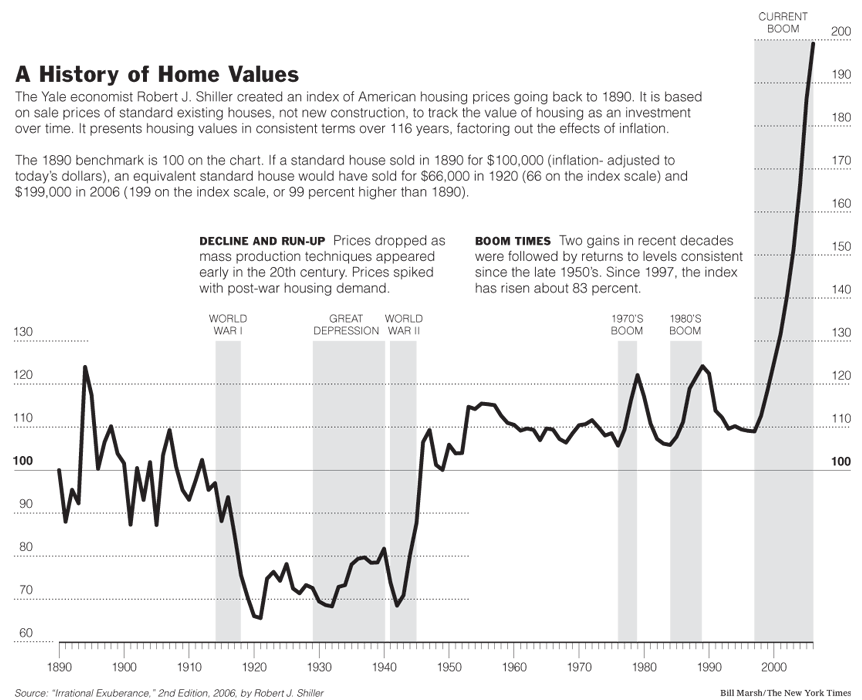
Any money manager will tell you that what you just said is false. Excepting a few cities, when you look at the data and adjust for inflation, owning a house is not a particularly good investment ( http://files.foreclosureradar.com/images/foreclosuretruth/Hi... ). Add in that the average home loan lasts about 6ish years before folks sell/refi, the fact that interest/fees are front-loaded into the first 5 years of the loan, and that avg. annual maintenance on a house (NOT improvements) tend to average about 1% of the value of the home per year, it gets worse.

What it CAN be (if you're disciplined and lucky) is leverage and liquidity. Example: I have my house paid off. I get a mortgage on it, essentially getting a loan at 4% for $700k. Now I have $700k that I can make work for me-- a worthwhile idea if I can find a way to make more than 4% on that $700k via other investments (which are not remotely risk-free, but can pay off). Of course, what most people do when they re-fi their house is self-indulgent stuff-- buying a vacation home, a boat, home improvements that don't pay for themselves, etc.

Re: It Is Not About the Money, Silly, It Is All About the Time

#86
post #83

Earlier quoted context omitted.

You get to use the property for that entire time rather than having to wait until you can pay for it in cash, however. Your alternative to paying a mortgage isn't living in a home for free. It's paying rent or being homeless. If your rent is $2,500 a month, you need to subtract about $900k from that amount you're talking about putting in your savings account because it'll be going to your landlord instead.

I have no idea where you live that rent is $2,500 a month, but if it really is, I'm guessing houses aren't $400k.

Im talking what you would otherwise pay in rent for a house of the same type and quality. As both a homeowner and landlord of properties in that price range, I can tell you that those numbers arent far off. If you're trying to compare taking a mortgage on a 400k home to renting a property that would sell for considerably less, you aren't talking about the effects of taking on debt, you're talking about the effects of downgrading your lifestyle.

Re: It Is Not About the Money, Silly, It Is All About the Time

#87

Some sensible advice here, but also ignoring all debt is not a good idea. I used to have a similarly black-and-white view, but now I realise that debt is simply another trade-off to be considered. Remember, your life is precious. Don't live your 20s and 30s as an ascetic just so you can retire to a golf course in your 50s. I spend a lot now (but not beyond my means) because these are some of the best years of my life…

10 years is not a long-term view. Try 50 years. Your ability to make $100 now is must more guaranteed than your ability to make $100 when you're in your 70s. A lot can happen between now and then. You could suffer a debilitating illness or become disabled. Your currently bankable skills may no longer be in demand. If you're 28, chances are you have about 10, maybe 20 years left of barely increasing eating potential, followed by a pretty steep drop-off.

I, for one, don't want to be in my 70s thinking, boy, if I only saved a little when I was younger, I wouldn't be eating dog food right now and choosing between my arthritis medication and rent.

Re: It Is Not About the Money, Silly, It Is All About the Time

#88
post #77

Saving is so much easier than earning, and it’s a habit that once built will pay you back for the rest of your life. There's a weird cultural meme that's convinced the middle class that the road to wealth is saving. The road to wealth is earning. This is just kind of an obvious thing, but I guess there are benefits to convincing people who will never earn enough to be wealthy that there are attainable ways to go abou…

Investing $4000/month (which is what I do on a salary barely over $100k while living by myself in a 1 bedroom in the East Village, NYC and going out for every meal) at 3% will get you $1 million in 17 years. That means you'll be a millionaire by the time you're 40 if you start doing this right after graduating college. 3% happens to be the rate that stocks have historically appreciated above inflation, so by doing th…

$48,000 a year in investment is $18,000 more than the median total income for an individual in the United States.

What you are able to do is exactly what the vast majority of Americans are unable to do.

Re: It Is Not About the Money, Silly, It Is All About the Time

#89

Saving is so much easier than earning, and it’s a habit that once built will pay you back for the rest of your life. There's a weird cultural meme that's convinced the middle class that the road to wealth is saving. The road to wealth is earning. This is just kind of an obvious thing, but I guess there are benefits to convincing people who will never earn enough to be wealthy that there are attainable ways to go abou…

"The road to wealth is earning."

That's half the road, which is the OP's point. We all know tons of people who earn a ton of money, but they never get rich or free because they keep ratcheting up their spending.

The road to wealth is spending dramatically less than you make in an ongoing way.

Re: It Is Not About the Money, Silly, It Is All About the Time

#90
post #66

Earlier quoted context omitted.

Health insurance for starters. Poor people will likely have a (mostly less than sufficient) government option that they pay little for, hoping that they don't get sick. Then comes the mandatory insurances of "ownerships". Mortgage insurance to cover loan default, required property insurance for that home, auto insurance (full coverage also required by your lender on a new car) etc. Fearful insurances like disability…

To give a concrete example to artmageddon - I drive a $450 car so I have the absolute minimum insurance on it required by law. Even after only one year of not paying for full comprehensive, I will save money if it gets stolen or burns to the ground and I walk away. (I do have high third party - so if I hit a Porsche, damage to it and people is covered). I pay $300/year for the car insurance I have. I currently don't…

You opted out of health insurance???

Obviously I would never wish a freak traumatic accident or sudden debilitating illness on anyone, but should one happen to you, please post back here about how those slightly bigger monthly paychecks worked out for you.

Post reply on HN