Live data from Hacker News

When Patients Read What Their Doctors Write

npr.org

101–110 of 110 posts

Re: When Patients Read What Their Doctors Write

#101
post #92

I would imagine a lot of the concern over this is more of the existential fear resulting from the balance of power between patient and doctor than anything else. The Internet started that, with patients able to become much more knowledgable about their own conditions (with the unfortunate side effect of every symptom being cancer). Once patients become knowledgable, the doctor moves from a pillar of all knowledge to…

Physician here. I personally believe patients should do their own research, up to a certain point. There is a reason physicians have tens of thousands of hours of training. We quickly learn medicine is rarely black and white and straight from the textbooks. The art of medicine is a skill that takes a lifetime to develop, and is still not perfect. Sure, you can search pubmed for the best therapies, but patients often…

I honestly think this "I want this, this and this" comes down to how we infantalize adults in modern society, and how that comes out in the way that we pay for healthcare (insurance or social programs rather than out of pocket) and in the drug war. About half the time I go to the doctor, I already know what I want (i.e. not for diagnostic reasons) and if I could get it and at least try it out without a prescription, I wouldn't need to waste my time and the doctor's time. Sometimes I don't know what's wrong with me and I actually do want to utilize the doctor's diagnostic skill, but that's not always the case - the same is true when I visit a mechanic, sometimes you already know you need an oil change and a tire rotation or whatever.

Yes, people might make the wrong call about their health sometimes, but that's not the doctor's concern - they're adults, not infants, they've earned the right to make their own mistakes.
Re: When Patients Read What Their Doctors Write

#102

I would imagine a lot of the concern over this is more of the existential fear resulting from the balance of power between patient and doctor than anything else. The Internet started that, with patients able to become much more knowledgable about their own conditions (with the unfortunate side effect of every symptom being cancer). Once patients become knowledgable, the doctor moves from a pillar of all knowledge to…

> The Internet started that, with patients able to become much more knowledgable about their own conditions

... or more deluded. I've heard of patients telling doctors that vaccines cause autism, fluoride causes impotence, etc. Because, you know, the internet said so. People who can't say what major body parts do should not tell doctors how disease processes operate.

I'm not saying you are deluded, but it seems common.

Re: When Patients Read What Their Doctors Write

#103
post #84

I've met the guys behind a German startup called "Was hab ich?"[0] - which translates roughly to "what have I got?". It's a platform that lets people post their doctor's notes and have med students interpret it for them in an easy to digest form. It helps both patients better understand their conditions and med students learn how to read and interpret diagnosis. It's a non-profit as far as I'm aware, since part of th…

Very interesting. What happens if the med students give advice contrary to the physician?

I'm not entirely sure, but I don't think they give any advice. The students only interpret / translate what the physician wrote in their usually-cryptic notes, and turn it into a simple, understandable form that almost any person can understand.

If I remember correctly (I don't speak German nor understand medicine), the note can say something like "test XYZ - negative results". This can sound scary to someone who doesn't understand what this test is about. The interpretation could be that negative results on this test means the patient does not suffer from some kind of disease, and this indicates normal function...

Re: When Patients Read What Their Doctors Write

#104
post #48

The biggest indicator of health is nutrition, yet it's one of the most poorly understood topics in medicine. Ask five different doctors and you'll get five different responses as to what are the accepted parameters in a healthy diet. What we need is a concerted research effort by governments to make headway in figuring this thing out instead of relying on research by teams funded by large agribusiness conglomerates.…

> Ask five different doctors and you'll get five different responses as to what are the accepted parameters in a healthy diet. You really wont. It'll be pretty much advice about eating a varied diet, not too much fat, salt, or sugar, with a lot of vegetables and a wide range of fruit and veg.

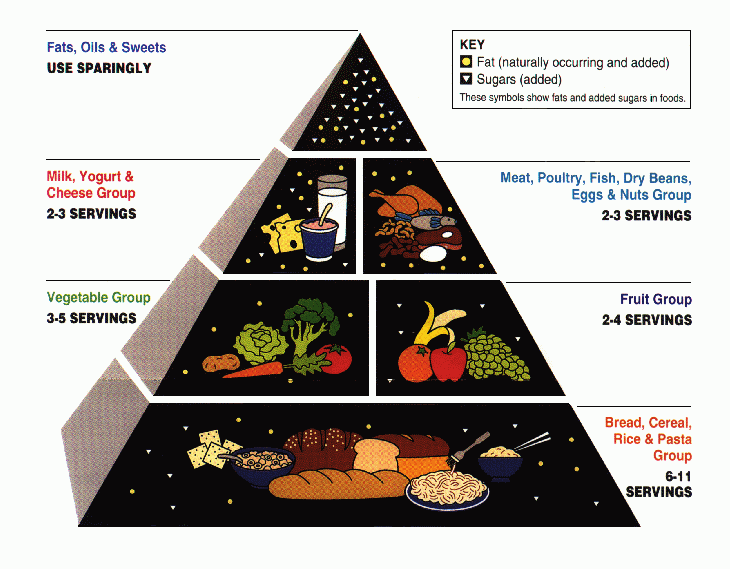
You really will. Eggs, for example, have been controversial forever [0]. And who could forget the USDA Food Pyramid, encouraging people to eat 6-11 servings of carbs [1]? The 90s heralded the low-fat craze with the mantra "Sugar doesn't make you fat. Fat makes you fat." [2] We've swung the other way in recent years with the anti-carb options that started in earnest with Atkins and branched out to keto/paleo.

Nutrition is tricky and is heavily marketed by extremely powerful industries.

[0] https://www.google.com/search?q=eggs+health+controversy

[1] http://upload.wikimedia.org/wikipedia/commons/6/6d/USDA_Food...

[2] http://articles.baltimoresun.com/1998-10-25/features/1998298...

Re: When Patients Read What Their Doctors Write

#105

One problem with this approach is patients who are making stuff up entirely. They're not a large part of the population, but since they relentlessly seek medical attention (often to the point of self-harm), every doctor is familiar with them. Giving such patients editorial power over doctors' notes gives them a further lever with which to manipulate the system. It's a weird situation in which the doctor/patient relat…

People are talking about hidden notes but it seems like a better system is to just have all the notes immutable with the ability for patients to comment on line sections (like code review tools).

This way you can correct without rewriting history.

Re: When Patients Read What Their Doctors Write

#106
post #60
post #50

Earlier quoted context omitted.

It's not about the patient editing the record directly. It's more about the patient talking to a different doctor than the one that wrote the notes, and then saying, "oh, that's wrong. This is the right information." If the doctor takes that at face-value (like in the article's example), I assume that it ends up on the notes.

Ultimately anyone can lie to anyone, and misplaced trust is a separate problem from letting people know. Plenty of records are incorrect, and kill people.

By hiding the records from the patients, it obfuscates the record from the patients. They can't know what's in there to correct (with truth or falsehoods) it without seeing it.

Re: When Patients Read What Their Doctors Write

#107

Earlier quoted context omitted.

While this is something that may be possible for you, I think what the parent is saying is that most people lack not only the desire and willingness to do their own research, but also the general knowledge of the topics to fully comprehend what it is they're reading. While doctors do typically go to school for a more 'general' understanding of any given disease, they still have a great more background on the subject…

I'm not suggesting anybody to distrust their medical provider, and I disagree that it is anything like software. This is your body. It is your life. It is your health. Nobody cares as much about you as you do. If you distrust your healthcare provider, find a new one. But if your healthcare provider does respect you and your needs, isn't willing to answer your questions, then I also think you should find a new one. An…

That is right. Some patients are quick to see a conspiracy when doctors can't cure them. But some diseases are just outside the capabilities of current medicine. It sounds like you suffer from something like metabolic syndrome. It's a deadly serious disease that's unfortunately common, and one that has no cure (as with any chronic disease).

>>existential fear resulting from the balance of power between patient and doctor than anything else

It's the most elemental fear of all, I think. It's the fear of one's own mortality. Would the doctor-patient relationship be so fraught otherwise?

Re: When Patients Read What Their Doctors Write

#109
post #96

Earlier quoted context omitted.

I'm in the UK - it's straightforward to complain, but nothing comes of it, apart from even shittier treatment the next time around, because they know you've complained about them!

Sounds like your GP sucks, have you tried a different one?

Several, over the years.

My favourite was the one who threw a mop at me for blacking out and bleeding all over her surgery, and then gave me a sticking plaster for my very obviously very infected wound.

Ended up in an ambulance to hospital the next day with a brain-cooking fever and sepsis. She was fired - but didn't lose her license.

Re: When Patients Read What Their Doctors Write

#110
post #96

Earlier quoted context omitted.

Sounds like your GP sucks, have you tried a different one?

Several, over the years. My favourite was the one who threw a mop at me for blacking out and bleeding all over her surgery, and then gave me a sticking plaster for my very obviously very infected wound. Ended up in an ambulance to hospital the next day with a brain-cooking fever and sepsis. She was fired - but didn't lose her license.

Jesus christ man, I've had nothing but good experiences with my GP in Yorkshire, even for the supposedly failing/diminishing mental health services. He listens to everything I have to say and trusts that I can actually think for myself.
Post reply on HN