Live data from Hacker News

UPower (YC S14) Is Building Nuclear Batteries

techcrunch.com

101–110 of 123 posts

Re: UPower (YC S14) Is Building Nuclear Batteries

#101
post #94

Earlier quoted context omitted.

A couple side notes on TC article specifically for those interested: 1) NO reprocessing as somewhat indicated in article ("processing"). We use the low enriched used fuel from the reactor to make new fuel for the next deployment. We don't isolate dangerous parts as done in reprocessing which is the main concern with reprocessing. 2) True waste elimination- it's not just "less of a pain", which is definitely good: the…

Similar to the Integral Fast Reactor? (I'm a fan, and friends with Tom Blees.)

The Integral Fast Reactor was a great project, and it ran against exactly the sort of think I'm worried will kill UPower:

http://large.stanford.edu/courses/2013/ph241/waisberg1/

"However, the project was hampered in 1994 after a series of controversies involving safety issues and nuclear non-proliferation policies."

Re: UPower (YC S14) Is Building Nuclear Batteries

#102

From the website: "waste products that have to be buried for hundreds of years" Wow, that is... inaccurate. Let's have a look. (EDIT: to clarify, format is substance (% present in used fuel): half life U238 (~94% of used nuclear fuel): ~4.5 billion years Pu (~1% of used nuclear fuel): 24 000 years Sources: http://www.techniklexikon.net/d/abgebrannte_brennelemente/ab... http://en.wikipedia.org/wiki/Plutonium http://de…

Just because it is a long-lived radioactive isotope does not mean it is dangerous. I'm referring to U238. It decays by alpha radiation, so unless you are literally eating it or inhaling it, those alpha particles will not penetrate your skin. Additionally, U238's long half life is why it remains as the most plentiful naturally occurring (on Earth) radioactive isotope. I'm tired of people trying to fear-monger radiation by throwing big numbers around. It would be instead be helpful discussing how to get roughly 4 alpha particles to decay per day inside them someone needs to eat roughly 1,000,000,000,000g of pure U238 that day.

Re: UPower (YC S14) Is Building Nuclear Batteries

#103
post #100

Quote from http://www.upowertech.com/p/technology.html : "carbon-free and emission-free" You're telling me that you get enriched fuel, plant production, transport and waste management (plant and fuel) emission free?!? How do people fall for things like this? "I doesn't produce emissions if you only count the parts that don't produce emissions". Brilliant. And don't even get me started about the super secret "nano-nuc…

Generally, when people advertise about "carbon-free and emission-free", they are talking about the powerplant's operation. Likewise with cars, they are advertised based on their operation. Asking about the rest of the supply chain is generally a good thing (and having critical reading skills in general), but phrasing it the way you are ("How do people fall for things like this?") comes off in an extremely negative li…

Yes, I edited the other comment because I felt i needed to add a note for clarity. Sorry if that nuked your response...

Concerning the carbon free issue: That is false advertising and needs to be put in an extremely negative light because it suggests something to the consumer which is not true. How much carbon or emissions a power plant generates under some specific conditions (like in its main operation time) is completely irrelevant to how environmently friendly it is. The complete balance needs to be taken into account, otherwise you end up cheating yourself (or others) into believing you have reduced emissions when overall you haven't.

It's true that standing next to a kg of U238 for a limited amount of time will likely not hurt you much. The same is true for lead for example. That does not mean it is not hazardous! It still needs to be taken care of. Also, it is interesting that you ignored the Pu. I'm not trying to fear-monger. The statement from the article is simply wrong. Nuclear waste has to be taken care of for tens of thousands of years, not hundreds.

Re: UPower (YC S14) Is Building Nuclear Batteries

#104
post #102

From the website: "waste products that have to be buried for hundreds of years" Wow, that is... inaccurate. Let's have a look. (EDIT: to clarify, format is substance (% present in used fuel): half life U238 (~94% of used nuclear fuel): ~4.5 billion years Pu (~1% of used nuclear fuel): 24 000 years Sources: http://www.techniklexikon.net/d/abgebrannte_brennelemente/ab... http://en.wikipedia.org/wiki/Plutonium http://de…

Just because it is a long-lived radioactive isotope does not mean it is dangerous. I'm referring to U238. It decays by alpha radiation, so unless you are literally eating it or inhaling it, those alpha particles will not penetrate your skin. Additionally, U238's long half life is why it remains as the most plentiful naturally occurring (on Earth) radioactive isotope. I'm tired of people trying to fear-monger radiatio…

U238 decays to (among others) Polonium which will kill your very fast from inside you body.

I think your estimate is off by a few orders of magnitude.

Edit: "pure U238" is another point where you go wrong. There is no such thing in nuclear waste, nor will there ever be when it decays. So if i grant you that pure U238 on it's own is not that dangerous, that does absolutely not make nuclear waste less dangerous. The U238 decays to other radioactive substances, then those decay and so on. The long half life of the U238 guarantees that you have a very toxic mix for tens of thousands of years.

Re: UPower (YC S14) Is Building Nuclear Batteries

#105
post #102

Earlier quoted context omitted.

Just because it is a long-lived radioactive isotope does not mean it is dangerous. I'm referring to U238. It decays by alpha radiation, so unless you are literally eating it or inhaling it, those alpha particles will not penetrate your skin. Additionally, U238's long half life is why it remains as the most plentiful naturally occurring (on Earth) radioactive isotope. I'm tired of people trying to fear-monger radiatio…

U238 decays to (among others) Polonium which will kill your very fast from inside you body. I think your estimate is off by a few orders of magnitude. Edit: "pure U238" is another point where you go wrong. There is no such thing in nuclear waste, nor will there ever be when it decays. So if i grant you that pure U238 on it's own is not that dangerous, that does absolutely not make nuclear waste less dangerous. The U2…

That's what I get trying to balance rough numbers in my head. I was using roughly the number of atoms, not grams. Here's the math laid bare:

    Frac Remain In 1 Day = 0.5 ^ ((1/365)/4,500,000,000 years)
    Frac Remain In 1 Day = 0.999999999999578
    
    Frac Decay In 1 Day = 1 - Frac Remain In 1 Day
    Frac Decay In 1 Day = 4.22 * 10^-13
    
    Have 4 Decays In 1 Day = Total U238 * Frac Decay In 1 Day
    4 = Total U238 * 4.22 * 10^-13
    4 / (4.22 * 10^-13) = Total U238
    Total U238 = 9.48 * 10 ^ 12 atoms
I stand corrected, thanks for catching that.

Re: UPower (YC S14) Is Building Nuclear Batteries

#106

Earlier quoted context omitted.

A couple side notes on TC article specifically for those interested: 1) NO reprocessing as somewhat indicated in article ("processing"). We use the low enriched used fuel from the reactor to make new fuel for the next deployment. We don't isolate dangerous parts as done in reprocessing which is the main concern with reprocessing. 2) True waste elimination- it's not just "less of a pain", which is definitely good: the…

> ... the reactor actually eliminates waste instead of just using it for fuel as some thermal types do (eg some startups seen in the media). Without fast neutrons, a reactor cannot burn the longest-lived parts of waste. What's your source of fast neutrons? Also, is it accurate to describe your product as a nuclear battery? The TechCrunch article refers to it generating heat (as opposed to electricity), so is "nuclear…

fission. :) it can run several fuels as described in article.

Battery seemed to have stuck. it's not my favorite. I would say generator. battery apparently seems more innocuous.

Battery also feels accurate because the reactor will be more or less "plug and play" like a really, really, really long lasting battery that produces the same amount of power. It can also be used in "packs" like a battery.

Fundamentally, nuclear, just like coal or anything else is a source of heat. With different secondary packages, you can produce electricity or cogenerate steam.

Re: UPower (YC S14) Is Building Nuclear Batteries

#107

Earlier quoted context omitted.

A couple side notes on TC article specifically for those interested: 1) NO reprocessing as somewhat indicated in article ("processing"). We use the low enriched used fuel from the reactor to make new fuel for the next deployment. We don't isolate dangerous parts as done in reprocessing which is the main concern with reprocessing. 2) True waste elimination- it's not just "less of a pain", which is definitely good: the…

Hi. First of all, best of luck with your startup. I'm all for better nuclear technology. However, I'm related to a nuclear engineer (who is currently in a senior position at IAEA, thus the anonymous account), and I understood that both steps you're currently undertaking were commonly know to be viable and efficient, BUT contravened most non-proliferation agreements (note: I'm not a nuclear engineer or physicist. Just…

Thanks so much for the luck wishes! We will try to make the most of this luck. ;)

I'm glad you brought up the dirty bomb factor again.

The perpetuation of the myth of the dangers of the dirty bomb is truly sad. We all intuitively realize that the dangers of chemical warfare, biological dispersion (especially because it is transmissible long after the incident), and the dangers of bombs themselves are so much greater than some amount of radiation that decays rapidly and, by the nature of a bomb, is highly dispersed.

As an example of the worst possible radiological contamination (which would not practically be achieved by a dirty bomb to scale), read about the story of the "Atomic Man". In an instant, he received 500 times the "lethal lifetime dose." He died at 75 of unrelated causes. The atopsy showed zero cancer. The chemicals were terrible. the explosion was terrible. Ultimately the radiation itself was not as bad as expected.

In another example, studies showed mice fed plutonium dust had their lives expanded by 120%. See here for an overview of these types of studies and natural effects of hormesis. http://www.radpro.com/641luckey.pdf

It's my belief this disproportionate fear is really a tragedy, a play on the fears of uneducated people (again, fed by media since anything nuclear is like sex or plane crashes) that may ultimately cheat them from peace of mind and clean, reliable energy sooner. What if people refused transportation:vehicles, trucks, and planes because gasoline is highly combustible and kills so many per year? Our economy exploded with oil at the turn of the last century.

But that's a side point, sorry for digression.

Could this be blown up? 1) it's underground 2) it's surrounded by concrete that has been tested to be safe to drop from hundreds of feet in the air 3) it's a solid metal block. It doesn't have dispersion capabilities like other forms.

Unrelated fact since we aren't reprocessing: It's a common misconception that reprocessing is not legal in the US. It is. Also for instance, France does it and has been doing it for a while.
Re: UPower (YC S14) Is Building Nuclear Batteries

#108

Earlier quoted context omitted.

Go on, my understanding is that the "explosion" was basically a steam pressure explosion which blew the top off of the reactor, if that is incorrect do you have a reasonably easy to understand source?

There were two explosions - first was a steam explosion followed 2 or 3 seconds later by another more powerful explosion - with the cause of the latter still being debated. However, one theory does describe it as follows: "However, the sheer force of the second explosion, and the ratio of xenon radioisotopes released during the event, indicate that the second explosion could have been a nuclear power transient; the r…

Arnie Gunderson from Fairewinds makes the case that the explosion in fuel pool of Unit 3 at Fukushima was a detonation (faster than the speed of sound) and not a deflagration (speed of sound). A plausible reason was a initial hydrogen explosion in the pool distorted the fuel and initiated a moderated prompt criticality. http://www.fairewinds.org/gundersen-postulates-unit-3-explos...

"It is not a bomb. A bomb is a prompt fast criticality." http://www.fairewinds.org/fukushima-daiichi-the-truth-and-th...

In the 50s the US did an open air experiment called Borax - Safety Experiment on a Boiling Water Reactor, where they blew up a reactor. http://nukeprofessional.blogspot.com/p/videos-moderated-prom...

Re: UPower (YC S14) Is Building Nuclear Batteries

#109

Quote from http://www.upowertech.com/p/technology.html : "carbon-free and emission-free" You're telling me that you get enriched fuel, plant production, transport and waste management (plant and fuel) emission free?!? How do people fall for things like this? "I doesn't produce emissions if you only count the parts that don't produce emissions". Brilliant. And don't even get me started about the super secret "nano-nuc…

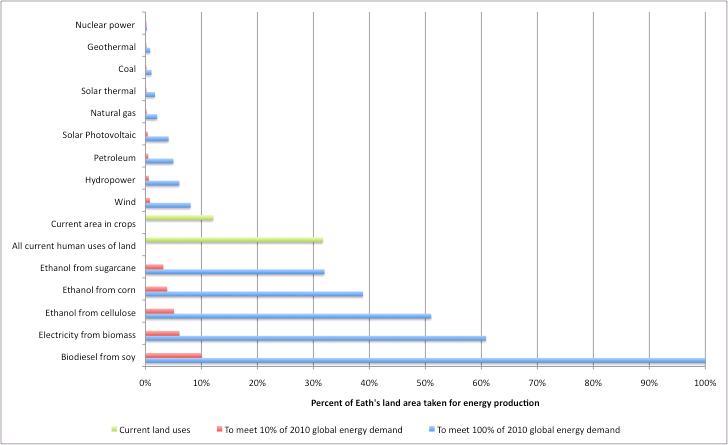
nuclear fuel is 2 million times more energy dense than any other fuel (even more energy dense than that for solar or wind), and this reactor is 30 times more efficient than conventional reactors.

that means roughly 2 million times less transportation, less land use and less waste. (Land use comparisons: http://newenergyandfuel.com/wp-content/uploads/2010/06/LandU...)

How can we factor in the amount of CO2 removal lost by removal of millions of trees for wind farms? (http://www.telegraph.co.uk/news/politics/10546071/Millions-o...) Or millions less train use in transport of coal?

It's a good point though. We should count not just that the reactor itself saves 200,000 tons of CO2 during operation, but also the frequently 10x that of fuel burnt to transport that diesel in conventional generators. So each reactor deployment may save 2 million tons of CO2.

Nuclear facilities are also much longer lived than many. Eg solar panel life degrades significantly after a decade. Wind turbines generally have a life of 15 years of so. So that's less concrete, construction, etc.

You're right it's tough or impossible to quanitfy. Intuitively, it all comes back to the energy density number. 2 million times more energy dense, no emissions or pollution in operation, and the "waste" is actually useful fuel which produces energy.

Re: UPower (YC S14) Is Building Nuclear Batteries

#110

Earlier quoted context omitted.

This seems like an interesting technology, especially if you can keep the moving parts to a minimum. I did a bit of research on mineral extraction. Not surprisingly the more refined your minerals the more valuable they are, and building an on-site blast furnace to convert various forms of iron ore into pig iron would allow countries like Afghanistan extract more value out of their mineral deposits. The challenge is t…

Great assessment and distilled description. We have literally spoken to people from lithium mines to chromium mines to remote oil or copper mines and they have explained this same predicament of difficulty of reliable power on site. As far as unattended: in sum, the technology allows it, but the regulatory structure may not be comfortable with it in the near term. It's not the deal breaker you might think in terms of…

EBR?
Post reply on HN