Live data from Hacker News

Macintel: The End Is Nigh

mondaynote.com

51–60 of 156 posts

Re: Macintel: The End Is Nigh

#51

"The aging x86 architecture is beset by layers of architectural silt accreted from a succession of additions to the instruction set... Because of this excess baggage, an x86 chip needs more transistors than its ARM-based equivalent" I wish people would stop saying this. On the inside, x86 CPUs are basically RISC. There is a translation layer from the publicly facing instruction layer to the internal representation. T…

Yeah, as soon as the guy started saying this I discounted the whole article. Yes, maybe Apple will switch to A7 chips, but this author sure doesn't know enough about processors to have any kind of a privileged viewpoint.

If one doesn't even know what uops are, and doesn't have a mental estimate of what percentage of i7 silicon is devoted to the instruction decoder, one doesn't get to write articles comparing Intel to ARM chips.

Edit: Going back to the article I note the author is Jean-Louis Gassee, so this is just bizarre. He is kind of just talking out his ass and I would hope he'd know better than that, because whereas making stuff up is a survival skill in exec-land, being blatantly and demonstrably wrong about said make-ups is not.
Re: Macintel: The End Is Nigh

#52

"The aging x86 architecture is beset by layers of architectural silt accreted from a succession of additions to the instruction set... Because of this excess baggage, an x86 chip needs more transistors than its ARM-based equivalent" I wish people would stop saying this. On the inside, x86 CPUs are basically RISC. There is a translation layer from the publicly facing instruction layer to the internal representation. T…

It actually is true, though it's easy to exaggerate how important it is. Decoding an x86 instruction into the RISCish internal format isn't hard, but decoding 4 at once can be quite a challenge. There's no way to look at a single byte of the incoming instruction stream and figure out if it's the start of an instruction or not, you need to do a fair amount of decoding on each byte of the chunk that you fetch from I$ before you can tell where the instruction boundaries are. For A64 ARM you know that every fourth byte is going to be a new instruction start. I wouldn't put this penalty at more than maaaaybe 20% at the very most, but it is a thing.

EDIT: And there are things like instruction gates that seriously are cruft that gums up how the memory system works, and some would argue that the x86 memory ordering constraints fall under this as well. On the other hand you should listen to Linus rant about how REP MOVS is the best thing since sliced bread that every other architecture is missing out on.

Re: Macintel: The End Is Nigh

#53
post #47

While I think the article's prediction is incorrect (see my other comment for why), it did give me an idea: Why doesn't Apple design their own x86 CPU? Their work on the Ax series has probably taught them quite a bit that could be ported over to x86-land. Also, Apple could leave out x86 cruft they don't use: legacy addressing modes, PAE, etc. And of course, they could design the CPU specifically for their products in…

If they left out stuff they didn't use, they would still have to keep in stuff that others use. Apple might not use Feature A, but application A might use Feature A, or at the least, VMWare might need Feature A in order to run Windows 7 or Ubuntu.

If Apple wanted to go full-iOS and lock out everything that isn't Apple-approved, then this would be a good idea. If they wanted to keep Bootcamp, virtualization, or an unregulated third-party application development environment, designing chips without the standard features of Intel chips wouldn't be a great idea.

Re: Macintel: The End Is Nigh

#54
The "transitions" comments leave out a big piece of functionality; certainly big for me, and I imagine big for others. That's VMs for Windows and Linux. I have all kinds of Linux VMs I run on my Mac, and I imagine others that need "that one Windows app" run Windows a lot in VMWare and VirtualBox. Going to ARM would torch a big part of Mac functionality for me.

Re: Macintel: The End Is Nigh

#55
According to Geekbench the current CPU in the iPad Air (the A7) scores about the same as a Core 2 Duo from 2006 (the E6600). Nothing to sneeze at and definitely getting close to the low power Haswell CPU's in systems like the Macbook Air. But I reckon it'll be a few generations of A series CPU's before they reach the point where they can challenge Intel for the crown

Re: Macintel: The End Is Nigh

#56

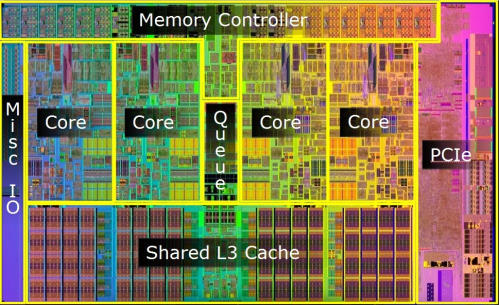
From the article: > Because of this excess baggage, an x86 chip needs more > transistors than its ARM-based equivalent, and thus it > consumes more power and must dissipate more heat. This is true but it ignores the primary reality of "desktop class" processor design today: RAM is the bottleneck in a really major way and most of a desktop class CPU's transistors are dedicated to overcoming this. In the ancient days,…

Cribbing a die shot:

http://www.tweakpc.de/hardware/tests/cpu/intel_core_i5_760_b...

Notice the size of the L3. Now look at a core- each core is probably 50% L2 by area, and the L1 + branch predictor/prefetcher probably occupies another 25%.

Re: Macintel: The End Is Nigh

#57
post #9

If this happens I hope entry level Mac’s get below $500. I bought a MacBook Air for use as a Windows machine with the plan to learn iOS development at some point. It was worth the cost since I can use it as my day to day machine running Windows. I wouldn’t be able to justify spending $1000 on a Mac Laptop that could not run Windows. I could justify $400 for an entry level Mac Mini running ARM but not a lot more then…

I find the "Apple is too expensive" argument to hold little water when you really look at it. I won't argue that up front you will pay more for the lowest-end Apple laptop/desktop over a Windows laptop/desktop but in my experience Apple products hold their value much better than any Dell/HP/etc product. Even if you hate OS X then you still are better off buying an Apple laptop and running Windows than you are buying a Windows laptop. The hardware is more reliable, the resale value is greater, and they look 100x better than anything else out there.

Comparing a Dell XPS to a Macbook Pro Retina with the very similar stats (CPU/RAM/HD), the Mac has a few better specs, leaves us with a price difference of $100 in Dell's favor but I can promise you that the MBPr will resale for much higher than the XPS in 1-2 years time. I had friends in college that always would joke that I paid a small fortune for my MBP ($1500) however these were the same people who would buy a $500 laptop every year or so because their bargain bin laptops just didn't last long before they started having hardware issues or massive slowdowns. My MBP ran quite smoothly for 2.5 years before I needed a faster CPU (I'm a developer) and I sold my machine for $900 which resulted in an operating cost of $240/yr for the period I owned it.

Re: Macintel: The End Is Nigh

#58

I'm probably in the vast minority, but I tend to use apple hardware to run windows... so I'm hoping this doesn't come to pass. I use OSX occasionally, but the thing that got me to switch to apple in the first place was bootcamp.

It's quite possible that ARM Macs will run Windows. Windows RT already runs on ARM, and Microsoft seems to be moving in the direction of embracing alternative platforms (see how they push Azure for iOS). They'd sell more Windows licenses and gain more users, and at worst they'd lose some Surface sales. Whether Apple would allow it is a different question.

WindowsRT is a dead man walking.

I wouldn't predict a long maintenance life for it. Surface2 and the Nokia 2520 is about all the hardware left running it?

Re: Macintel: The End Is Nigh

#59

From the article: > Because of this excess baggage, an x86 chip needs more > transistors than its ARM-based equivalent, and thus it > consumes more power and must dissipate more heat. This is true but it ignores the primary reality of "desktop class" processor design today: RAM is the bottleneck in a really major way and most of a desktop class CPU's transistors are dedicated to overcoming this. In the ancient days,…

>Look at a modern i5 CPU die - https://www.google.com/search?q=intel+core+i5

That link didn't seem quite right - maybe you meant something like this?:

http://www.techpowerup.com/reviews/Intel/Core_i5_2500K_GPU/

Re: Macintel: The End Is Nigh

#60
post #26

What would happen to the cost, battery life, and size of an A10-powered MacBook Air? It would be worse in almost every aspect. The cost wouldn't change much, and Apple wouldn't profit much more from the switch. The cited CPU cost is the suggested retail price . Apple's volume lets them negotiate huge discounts. Battery life would go up a bit, but battery life is already pretty good on Apple laptops. My 2013 11" Air g…

What if Apple introduced workstation-class ARM another way; made a really powerful iPad/iPhone which could sit in a dock with keyboard/mouse/monitor, and run both iOS and ARM OSX? x86 computers could continue to exist for high-end users, but typical-users might be content with a hybrid tablet/computer. As ARM increased in power, x86 might dissapear entirely. Your comments on Windows compatibility/virtualization are s…

I think that it would be more likely that they'd just drop OS X in that scenario, and just have a beefed-up version of iOS with better keyboard and touchpad support.

The number of users who would actually benefit from OS X vs iOS, but would not be ticked off at an inability to dual boot Windows or run any legacy applications, is very small indeed.

iOS for ARM and OS X for x86 seems likely to remain in the future, but I do think that Apple could do a netbook or dockable tablet running ARM/iOS if they really thought there was demand. I'm not sure there is, but if the product was good enough they have shown in the past an ability to manufacture demand where it didn't exist previously...

Post reply on HN