Live data from Hacker News

Nine Nations of North America 30 years Later

nytimes.com

21–30 of 66 posts

Re: Nine Nations of North America 30 years Later

#21
post #18
post #9

I am not from Americas, and had never heard of the concept of Nine Nations. If you're equally lost with some of the terms ("Dixie"? "The Foundry"?) or the overall theory, this sheds some light on it: http://en.wikipedia.org/wiki/Nine_Nations (but unfortunately does not provide links for some of the regions). Anyone know of a better online exposition?

"Dixie" generally refers to states south of the Mason-Dixon survey line where slavery was legal. This map's concept of Dixie includes some areas above that line and excludes some areas inside it, like most of Texas and Missouri. "The Foundry" seems like a euphemism for the more commonly used term "Rust Belt." It's an area that traditionally has had lots of heavy industry, but has largely been in economic decline in t…

[deleted]

Re: Nine Nations of North America 30 years Later

#23
post #6

Very cool idea. Although the recent oil and natural gas booms are fast transforming "The Empty Quarter" into "Extractopia" where oil, gas, logging, and mineral extraction, which are already the main industries, are going to become an increasingly important driver of overall North American economic growth.

I completely agree except I feel that the "topia" suffix implies it's some sort of paradise. Given the controversy around environmental damage, something more ominous like "gasland" might be better.

The suffix is present both in "utopia" and "dystopia".

Re: Nine Nations of North America 30 years Later

#24
post #6

Very cool idea. Although the recent oil and natural gas booms are fast transforming "The Empty Quarter" into "Extractopia" where oil, gas, logging, and mineral extraction, which are already the main industries, are going to become an increasingly important driver of overall North American economic growth.

Already the case with Alberta, which is a major driving force in the Canadian economy, on track to surpass Quebec as the second largest provincial economy.

Feels like a bit of a slight to lump it into an "Empty Quarter."

Re: Nine Nations of North America 30 years Later

#25
post #22

Why "Empty Quarter"? What's the reason behind that name?

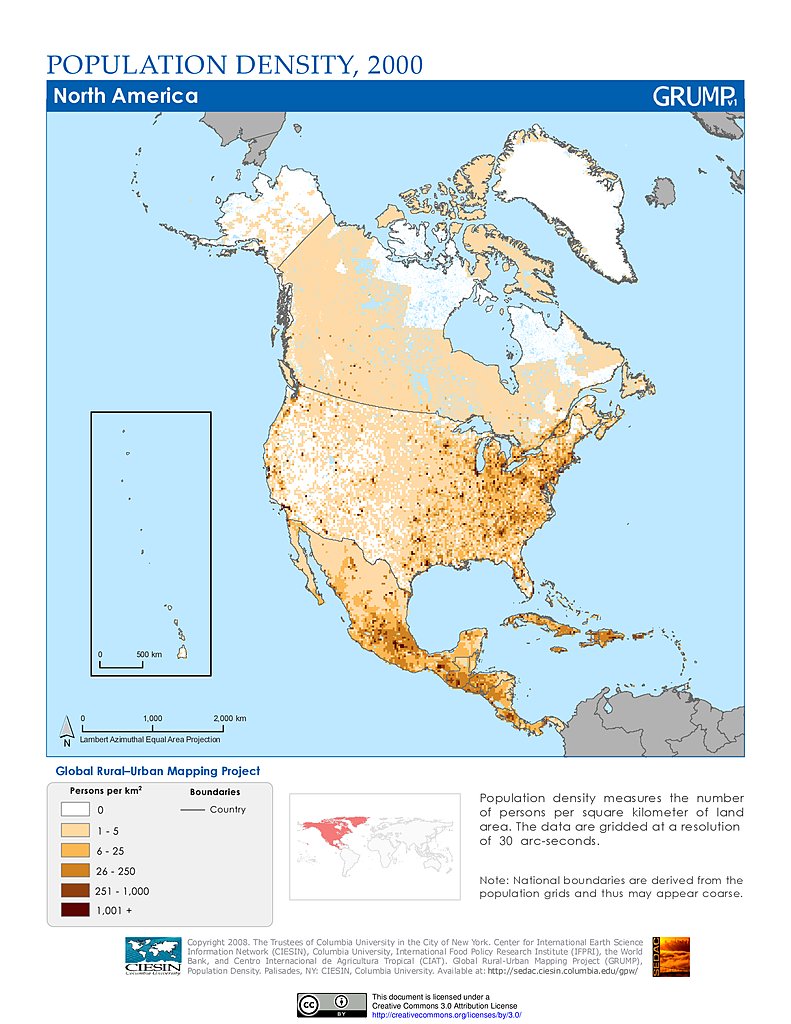
The population and population density in those areas are incredibly low.

At least on the Canada side, the only two major cities in that area are Edmonton and Calgary, with a combined population of less than 2 million.

Re: Nine Nations of North America 30 years Later

#26

Similar to the 7 States of Facebook which surfaced a few years ago. http://gigaom.com/2010/02/08/the-7-somewhat-united-states-of... Culturally some of these boundaries seem more accurate.

It really irritates me, almost unreasonably so, that I cannot view a larger version of that map. And I've been searching for it since the first time it was posted. Take this post [1] for example, where it says "Click on the map to learn more". Clicking on the map refreshes the page. It also has a link that says "To make sense of the patterns I'm seeing, I've marked and labeled the clusters, and added some notes about…

Did you see Peter Warden's post? He's the creator of that map.

http://petewarden.typepad.com/searchbrowser/2010/02/how-to-s...

Re: Nine Nations of North America 30 years Later

#29
As Mexican I can give you an update about the Five Nations of Mexico:

http://www.csuchico.edu/~sbrady/357fivenationsofmexico.pdf (1987)

> "More than three decades after publication, two things amaze me: how little the boundaries have changed and how much chatter this idea is getting recently. "

This is also true for the Mexican Nations, although the Mexican nations started a new experiment called "Democracy" in the 2000, they chose a tri-party system. Also boundaries have changed , Mexamerica have expanded north of the border defined 30 years ago, but also lose territory to it's southern neighbor, New Spain. In a way the Mexamerican nation is moving to the North. Thanks to NAFTA, Mexamerica economy became richer and interlaced. Mexamerica became politically powerful in the mid-2000's just to see lose its leverage because of the great recession and the drug war, being politically neutralized in 2012 elections. Although things are returning to normality Mexamerica saw many of the bloodiest battles in the Drug war. Once the richest of the Nations, its economic supremacy it's being contested by Metromex and New Spain.

New Spain saw great progress, it diversified its crops thanks to NAFTA. It created a new industrial corridor comprising the cities of León, Aguascalientes, Irapuato, Celaya, Salamanca which many were part of Mexamerica but now are tied economically and culturally to New Spain and now are home to Nissan, Texas Instruments, General Motors, and many other's factories. IT companies like Intel, IBM, Freescale, HP, Oracle, Hitachi, etc. built its regional headquarters at Guadalajara. By not relying in the demand of Metromex, it gained the political power it always wanted in the Federation congress.

Metromex saw it's political power now reduced to a distant memory. The middle class not ceased to grow and now is one of the biggest markets for many industries worldwide. It transformed its economy from an industry oriented to a service oriented. It bulldozed its factories to make space for skyscrapers and transformed it's colony to the west, Toluca, to it's new industrial hub. It reached the 8th place on the 2008 PwC Richest Cities ranking. In a few years it will become a true cosmopolitan megalopolis stretching to Queretaro to the north, Puebla to the east, Cuernavaca to the south and Toluca to the west.

Club Mex received new territorial additions, Punta Mita from New Spain, Los Cabos from Mexamerica, the whole south pacific and Caribbean coast from South Mexico. Although it hasn't gained the political power it deserves, Club Mex grew to became 30% of the Federation GDP. Club Mex future is the most uncertain, climate change and the pressure from the organized crime pose a great threat to many of its inhabitants which many are immigrants from the First world and South America.

South Mexico is still stuck in the past, the massive immigration in the 80's and 90's to the United States had left many towns deserted, while many others only inhabited with old people and children. Its economy was destroyed by the NAFTA, unable to compete to North-American farmers it has tried to become the new Club Mex with mixed results, one of the most notable success is Chiapas.
Re: Nine Nations of North America 30 years Later

#30

I'd carve off an additional nation stretching from Boston to D.C. Putting NYC in a declining industrial nation with Detroit as its capital seems puzzling even for 30 years ago...

I think Brooklyn was considered Foundry but Manhattan is its own city-state. Same with DC. "Mex-America" is a weird one (and why is the capital in the U.S.?) too. If Minnesota and Michigan are different nations, then Mexico (which is much more tribally, ethnically, and socioeconomically heterogeneous) cannot reasonably be cast as one bloc. Oaxaca, Mexico DF, the Yucatan, and Juarez are all very different places (just…

You're right on about Manhattan.

But MexAmerica was not all of Mexico. In Mexico, it was measured by US influence, just as in the US, it was measured by Mexican influence. (IIRC, one measure he gave for the southern border of MexAmerica was where you stopped being able to receive Spanish-language radio stations that were broadcast from the US.)

Post reply on HN