Live data from Hacker News

Software used to count Australian Senate votes is a “trade secret”

easycount.mjec.net

41–50 of 100 posts

Re: Software used to count Australian Senate votes is a “trade secret”

#41
The algorithm used is fairly complicated, being both preferential and proportional. (The lower house is preferential but not proportional).

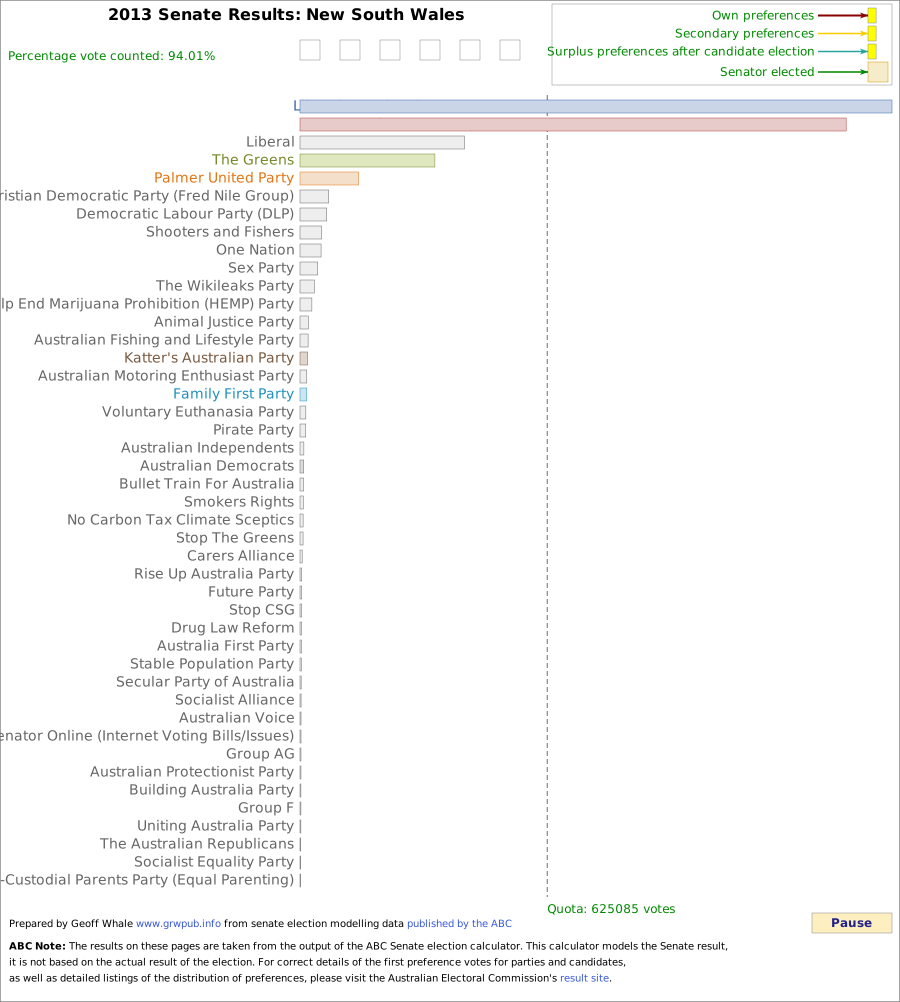
Here is a nifty visualization of the senate vote flows in NSW: http://www.grwpub.info/senate/nsw.svg.

Essentially you need a certain number of votes to cross the line and win a seat. After winning the seat, those votes are subtracted from the party. Eventually when no parties have enough votes, the lowest voted party is eliminated and its votes are redistributed by preference.

Re: Software used to count Australian Senate votes is a “trade secret”

#42

I've always though the Hare Clark system is intrinsically I democratic (even though it produces reasonable results) because no one seems to understand it (certainly the people who claim to can't explain it). It's also non deterministic -- the outcome can change hassle on the order in which votes are counted (although the impact will be very small in all probability)

STV used in Australia is deterministic. It does not change depending on the order in which votes are counted.

Re: Software used to count Australian Senate votes is a “trade secret”

#43
post #8

Visibility of the source code is a side-show in electronic voting systems. Even if the source code is published, there is no way to be sure that that is the code that is running on the hardware, or to be certain that the hardware itself has not been tampered with. Votes need to be printed out on paper, verified by the voter, and counted by hand. Still, when we had the source code for the Irish system (now abandoned d…

> counted by hand.

By whom? Overseen by whom? Who oversees the overseers? Not to mention people make mistakes, ballots get dumped, and nobody has any evidence their vote was actually counted.

Here's a long but fascinating tech talk on a real solution:

https://www.youtube.com/watch?v=ZDnShu5V99s

Re: Software used to count Australian Senate votes is a “trade secret”

#44

Earlier quoted context omitted.

In that case a simpler fix would be to allow any independent party (within reason) to supply and use their own software and render their own tally. If the parties are mutually distrusting, and their tallies still agree, that can be enough to trust the outcome. Auditing the source code has no real utility; it's worthless because you can't be sure that the code you've audited is the code actually running. "Open and ver…

I would prefer if the input to the software was published and anyone could verify the outcome. Unfortunately, currently none of this information is published and the whole system is based on trust.

The AEC does publish the totals for each candidate, at each stage of the Senate count [1]. There is a PDF for each state, under the heading "Distribution of Preferences". An example for NSW is at [2] Are these numbers sufficient input, to duplicate and verify the results of the AEC software?

[1] http://results.aec.gov.au/17496/Website/SenateResultsMenu-17...

[2] http://results.aec.gov.au/17496/Website/External/SenateState...

Re: Software used to count Australian Senate votes is a “trade secret”

#45
post #30
post #4

Thats appalling. As an Australian citizen, who should I call about this to voice my objection?

You have a set of questions for this Abbott-led government regarding technology backed up by legitimate concerns? Save your time, I already know the response to that. It's 'Get Fucked'. And that was before the election. http://delimiter.com.au/2013/08/07/get-fucked-turnbull-staff...

The AEC is supposed to be non-partisan, and not have much to do with the parties themselves, IIRC (although they do report to the government at the end of the day).

Your point is well taken though. I'm thoroughly disgusted with the fear-mongering, technophobic way our government has conducted itself.

If you're interested in applying your technical skills to furthering the democratic process in Australia, volunteer with the Open Australia Foundation (which is what I'm doing). They've got everything on GitHub, and accept PRs!

https://www.openaustraliafoundation.org.au/

Re: Software used to count Australian Senate votes is a “trade secret”

#46
post #43
post #8

Visibility of the source code is a side-show in electronic voting systems. Even if the source code is published, there is no way to be sure that that is the code that is running on the hardware, or to be certain that the hardware itself has not been tampered with. Votes need to be printed out on paper, verified by the voter, and counted by hand. Still, when we had the source code for the Irish system (now abandoned d…

> counted by hand. By whom? Overseen by whom? Who oversees the overseers? Not to mention people make mistakes, ballots get dumped, and nobody has any evidence their vote was actually counted. Here's a long but fascinating tech talk on a real solution: https://www.youtube.com/watch?v=ZDnShu5V99s

I can talk about Ireland, as I've been an election observer there. The way we do it is that ballot boxes are locked and sealed with tamper-evident seals after a polling station has closed. Elections observers; including representatives from the political parties may request to add their own seals. In some particularly contentious districts this is done, but for the most part people are happy with the official seals.

The ballot boxes are then transported by the police force to the nearest "count center". The next morning, the seals are inspected and those ballot boxes are opened. All of the ballot boxes in a constituency are counted together in a secure, but open area. Here's a flickr set with a good number of photos showing how it's done:

https://www.flickr.com/photos/redmum/sets/72157600270850764

the counters are within the fenced area, and the observers - including many people from the political parties, surround the fence. The entire process is easy to see.

One particularly important part is what happens when the boxes are opened. The contents are just dumped out on the table and one by one each vote is turned to face up and towards the observers. The observers then "tally" the votes and mark which candidate (or referendum choice) the voter marked as their first preference.

All parties participate in this tally and it provides the first take on what the result will be. The margin of error on the tally is Contentious votes with identifying or ambiguous marks and so on are kept aside and argued over by people like me for an hour or so, but they never make much of a difference.

The end result is a process is very verifiable and auditable, in easy-to-understand human ways; you can literally show up at a count center and count the votes yourself as they come out of the boxes, and make sure that you're not being duped. That's a nice accessibility property too.
Re: Software used to count Australian Senate votes is a “trade secret”

#47
post #44

Earlier quoted context omitted.

I would prefer if the input to the software was published and anyone could verify the outcome. Unfortunately, currently none of this information is published and the whole system is based on trust.

The AEC does publish the totals for each candidate, at each stage of the Senate count [1]. There is a PDF for each state, under the heading "Distribution of Preferences". An example for NSW is at [2] Are these numbers sufficient input, to duplicate and verify the results of the AEC software? [1] http://results.aec.gov.au/17496/Website/SenateResultsMenu-17... [2] http://results.aec.gov.au/17496/Website/External/Senate…

As I understand it - yes normally these numbers are sufficient to verify outcomes.

However in extremely close races, such as what happened in WA - it can come down to very small numbers of individual ballots and how their preferences are stated, as to what order senators are elected in.

This then affects the re-flow of preferences.

Re: Software used to count Australian Senate votes is a “trade secret”

#48

Earlier quoted context omitted.

The algorithm is public. It's the Australian Electoral Commission's implementation of it, their software, that's used in public elections that they're calling a trade secret.

In their defence, in Section 15 of the FOI rejection letter, they mention the software is used for several fee-for-service industrial elections.

Isn't that a conflict of interest? I mean, who or what pays for the development of the implementation?

Re: Software used to count Australian Senate votes is a “trade secret”

#49
post #44

Earlier quoted context omitted.

I would prefer if the input to the software was published and anyone could verify the outcome. Unfortunately, currently none of this information is published and the whole system is based on trust.

The AEC does publish the totals for each candidate, at each stage of the Senate count [1]. There is a PDF for each state, under the heading "Distribution of Preferences". An example for NSW is at [2] Are these numbers sufficient input, to duplicate and verify the results of the AEC software? [1] http://results.aec.gov.au/17496/Website/SenateResultsMenu-17... [2] http://results.aec.gov.au/17496/Website/External/Senate…

Not really the same as the raw input, because while most people vote above the line, there will be a small number who vote below the line, and the incremental count doesn't show if these were allocated correctly.

The best you could do is compare the expected flow each step, based on group voting ticket, against the actual flow, and make sure the total difference does not exceed the number of below the line votes.

Re: Software used to count Australian Senate votes is a “trade secret”

#50
post #25

Earlier quoted context omitted.

It's not a side show at all, it's the most important thing. By showing us the code the AEC is making the implicit commitment that this is the code running on their systems. Until they show us some code they are not even making that commitment at all - they could be running anything, they could change it every day to match their whims. My own suspicion is that they DO know of numerous problems either current or past a…

I don't mean any offense - but your position is not self-consistent. "Showing us the code" does not invalidate "could change it every day to match their whims". For example the entire source code to Linux is public, but looking from the outside, you as an observer have no way to know that a particular copy of the Linux code is what is running on my laptop. Which is why I say it's a side-show. If the source code is sh…

I actually see where both you and the person you're debating with are coming from. Yeah, it's kinda a side-show because they can publish anything they want and you or I can't verify that's truly what is running. But it's a side-show that can turn into the main-show if the government really screws it up or a whistle-blower appears on the scene. From that angle, I say making them publish the code & promise the public that's the real code in production will then at least add one more avenue for any government-scandals to be "accidentally" revealed.

Basically, the more often you can force someone to tell a lie the more likely they screw up somewhere and it all falls apart.

Post reply on HN