I hate the font choice of this article.
Same here, I thought she picked the font on purpose for this article, but her entire site uses awful unreadable fonts, colours, etc.
41–50 of 250 posts
I hate the font choice of this article.
Show me a virtual machine that I can test with, that puts me in the shoes of a user w/ a disability, and I'll develop with accessibility in mind. But the inability to replicate the experience in full, I think , inhibits catering to that demographic.
We hackers are frequently solution driven, with a heavy focus on tools. This quickly tailspins into goals focused on incremental changes (load faster, show more info, integrate with this other thing) instead of stepping back and looking at the larger picture (who are my users and what do they want to do?)
Fighting for 3 hours to get your graph to load properly on IE7/8/9 is silly if a table displays the information more clearly and is more accessible.
Well to be honest I can test my code in IE9 to see if it works. But I have no idea how a disabled person is experiencing my website, I do put all the "alt" attributes etc...but it's hard to imagine it.
Yes, that's a real issue. I've had to add JAWS Screen Reader support to an app, and even after you shell out for the thousand dollar license, it's very difficult for a casual user to use it in the same way that an actual blind user does. Ideally you test with an actual impaired user, but they have real jobs and don't want to spend all their time testing your apps.
There are probably many groups already doing this stuff. Perhaps they just need better organisation or SEO?
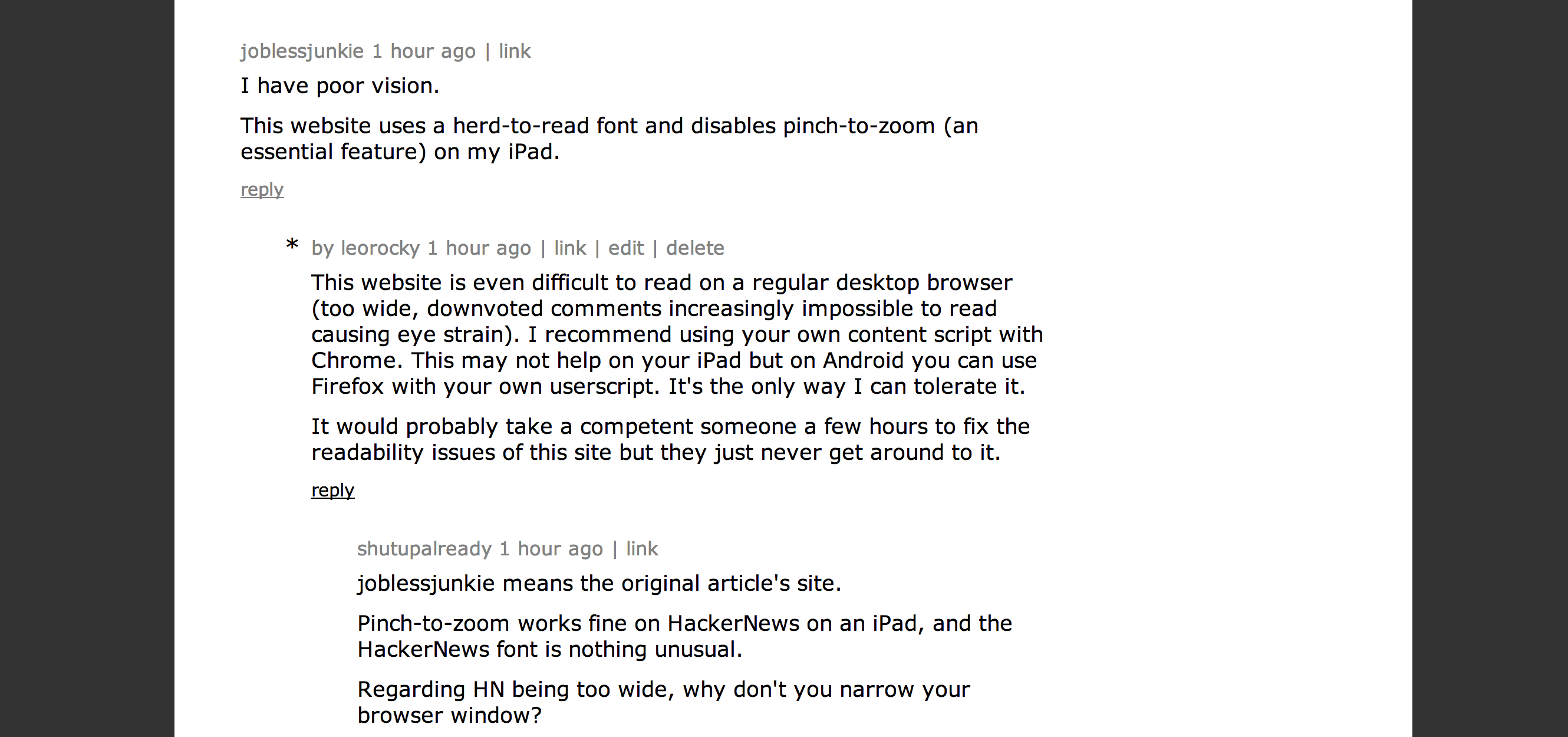
I have poor vision. This website uses a herd-to-read font and disables pinch-to-zoom (an essential feature) on my iPad.
It would probably take a competent someone a few hours to fix the readability issues of this site but they just never get around to it.
Edit:
Here's a link to what all comments look like for me, even if they're downvoted:
http://dl.dropboxusercontent.com/s/v5zcn9n4vg4m3cn/2014-06-1...
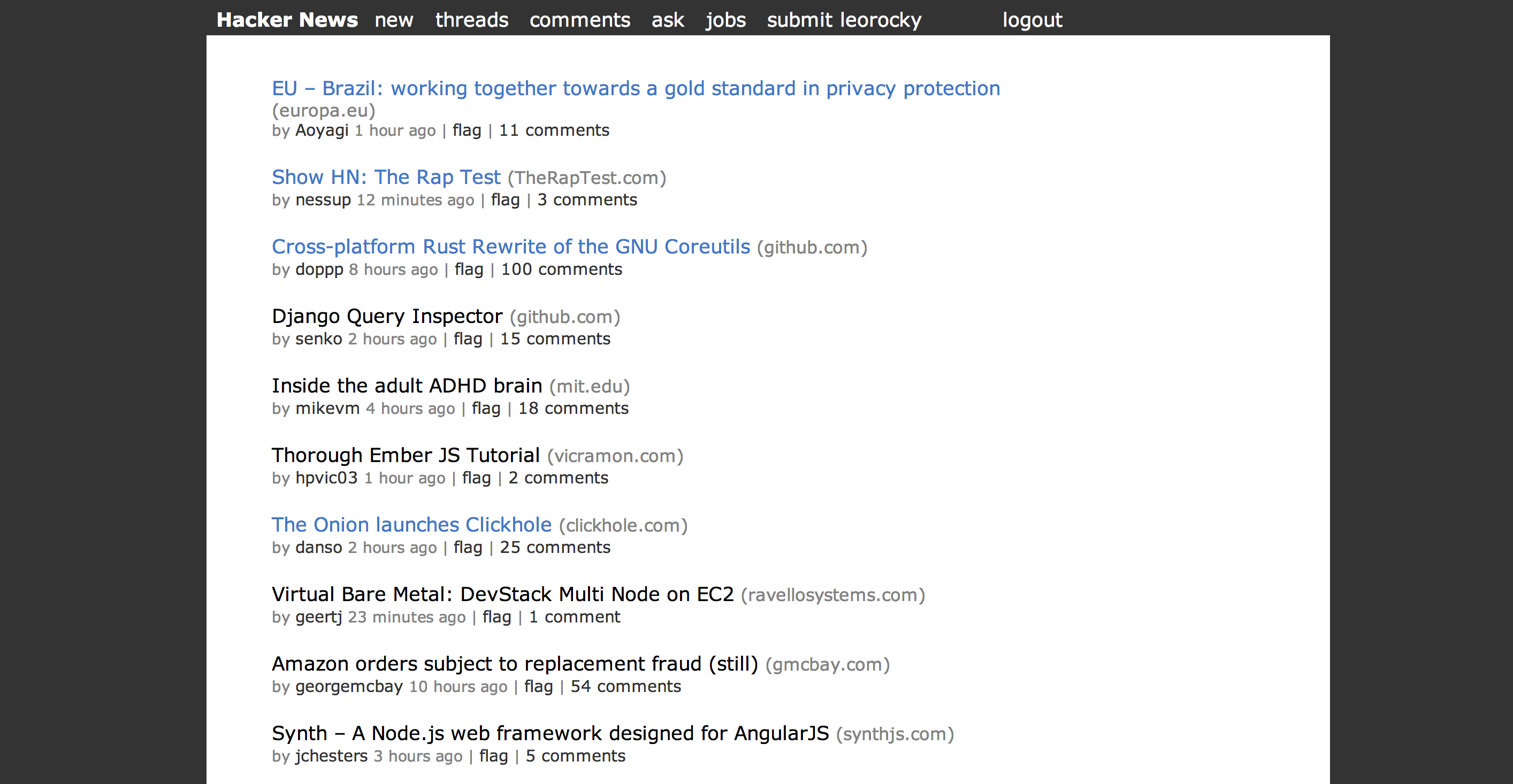
I also disabled scores and voting because I dislike that stuff.
This is the home page:
http://dl.dropboxusercontent.com/s/sicqor50smsl4hx/2014-06-1...
Furthermore I always try to optimize the "dry" HTML and use semantic HTML not because of the blind and disabled but because I like my documents be read by non-humans that apparently are blind and deaf and have bad JavaScript support in their browsers to boot.
Don't do it for the disabled. Do it for the blind and deaf unstoppable corporate robots.
You usually can't have a design that makes all of them happy at once.
For example, high contrast UI themes often leave large white areas on the screen that users with glaucoma find blinding, but other users like a lot.
I have poor vision. This website uses a herd-to-read font and disables pinch-to-zoom (an essential feature) on my iPad.
I wouldn't consider this an impairment, but my eyesight is changing (it is getting harder for me to work on a screen when I'm wearing glasses). This font is very hard to read!!
I have poor vision. This website uses a herd-to-read font and disables pinch-to-zoom (an essential feature) on my iPad.
> I'd like to start this post with a disclaimer: I don't know much about creating accessible websites.
I hate the font choice of this article.
Probably because those 3% are homogeneous, while the 9% decompose into lots and lots of categories, all with specific needs, and all much smaller than 9%.
...although you can do a damn good job addressing most of them with a few simple things: -Write good, semantic HTML, and use alt tags correctly -Don't overwrite browser defaults for scrolling, tabbing, etc (even if it's "hot design") -Don't rely purely on color to convey information -Use ARIA attributes where you can if you're building an application Some harder stuff that is really still worth it: -Send your media o…
[1] http://wongm.com/2014/06/asking-vision-impaired-to-push-gree...