Cool. It reminded me of a similar work published by Opera some years ago
http://dev.opera.com/articles/3d-games-with-canvas-and-rayca...
woa! it was 2008, time sure pass by.
31–40 of 99 posts
http://dev.opera.com/articles/3d-games-with-canvas-and-rayca...
woa! it was 2008, time sure pass by.
It is very interesting to me that you need to multiply the distance-to-wall by the cosine of the angle to transform the image from fisheye to normal. It makes me wonder, why is it that our eye in real life sees straight lines as straight, the way this demo renders the image? To illustrate the question, see https://en.wikipedia.org/wiki/File:Panotools5618.jpg – why do we see the world as in the bottom image instead of…
Not always. Next time the Sun and the Moon happen to be in view at the same time, look at the dividing line X on the Moon between the parts illuminated and in shadow. Then draw a straight line Y from the Moon to the Sun.
Common sense tells us that the two lines are perpendicular, but often this is not the case. I don't understand it completely myself, but it is something to do with us residing on a curved surface.
It is very interesting to me that you need to multiply the distance-to-wall by the cosine of the angle to transform the image from fisheye to normal. It makes me wonder, why is it that our eye in real life sees straight lines as straight, the way this demo renders the image? To illustrate the question, see https://en.wikipedia.org/wiki/File:Panotools5618.jpg – why do we see the world as in the bottom image instead of…
It does a lot of pre-processing, so to speak -- which is why we get such awesome illusions as the Poggendorff illusion [0], tricks like the Pulfrich effect [1], etc.
I don't know enough about the mechanics of how light enters and is interpreted by the eye, but I wouldn't be surprised at ALL if we "should" be seeing more like a fisheye lens but our brain is saying no, no, those lines are straight, based on the countless other stimuli it's receiving.
Earlier quoted context omitted.
What graphics card/driver combination do you have? It runs decently for me with Firefox 29 on Linux, intel graphics (Sandy Bridge).
It is not using the GPU to do the drawing: https://github.com/hunterloftis/playfuljs/blob/master/conten... Note that it is using canvas 2d rather than canvas 3d (aka WebGL[1]). But if you take ray casting to extreme, you end up with Ray Tracing[2], which is kinda expensive. Which is why we had such an effusive conversation a few months ago about hardware accelerated RayTracing[3]. A sample ray traced scene from Alter…
It is very interesting to me that you need to multiply the distance-to-wall by the cosine of the angle to transform the image from fisheye to normal. It makes me wonder, why is it that our eye in real life sees straight lines as straight, the way this demo renders the image? To illustrate the question, see https://en.wikipedia.org/wiki/File:Panotools5618.jpg – why do we see the world as in the bottom image instead of…
It is very interesting to me that you need to multiply the distance-to-wall by the cosine of the angle to transform the image from fisheye to normal. It makes me wonder, why is it that our eye in real life sees straight lines as straight, the way this demo renders the image? To illustrate the question, see https://en.wikipedia.org/wiki/File:Panotools5618.jpg – why do we see the world as in the bottom image instead of…
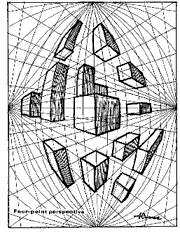
[1] http://www.craftsy.com/blog/wp-content/uploads/2013/07/cropp... [2] http://www.termespheres.com/images/perspective/fourpointpers...
Heh, reminds me of kkrieger - a first person shooter in 100KB for a scene demo. https://www.scene.org/file.php?file=%2Fparties%2F2004%2Fbrea...
If you missed it a couple of weeks ago, this article about its creation was really interesting: http://fgiesen.wordpress.com/2012/04/08/metaprogramming-for-... ( Thread: https://news.ycombinator.com/item?id=7739599 )
It is very interesting to me that you need to multiply the distance-to-wall by the cosine of the angle to transform the image from fisheye to normal. It makes me wonder, why is it that our eye in real life sees straight lines as straight, the way this demo renders the image? To illustrate the question, see https://en.wikipedia.org/wiki/File:Panotools5618.jpg – why do we see the world as in the bottom image instead of…
Its gotta be the shape of our eye, for the same reason the effect works in a mechanical DSLR camera, where light is only refracted through the lens.
The sensor on the back of a camera is a flat plane, which is why (with most lenses) you get an image where straight lines appear straight. The sensor on the back of your eye (the retina) is curved.
Earlier quoted context omitted.
It is not using the GPU to do the drawing: https://github.com/hunterloftis/playfuljs/blob/master/conten... Note that it is using canvas 2d rather than canvas 3d (aka WebGL[1]). But if you take ray casting to extreme, you end up with Ray Tracing[2], which is kinda expensive. Which is why we had such an effusive conversation a few months ago about hardware accelerated RayTracing[3]. A sample ray traced scene from Alter…
2D canvas should be hw accelerated too on most browsers.
Just compare with this pure fragment shader demo: https://www.shadertoy.com/view/MsS3W3