Live data from Hacker News

If Jesus Never Called Himself God, How Did He Become One?

npr.org

21–30 of 36 posts

Re: If Jesus Never Called Himself God, How Did He Become One?

#21
post #19

Earlier quoted context omitted.

http://en.wikipedia.org/wiki/Alexander_the_Great_in_the_Qura...

I have come across that page before. Unfortunately it is full of false information (I researched it). For instance, the Alexander romance incidents that match the Quran were actually copied from the Quran, not the other way around. Furthermore, note that even what is mentioned on that page is speculation from certain Islamic scholars. There is absolutely no authentic Hadith (or even non-authentic as far as I know) th…

If it's wrong then please contribute to it and fix it. Your knowledge of this subject should be shared.

Online society's attitude to Wikipedia seems to have settled into two camps; those who refer to it as an authority and those whose avoid it due to negative experiences with inaccuracies or politics.

I'm trying to move from the second group to a third; patch-up articles for the benefit of other people.

Re: If Jesus Never Called Himself God, How Did He Become One?

#22
post #19

Earlier quoted context omitted.

I have come across that page before. Unfortunately it is full of false information (I researched it). For instance, the Alexander romance incidents that match the Quran were actually copied from the Quran, not the other way around. Furthermore, note that even what is mentioned on that page is speculation from certain Islamic scholars. There is absolutely no authentic Hadith (or even non-authentic as far as I know) th…

If it's wrong then please contribute to it and fix it. Your knowledge of this subject should be shared. Online society's attitude to Wikipedia seems to have settled into two camps; those who refer to it as an authority and those whose avoid it due to negative experiences with inaccuracies or politics. I'm trying to move from the second group to a third; patch-up articles for the benefit of other people.

I have had mostly good experiences with Wikipedia regarding technical subjects. I think this was the first topic I came across that really stuck in my mind where Wikipedia was conspicuously wrong (which I affirmed even more after doing some research).

I will take your advice into consideration and attempt to amend that page. I don't know what the monitoring procedures are on wikipedia, and if they will allow such changes to persist.

Re: If Jesus Never Called Himself God, How Did He Become One?

#23
post #8

Weird that JC in on HN. Completely odd premise to me. I wasn't aware people discounted the gospel of John when considering this. Here are some of basics as I understand them (as a christian): * OT prophecies refer to Jesus as "God with us" and "mighty God" [1][2] * He said "I am in the Father and the Father is in me ..." [3] * He said "If you had known me, you would have known my Father also." [3] * He said "I and th…

I don't know about 'discounting' but John wasn't composed until well after virtually anyone who might have encountered Jesus personally was already dead, near the end of the first century AD. Not exactly the type of source that can be relied upon for accurate, direct quotes.

Re: If Jesus Never Called Himself God, How Did He Become One?

#24
post #20
post #17

Earlier quoted context omitted.

> Citation needed. I take it you have not read the Quran. The accounts of the Battles of Badr, Uhud, as well as others are sufficient to disprove this claim. My comment was written today, yet talks about things older than 2 centuries. How exactly does mentioning historical events prove the age (aside from maximum age ?). > Again, citation needed. I speak, read, and write Arabic fluently, and this is the first time I…

You stated that Kufic is a dialect of Aramaic, which is completely false. Kufic is a script used to write Arabic, which people still write in to this day for your information. The way the Quran uses language is very intricate. It would not be possible to achieve the same effect by translating from one language (Aramaic) to another (Arabic) as you are claiming. If you were to listen to recitation of the Quran that mig…

> The way the Quran uses language is very intricate.

That's what muslims claim. Actually reading the thing does not at all give that impression. It truly is a massive effort, reading it. I admire anyone who's gotten through it because it's so incredibly obtuse and confusing (yes I know about the chapter and sentence ordering, what moron came up with that ?). Except of course, if you assume any word you don't immediately recognize is greek it becomes a lot easier. Of course then you start saying "wait ... this translation is wrong". Try it.

When it comes to recitation, this is actually a tradition of the ancient world, and all texts from those eras were written like that, always. You can recite rhythmically pretty much any ancient text (meaning from the ancient era : 1000 BC to 500 AD or so, and then the renaissance texts of course). You should listen to a few Roman recitations :

https://www.youtube.com/watch?v=IGH8QKeHnpQ

In other words, I see your recitation as further proof that the quran is just a text that fits perfectly within it's timeframe, which is of course a very strong argument against that it is anything special. The bible is more interesting, as it has pieces from different eras that follow different styles, but when God speaks (not often, grant you) there is never any local style applied. Stories are styled, including in verses to enable recitation.

As for the language of the Quran, have you ever googled "Christopher Luxenberg" ?

http://en.wikipedia.org/wiki/The_Syro-Aramaic_Reading_of_the...

Here's his central argument : rewrite the quran in arameic(/greek), letter-by-letter and it makes sense, both in a historical context, the grammar is suddenly correct (no longer "intricate"), and it is obviously based on the New Testament. Whereas in arabic it cannot be read by itself, it just does not make sense. As you say "The way the Quran uses language is very intricate". It's not intricate, however, it's wrong.

Oh and there is even an Arameic word for "Songbook" (meaning an extract of the New Testament, with most text put into verses to be sung, as you can find today in every church on the planet). Know what that word is ? "Koran" ... This word is at least 300 years older than islam ... Coincidence ? Not really.

Keep in mind that Arabic is not in fact that far removed from Greek, because it is based on Hebrew, a late dialect of Hebrew was heavily influenced by Greek. It is like Doric text. Doric text will sort-of make sense to an English reader, he will probably think it's ancient English. But of course it's not. But only an Doric speaker will know that. The same is true for the quran. It is incredibly obtuse language in arabic, but it's perfectly clear and normal language in Arameic.

Example:

  GIN I was God, sitting up there abeen,
  Weariet nae doot noo an my darg was deen,
  Deaved wih the harps an hymns oonending ringing,
  Tired of the flocking angels hairse wih singing,
(famous poem)

Looks like English, doesn't it ? Looks "intricate", perhaps ? But you see wrong grammar (e.g. the form of "to be" in "weariet nae doot noo" (it translates to 'there was no doubt')), you see recognizable, but misspelled words. But they're not wrong. It's simply a different language.

Re: If Jesus Never Called Himself God, How Did He Become One?

#25
post #24
post #20

Earlier quoted context omitted.

You stated that Kufic is a dialect of Aramaic, which is completely false. Kufic is a script used to write Arabic, which people still write in to this day for your information. The way the Quran uses language is very intricate. It would not be possible to achieve the same effect by translating from one language (Aramaic) to another (Arabic) as you are claiming. If you were to listen to recitation of the Quran that mig…

> The way the Quran uses language is very intricate. That's what muslims claim. Actually reading the thing does not at all give that impression. It truly is a massive effort, reading it. I admire anyone who's gotten through it because it's so incredibly obtuse and confusing (yes I know about the chapter and sentence ordering, what moron came up with that ?). Except of course, if you assume any word you don't immediat…

[deleted]

Re: If Jesus Never Called Himself God, How Did He Become One?

#26
post #24
post #20

Earlier quoted context omitted.

You stated that Kufic is a dialect of Aramaic, which is completely false. Kufic is a script used to write Arabic, which people still write in to this day for your information. The way the Quran uses language is very intricate. It would not be possible to achieve the same effect by translating from one language (Aramaic) to another (Arabic) as you are claiming. If you were to listen to recitation of the Quran that mig…

> The way the Quran uses language is very intricate. That's what muslims claim. Actually reading the thing does not at all give that impression. It truly is a massive effort, reading it. I admire anyone who's gotten through it because it's so incredibly obtuse and confusing (yes I know about the chapter and sentence ordering, what moron came up with that ?). Except of course, if you assume any word you don't immediat…

> That's what muslims claim. Actually reading the thing does not at all give that impression

Did you read it in Arabic? Do you even speak the language?

> don't immediately recognize is greek it becomes a lot easier.

One really nice thing about Arabic is that you can reduce practically every word to 3 or 4 letter roots. This really makes it clear where a derivative of a word came from (including the word "Quraan" incidentally).

> As for the language of the Quran, have you ever googled "Christopher Luxenberg" ?

I have heard of him, yes. His argument is painfully laughable that it's unbearable to answer with a straight face. Without going into much detail, it is clear that he is selecting whatever supports his so called analysis, and discarding (or he is perhaps ignorant of) everything else. A beginner in Islamic studies would be able to refute him blind folded so to speak.

> Here's his central argument : rewrite the quran in arameic(/greek), letter-by-letter and it makes sense, both in a historical context, the grammar is suddenly correct

Umm, no. I have looked into Aramaic as well as Hebrew (I developed an interest in these languages after watching Passion of the Christ and recognizing a bunch of words in the movie). My knowledge of Arabic gives me an advantage in that I am able to easily make out similarities in syntax and pronunciation (incidentally, a lot of (most?) modern Hebrew speakers really twist the language, and it sounds nothing like it would have sounded back in the day -- many letters are dropped or merged, pronounced incorrectly, etc). The key point being: there is no one-to-one mapping of Arabic letters to Aramaic or Hebrew letters. There is a very large overlap; however, there exist letters in Arabic not present in Aramaic/Hebrew, as well as as the other way around (such as 'p' and 'v').

I concur that there are some words shared between these languages (e.g. "house", "bird", "eye", "them", "one"). However, the grammatical constructs, transformation of words, usage, plurals, pronunciation, etc are all quite different. Arabic grammar and conjugation is much more rich and complex than Aramaic or Hebrew. As a tiny example, "house" => "bayt" in Arabic/Aramaic/Hebrew -- a place of resting. Now, "yabeet" (only in Arabic) means to spend the night at a house; but in this example, you can see that they both have the same root of (ba-ya-ta). I have not seen this behavior in Aramaic or Hebrew. Aramaic is closer to Hebrew than Arabic.

That being said, it is impossible to have a letter-by-letter re-write from Arabic to Aramaic by definition. It's illogical and impossible.

> Oh and there is even an Arameic word for "Songbook" (meaning an extract of the New Testament, with most text put into verses to be sung, as you can find today in every church on the planet). Know what that word is ? "Koran"

Wrong again. The Aramaic (Syriac actually) word you are looking for is "Kriyana" ('reading the scriptures' or 'lesson'). The three-letter root of Qur'aan is (Qa-Ra-'a) -- to read/recite. So, while they sound similar (not surprising given what I mentioned about similar roots above), or even have somewhat similar meanings, they are not the same word as you were trying to make it out to be. If anything, the Arabic word "Kira'a" (reading/recitation) is closer in meaning (it's a gerund) to the Aramaic version than Qur'aan (a proper noun). Also, the Quraan has multiple names too, such as Al-Furqan, Al-Thikr, Al-Huda, etc, but that doesn't really relate to this discussion. Just something for your information.

> Keep in mind that Arabic is not in fact that far removed from Greek, because it is based on Hebrew

According to Wikipedia, Greek is Indo-European, whereas Arabic and Hebrew are Semitic (deriving from Afro-Asiatic). I re-iterate that I am completely fluent in Arabic, and I have Greek colleagues. The languages are not similar (if at all) as what you're trying to point out. Are you sure you're not just re-iterating things you heard before from someone and trying to pass one on me?

Hebrew is a Northwest Semitic language (like Aramaic), both deriving from a Central Semitic language family. Arabic is also derived from a Central Semitic language family. This makes Arabic and Aramaic/Hebrew more like uncle/nephew instead of siblings or even descendents (like how Hebrew descended from Aramaic).

The analogy you are trying to make with the poem does not hold. The Quraan's Arabic is not obtuse like that at all. This just reinforces the fact that you don't seem to speak the language at all, yet you try to make a statement based on false claims. For your information, the Quraan and Hadith (moreso the former) are used as references for the Arabic language to know what is proper grammar from improper -- which yet again makes the poem analogy ridiculous.
Re: If Jesus Never Called Himself God, How Did He Become One?

#27
post #26
post #24

Earlier quoted context omitted.

> The way the Quran uses language is very intricate. That's what muslims claim. Actually reading the thing does not at all give that impression. It truly is a massive effort, reading it. I admire anyone who's gotten through it because it's so incredibly obtuse and confusing (yes I know about the chapter and sentence ordering, what moron came up with that ?). Except of course, if you assume any word you don't immediat…

> That's what muslims claim. Actually reading the thing does not at all give that impression Did you read it in Arabic? Do you even speak the language? > don't immediately recognize is greek it becomes a lot easier. One really nice thing about Arabic is that you can reduce practically every word to 3 or 4 letter roots. This really makes it clear where a derivative of a word came from (including the word "Quraan" inci…

Would you consider a "beginner in islamic studies" to be the least bit scientific ? The whole study field is, by definition, prejudiced.

> That being said, it is impossible to have a letter-by-letter re-write from Arabic to Aramaic by definition. It's illogical and impossible.

Of course it's not. And the argument you're bringing up is laughably weak. Greek does not have the same letters as our latin script, yet transliterating is perfectly possible, it's how half our students do it half the time. Hell, ever read, shall we say "teenage" arabic/sms arabic as I've seen it referred to ?

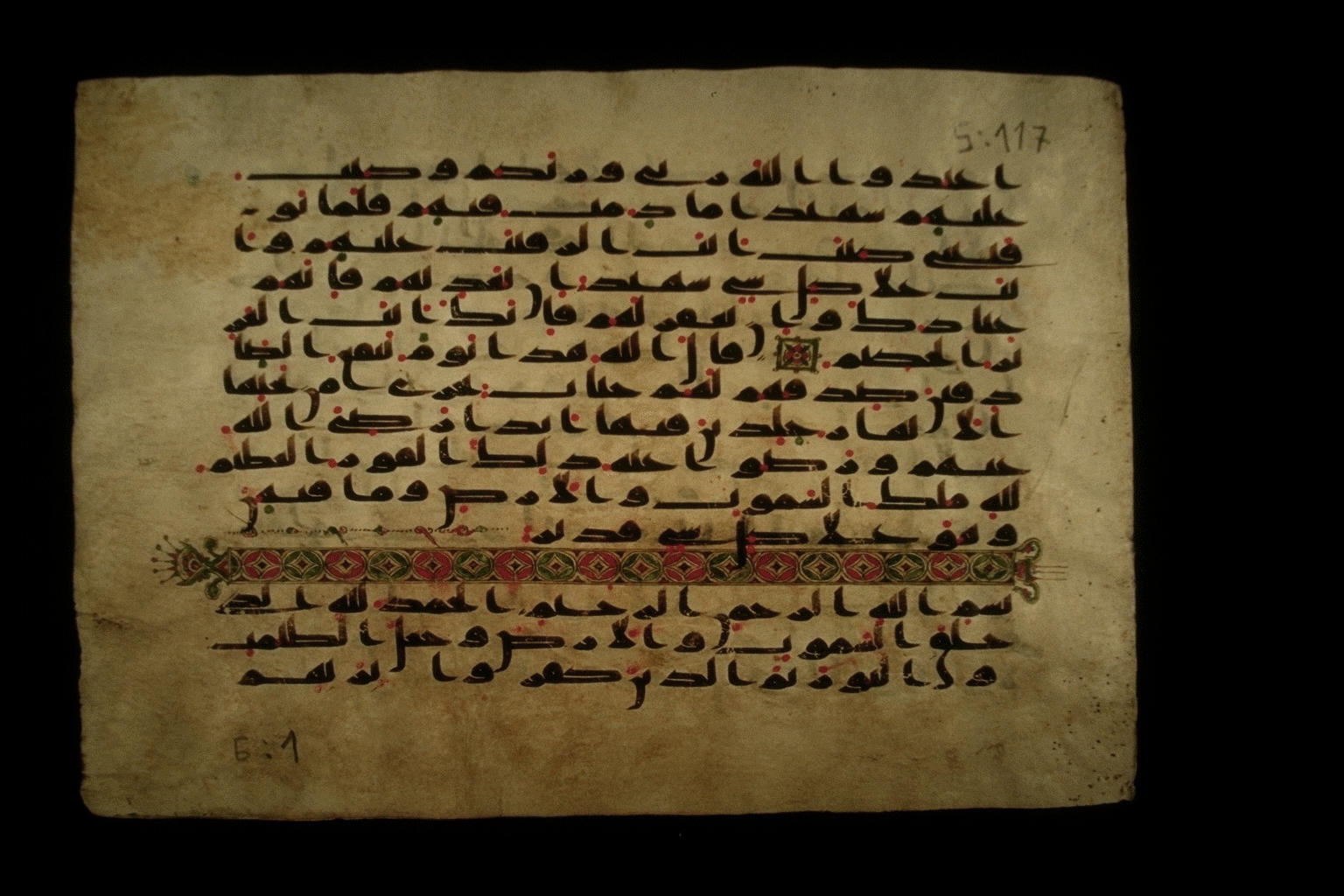
Here's essentially why I believe Luxenberg. I've shown the early quran pages to Semitic scholars (not Jews in case you're wondering) at my university, and while they can't read them smoothly, they can read them. With appropriate books, so can I (very slowly, sure). They also said that Luxenberg is right. I've also taken the same early quran page copies to an islamic scholar, freshly imported into the university, and it was blatantly obvious that he doesn't even recognize them, or the writing, despite having over 20 years of study at Al Azhar. I had to actually TELL him what it was, yet it was the thing they've supposedly been studying for 20 years. Researching the matter, it turns out to be actually true : in islamic studies you will never get to see an early islamic manuscript ...

You can imagine who I believe.

> The Aramaic (Syriac actually) word you are looking for is "Kriyana" ('reading the scriptures' or 'lesson'). The three-letter root of Qur'aan is (Qa-Ra-'a) -- to read/recite

You must realize that vowels are not written in either language, and it is not actually known what vowels were used in the period, or where they went or didn't go. Sorry to poing out the obvious but K R N ("Kriyana" in your text) would be considered identical to K R N ("quran"). Hell they did that in greek and latin for the longest time as well.

Hey wow ! I just transliterated 4 languages and 3 different alphabets there, you say it's impossible, yet it was not particularly hard. Wait we even have a global standard for doing that ...

> The Quraan's Arabic is not obtuse like that at all

https://www.google.com/search?q=quran+grammar ... half of the sites here (as does our islamic studies colleague) teach a separate form of arabic grammar called "quranic grammar", claiming that it's not possible to understand even a few lines of the book without learning the entirely different way the sentences hold together ...

https://www.google.com/search?q=quran+hard+to+read results: 8,580,000 ...

Re: If Jesus Never Called Himself God, How Did He Become One?

#28
post #22

Earlier quoted context omitted.

If it's wrong then please contribute to it and fix it. Your knowledge of this subject should be shared. Online society's attitude to Wikipedia seems to have settled into two camps; those who refer to it as an authority and those whose avoid it due to negative experiences with inaccuracies or politics. I'm trying to move from the second group to a third; patch-up articles for the benefit of other people.

I have had mostly good experiences with Wikipedia regarding technical subjects. I think this was the first topic I came across that really stuck in my mind where Wikipedia was conspicuously wrong (which I affirmed even more after doing some research). I will take your advice into consideration and attempt to amend that page. I don't know what the monitoring procedures are on wikipedia, and if they will allow such cha…

The Guerilla Skepticism on Wikipedia people may be of assistance in following the rules and making sure your edits are sufficiently scientifically skeptical. http://guerrillaskepticismonwikipedia.blogspot.com/

Re: If Jesus Never Called Himself God, How Did He Become One?

#29
post #5

>If Jesus had not been declared God by his followers, his followers would've remained a sect within Judaism — a small Jewish sect, and if that was the case it would not have attracted a large number of gentiles. It's interesting he raises that point because in Islam Jesus is considered a prophet and explicitly not God and in doing so tries to establish the argument that Judaism, Christianity and Islam are all the sam…

Bahá'ís, a more recent monotheistic world religion, similarly believe that Abraham, Moses, Jesus, Buddha, Krisha, the Báb and Bahá'u'lláh are all messengers or manifestations of God to humanity that are sent by Him at different times and in different places with a specific message, teachings and law system for the cultural evolutionary stage and needs of the society in which they appear. In this sense, these religions (and here religion means what these prophets send and not what humanity ends up doing with it) are really like different stages of one religion, one eternal process, since they all provide from God and have the same purpose. It is indeed interesting how each of the religions confirms the divinity and the truth of its predecessors and how their adherents fail to recognize the posterior prophets.

Re: If Jesus Never Called Himself God, How Did He Become One?

#30
post #27
post #26

Earlier quoted context omitted.

> That's what muslims claim. Actually reading the thing does not at all give that impression Did you read it in Arabic? Do you even speak the language? > don't immediately recognize is greek it becomes a lot easier. One really nice thing about Arabic is that you can reduce practically every word to 3 or 4 letter roots. This really makes it clear where a derivative of a word came from (including the word "Quraan" inci…

Would you consider a "beginner in islamic studies" to be the least bit scientific ? The whole study field is, by definition, prejudiced. > That being said, it is impossible to have a letter-by-letter re-write from Arabic to Aramaic by definition. It's illogical and impossible. Of course it's not. And the argument you're bringing up is laughably weak. Greek does not have the same letters as our latin script, yet trans…

> Would you consider a "beginner in islamic studies" to be the least bit scientific ? The whole study field is, by definition, prejudiced.

That was a figure of speech/hyperbole. If by the "whole study field" you mean religion in general, then I would agree to some extent.

> Hell, ever read, shall we say "teenage" arabic/sms arabic as I've seen it referred to ?

Yes, I chat with my friends in "sms" style Arabic on IM so to speak. Hmm, so you're saying Quranic Arabic is like sms style Aramaic? That's something new! Of course, the proof is on the one making the claim. Incidentally, the Arabic words I do recognize from Aramaic/Hebrew (even present day Persian since it was influenced by Arabic) sounds like broken Arabic to me :) This is because the usage of such words does not conform to Arabic conjugation rules (it's like saying, "he good today" -- as a very primitive example). Just goes to say that Arabic is more complicated.

> You must realize that vowels are not written in either language

Wrong again. Vowels ARE part of both languages. I think you might be confusing this with "taskheel", which are the "mini-vowels". That is something else though. Now, if you mean if the vowels are not part of the root of the word, then you're also wrong. Some roots do have vowels. The root you are suggesting: Q-R-N (ق ر ن) (pronounced Qa-Ra-Na, with mini-vowels, perhaps that was the source of your confusion) is a root for a different group of words than Q-R-' (ق ر ء) (pronounced Qa-Ra-'a with a glottal stop). From the former, you can derive qiran (wedding or matrimony), aqran (peers), muqaranah (comparison) and so on. From Q-R-' you can derive reading or recitation (qira'ah), and Qur'aan. Note the glottal stop in both words, this is part of the root. Again, this shows your ignorance in the language.

Take another example: from the root H-M-D (pronounced Ha-Ma-Da) (ح م د) one can derive Hamdan (حمدان) which rhymes with Qur'aan. Note how in both words, the last letter "n" is not part of the roots for either word. I'm happy to give you many more examples that show this is the case.

> Here's essentially why I believe Luxenberg...

Interesting account, but still not sufficient. I would be interested though in hearing more about it (e.g. if you wrote a report or short document with references and citations). All that you mentioned is that you took some early Quranic manuscripts and you had someone read them. Now I don't know who that Islamic scholar is, a single data point does not mean anything, and you should know better. It is incorrect that in early Islamic studies you will never see an early manuscript of the Qur'aan. Let me tell you something, we have known this since we were kids (exposed to it in school): that early Arabic script did not have dotted letters -- this is the Kufic script to which you are referring. It is not some obscure piece of information that only a handful of people know. I presume you are referring to scripts such as [0], am I correct? In any case, I would be interested to take a look at the Quranic scripts you mentioned.

Unless you formally show me at least a handful of Ayat (verses) of the Quran transliterated to Aramaic, let alone a page, let alone the entire book, while still making complete sense in Aramaic, then Luxenberg's claim really does not carry any weight. You should know better than to accept something like this without solid proof. It even says on the Wikipedia page that "That idea is in serious disagreement with the views of both traditional Muslims and western scholars of Islam"!

The Google links you mentioned really don't mean anything if you want to be "scientific" Oh look what I found here [1] 84,500,000 results! 10 times the number you listed! Of course, I won't use that argument since it does not make sense.

It is possible to understand parts of the Quran with elementary knowledge of Arabic (and I know because we studied it in grade school, middle school, and high school). It does have intricate parts, sure. The language of the Quran did play a role in converting people back when it was revealed, because it was unique -- yet still understandable.

If you really want to continue the discussion, my email address is in my profile page. Though, I would appreciate if you were to lose the attitude, and be willing to look at things in a less biased way.

[0] http://www.quran-m.com/firas/ar_photo/1263930976161291c.jpeg

[1] https://www.google.com/search?q=quran+hard+to+read#q=bible++...

Post reply on HN