Live data from Hacker News

Lock Picking – A Basic Guide

hackthis.co.uk

31–40 of 116 posts

Re: Lock Picking – A Basic Guide

#31

Can anyone explain how the pins getting "set" works? I understand there is torque applied to the entire cylinder, but once you push a pin up, why does it stay there, is it just the torque? How can you push many pins up when the torque required for each pin to become set is presumably variable?

It stay stuck on the outer frame because in the process to drill the holes on the lock frame, the alignment of them is never 100% accurate. The torque is not variable, the order that you press the pins is.

Ah OK, still a bit mysterious, but I think I get what you're saying.
Re: Lock Picking – A Basic Guide

#32
post #22
post #19

Pardon the self-promotion, but this hits a bit close to my area. If you'd like a much more comprehensive guide: http://www.youtube.com/playlist?list=PL66CD42F86F3A1F85&feat... I also cover disc detainers, and a bunch of other stuff. I'm shooting a new series on lock forensics presently, just got a great microscope that can take my DSLR for high def microscopy.

check out picked locks under an electron microscope. http://pumpingstationone.org/2013/12/lock-picking-and-sem/ you can actually tell which ones were picked.

<3 PS1. In Ollie's seminal "Impressioning" he also used SEM to look at keys as they were impressioning locks.

Re: Lock Picking – A Basic Guide

#34
post #2

I was really into this back in high school but never got proficient in it. The concept is simple to understand but actually executing it takes a LOT of practice. Raking can open a lot of older locks pretty quickly, but that doesn't mean you're skilled. Also, just owning the tools is illegal in some states.

Also, just owning the tools is illegal in some states.

Which is just completely silly. Who is going to pick the lock on somebody's house to break in? The idea of the highly-skilled locksmith cat-burglar is complete fiction.

Re: Lock Picking – A Basic Guide

#35

This is why my deadbolt uses an Abloy Protec2 cylinder (custom ordered from Bay Area Locks: http://www.bayarealocks.com ). It's drill resistant, and it's disk-based so it's bump and rake proof. Abloy also claims it's pick proof. Whether that will remain true in the future I'm not sure, but I do know that at the very least it has yet to be successfully picked. If someone did figure out a way it would likely be extreme…

What about your windows?

I've considered putting security film on them: http://www.youtube.com/watch?v=6lFCbjV7NgQ

But I rent so I hesitate because the film obviously has to be custom cut and I doubt it can be removed in a single piece after being installed anyway. I'm a little less worried about the windows though because only 1/4 of unauthorized entries are through windows, and window entry is (often) louder, more obvious, and takes a little longer to get through vs. quietly picking or bumping a lock or swiftly kicking the door in and entering quickly.

Re: Lock Picking – A Basic Guide

#36
post #11

This is why my deadbolt uses an Abloy Protec2 cylinder (custom ordered from Bay Area Locks: http://www.bayarealocks.com ). It's drill resistant, and it's disk-based so it's bump and rake proof. Abloy also claims it's pick proof. Whether that will remain true in the future I'm not sure, but I do know that at the very least it has yet to be successfully picked. If someone did figure out a way it would likely be extreme…

> After watching some videos that showed just how easy it is to simply kick a door in, another thing I did was replace my strike plate with a heavier duty one, and replace the worthless 3/4" screws that "hold" most strike plates in with 4" screws that actually go into the 2x4's of the house frame. This is good advice. I did this on my own door frame after being broken into on the first day where the door had simply b…

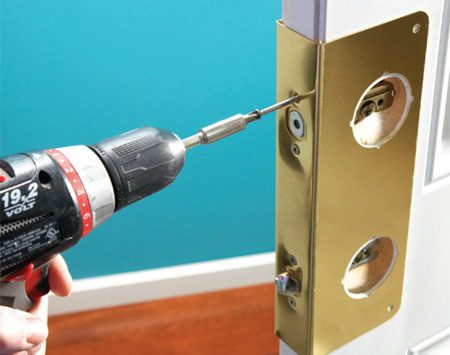
If you have a door that's not very strong and you can't afford to replace it with one that is, they do make metal plates that wrap around the deadbolt and optionally the door handle, which apparently makes it much more difficult to break the door itself.

They look something like this: http://hostedmedia.reimanpub.com/TFH/Step-By-Step/FH11JAU_DO...

Re: Lock Picking – A Basic Guide

#38
post #13

Earlier quoted context omitted.

Was Michael Jordon considered good because he beat a lot of high school kids?

If his goal was to beat high school kids and he did just that, then yes. If your goal is to pick locks and you successfully pick the locks you want to open, then you're good at picking locks. Can you be a good programmer without being the best programmer or even a world class programmer?

When did skill become a function of subjective goals?

Re: Lock Picking – A Basic Guide

#39
post #7

I taught myself how to pick locks my final year of high school - in France, high school students have to take the "baccalauréat", a set of exams that cover everything you've studied in high school, in all subjects. It spans the course of 2 weeks or so, and you get 1 week to prepare before it. I hadn't been doing so hot in high school (writing assembly for my TI-83's z80 was more fun than reading Shakespeare and doing…

A lot less glorious but in junior high school, some old ATX computer cases had a keylock connected to the motherboard, with BIOS support it would stop before bootloading. Being locked out of the computer being the best motivation, I dared to open and disconnect the wires and ran the computer innocently, after all, I never took the keys so it looked an error on my parents side.

Re: Lock Picking – A Basic Guide

#40

Can anyone explain how the pins getting "set" works? I understand there is torque applied to the entire cylinder, but once you push a pin up, why does it stay there, is it just the torque? How can you push many pins up when the torque required for each pin to become set is presumably variable?

It catches on the shelf of the pin chamber. Every time you set a pin, the plug actually rotates ever so slightly, misaligning the upper and lower pin chambers of whatever pin you were working on. The driver pin can't return to the lower chamber, and now you are putting pressure on another pin. Find that one, lift up, plug rotates, it sits on the shelf, next pin binds, and so on and so forth.
Post reply on HN