Live data from Hacker News

Isaac Asimov Predicts in 1964 What the World Will Look Like in 2014

openculture.com

41–50 of 120 posts

Re: Isaac Asimov Predicts in 1964 What the World Will Look Like in 2014

#41
post #40

One of the funny things is the video-phone. The technology is there for years, and we can't really say we don't do it at all - we do it sometimes. But mostly we don't - not because technology is not there but because it turned out it's not that great an idea after all. Turns out in most of the situations we don't actually need the video and voice only is good enough. It is fascinating how many people didn't think it…

I didn't realize at first that we had basically accomplished video-phones via Skype, Hangouts, and the internet. Seeing video chat was not very surprising for me, perhaps because it was such an obvious extension of the internet. It's funny how something that I had dreamed of as a kid, and always imagined as a dedicated hardware unit, became completely trivialized and overshadowed by the internet.
Re: Isaac Asimov Predicts in 1964 What the World Will Look Like in 2014

#42
"There will be aircraft, of course, but even ground travel will increasingly take to the air a foot or two off the ground."

Curious as to why there is such an obsession with hovering vehicles in pop culture depictions in the future. It seems cool but that it would be inefficient even if we did develop it. (Using a crapload of power to suspend a heavy vehicle when it could be sitting on the ground just doesn't make much sense to me.)

Re: Isaac Asimov Predicts in 1964 What the World Will Look Like in 2014

#43

Note that this article is a lightweight edit of Asimov's original piece: http://www.nytimes.com/books/97/03/23/lifetimes/asi-v-fair.h... In particular, the article is edited to only show you reasonable predictions, rather than all his predictions. I thought his mistakes were just as interesting, because they give us a window into what life was like in 1964. Asimov predicted that moon colonies would be common by now,…

The world growth rate has slowed down some since the 60s, largely due to the economic modernizations someone mentioned earlier. The current doubling time is roughly 50 years - http://www.globalchange.umich.edu/globalchange2/current/lect...

As you can see here - http://www.zetterberg.org/Lectures/l96bTab/doubling.htm. More industrialized regions have slower growth rates. Africa will double in just over 20 years while North America will double after over 100 years, for example.

Many countries, like japan and Italy are finding their population is actually shrinking, this tends to be bad for economic reasons. The US gets a lot of population growth from immigrants which keeps the country growing despite having only about 2.0 children per family (2.1 is optimal for maintaining a steady population.)

Re: Isaac Asimov Predicts in 1964 What the World Will Look Like in 2014

#44

I found this one funny: “Ordinary agriculture will keep up with great difficulty and there will be ‘farms’ turning to the more efficient micro-organisms. Processed yeast and algae products will be available in a variety of flavors.” Reminds me of Soylent Green (wasn't the original Soylent in the movie supposed to be processed algae?)

Not in the movie, in the book ('Make Room! Make Room!') by Harry Harrison which inspired the movie

Re: Isaac Asimov Predicts in 1964 What the World Will Look Like in 2014

#45
post #40

One of the funny things is the video-phone. The technology is there for years, and we can't really say we don't do it at all - we do it sometimes. But mostly we don't - not because technology is not there but because it turned out it's not that great an idea after all. Turns out in most of the situations we don't actually need the video and voice only is good enough. It is fascinating how many people didn't think it…

Infinite Jest actually covers this topic in a really comical way. The author talks about how people dislike the way they look on the video phones and therefore begin to wear masks that look like made-up versions of themselves. Eventually, they start putting up little pictures of themselves instead of actually attending to the video call, and video phones basically return to voice phones with a picture.

Re: Isaac Asimov Predicts in 1964 What the World Will Look Like in 2014

#47

"There will be aircraft, of course, but even ground travel will increasingly take to the air a foot or two off the ground." Curious as to why there is such an obsession with hovering vehicles in pop culture depictions in the future. It seems cool but that it would be inefficient even if we did develop it. (Using a crapload of power to suspend a heavy vehicle when it could be sitting on the ground just doesn't make mu…

Well, we do have maglev trains such as the ones in Shanghai. I could be wrong but I think the main benefit is the vehicle doesn't need to overcome rolling resistance, making it easier to accelerate and allowing faster travel.

Re: Isaac Asimov Predicts in 1964 What the World Will Look Like in 2014

#48
post #4

I like this one: “The appliances of 2014 will have no electric cords, of course, for they will be powered by long- lived batteries running on radioisotopes.”

I found that one particularly interesting, as That was a core theme of his "Foundation" novels. Those who were able to gadgetize nuclear energy were at a distinct advantage over others.

Not RTG-based, but still a seriously proposed concept https://en.wikipedia.org/wiki/Ford_Nucleon

Re: Isaac Asimov Predicts in 1964 What the World Will Look Like in 2014

#49
post #25

Note that this article is a lightweight edit of Asimov's original piece: http://www.nytimes.com/books/97/03/23/lifetimes/asi-v-fair.h... In particular, the article is edited to only show you reasonable predictions, rather than all his predictions. I thought his mistakes were just as interesting, because they give us a window into what life was like in 1964. Asimov predicted that moon colonies would be common by now,…

I'm of the opinion that SF is a poor place to look for predictions about the future, and that it is primarily about the present it's written in, a playground for changing the fundamental assumptions of that mundane present. But this one interests me: Mankind will therefore have become largely a race of machine tenders. I think, by and large, this is true in western society. We, here on this site, mostly tend to machi…

Funny though how your language makes the "non-machine tender" positions sound very robotic and machine-like: binmen, shelf-stackers, mailmen.

All sound like roles easily ascribed to machines. In fact, my garbage man is a truck driven which has a giant hydrolic hand which grabs the bin and dumps it into the truck. The driver has to minimally tend to the mechanical arm only when the bin needs a slight relocation (moved away from a different class of bin) to allow his arm to grab the right bin.

Re: Isaac Asimov Predicts in 1964 What the World Will Look Like in 2014

#50

Note that this article is a lightweight edit of Asimov's original piece: http://www.nytimes.com/books/97/03/23/lifetimes/asi-v-fair.h... In particular, the article is edited to only show you reasonable predictions, rather than all his predictions. I thought his mistakes were just as interesting, because they give us a window into what life was like in 1964. Asimov predicted that moon colonies would be common by now,…

The world growth rate has slowed down some since the 60s, largely due to the economic modernizations someone mentioned earlier. The current doubling time is roughly 50 years - http://www.globalchange.umich.edu/globalchange2/current/lect... As you can see here - http://www.zetterberg.org/Lectures/l96bTab/doubling.htm . More industrialized regions have slower growth rates. Africa will double in just over 20 years while…

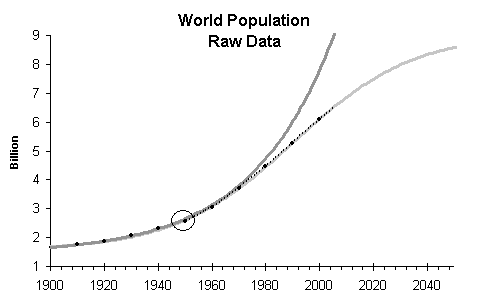
Asimov was working off a population model proposed by Malthus in 1798 [0], which has long been known to be flawed. It's not just industrial human populations that have slowing growth rates; most populations creatures have slowing growth rates as they near the population level the environment supports. The most common model for this is called "logistic growth" [1].

The "current doubling time" is kind of a misnomer -- it's how long it would take the population to double given the current growth rate, but the rate itself is also shrinking. Human population growth reached its peak (percentage-wise) in the early 1960s [2] and most credible estimates now have the world population leveling off in the 9-12 billion range (less than a full doubling from current levels) [3].

[0] http://en.wikipedia.org/wiki/An_Essay_on_the_Principle_of_Po...

[1] http://en.wikipedia.org/wiki/Logistic_function#In_ecology:_m... -- note that some populations follow very different trajectories in special circumstances. The Kaibab Deer are a rather tragic example: http://depts.alverno.edu/nsmt/youngcc/research/kaibab/story3...

[2] http://en.wikipedia.org/wiki/Population_growth#Human_populat... - see also http://www.growth-dynamics.com/articles/Kurzweil_files/image... , which is taken from the article http://www.growth-dynamics.com/articles/Kurzweil.htm

[3] http://en.wikipedia.org/wiki/Projections_of_population_growt...

Post reply on HN