Live data from Hacker News

The Moore's Law blowout sale is ending

itworld.com

21–30 of 44 posts

Re: The Moore's Law blowout sale is ending

#21

Whenever I'm wondering if Moore's law is still prevailing as a trailing indicator, I check out: http://www.top500.org/statistics/perfdevel/ If that (logarithmic) chart starts to flatten - particularly for device #500 (more price sensitive than the first part of the list) on the list, then we're running into real obstacles. Let's check back in 2020 and see if Device #500 is running at 10 Petaflops.

Most (all?) of those machines are clusters that scale mostly by throwing in nodes. Even if you have completely static technology, you'll see an exponential trend as long as you're scaling with economic growth by adding nodes.

But supercomputer customers' budgets aren't unlimited. If chips no longer get cheaper at some point they probably won't be able to afford more nodes.
Re: The Moore's Law blowout sale is ending

#23
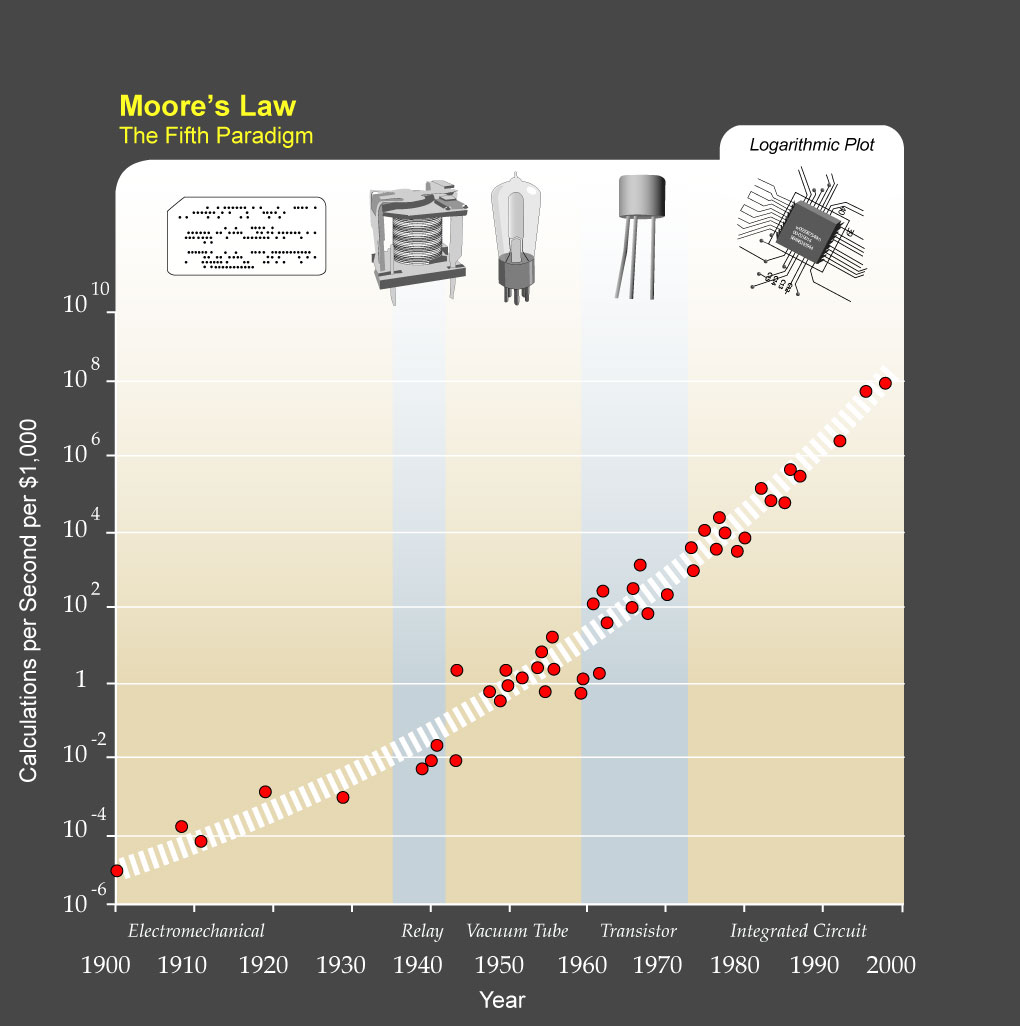
I like Kurzweil's backtrapolation over non-transistor computing hardware [jpg] http://upload.wikimedia.org/wikipedia/commons/c/c5/PPTMoores... (IC, transistor, tube, relay, mechanical)

His future predictions can be fanciful, but his data from the past is solid. He thinks it could be nanotubes next. But it seems fair to say it could be as surprising to us as vacuum tubes were to people using relays...

Re: The Moore's Law blowout sale is ending

#24
post #7

I don't see this as a major problem since my nearly 4 year old computer is still working fine for most of my computing needs. Computer chips are so powerful now that they don't use a lot more than older computers didn't use.

Hmm, consider that you haven't spent any money on a computer in 4 years. Look at the 'health' of the computer companies like HP, Dell, Acer, etc. The problem here is a bit more insidious than you might assume at first glance. The reason you can buy a motherboard for $100 which has close to a thousand individual components soldered to a 16 layer board is because a manufacturer invested tens of millions of dollars in a…

Except, were computers to stop improving, you could sell the same model for a longer time period and maintain the economy of scale.

Re: The Moore's Law blowout sale is ending

#25
Can somebody explain how and why this will hurt consumers like me? As long as I can still buy some general purpose computing device with 2013 desktop performance that I can plug a screen and keyboard into and run/write software the end of the upgrade treadmill seems pretty welcome. Am I missing something?

Re: The Moore's Law blowout sale is ending

#26
post #25

Can somebody explain how and why this will hurt consumers like me? As long as I can still buy some general purpose computing device with 2013 desktop performance that I can plug a screen and keyboard into and run/write software the end of the upgrade treadmill seems pretty welcome. Am I missing something?

Yes - that the progress so far has allowed other form factors like smartphones. If it continues, it may open up new possibilities as well that wouldn't be feasible with the current level of chip technology.

Re: The Moore's Law blowout sale is ending

#28
Hopefully the end of cost-effective process shrinks will mean programmers start cleaning up the mess of hugely inefficient everyday software.

The party may be winding down for full x86-64 cores, but there's still some room for improvement by increasing efficiency of instructions on those cores and adding new instructions for common tasks (like hashing acceleration instructions, sse9000, etc). Intel already does that with each new processor family.

There's a large one-time improvement available for computation-heavy workloads by integrating many simpler high-performance low-power cores into everyday machines (like the epiphany architecture: http://www.adapteva.com/). Intel seems to think only servers will go that route (Xeon Phi), but I don't know about that.

Re: The Moore's Law blowout sale is ending

#30

Hopefully the end of cost-effective process shrinks will mean programmers start cleaning up the mess of hugely inefficient everyday software. The party may be winding down for full x86-64 cores, but there's still some room for improvement by increasing efficiency of instructions on those cores and adding new instructions for common tasks (like hashing acceleration instructions, sse9000, etc). Intel already does that…

> start cleaning up the mess of hugely inefficient everyday software

I kind of wish for it too. Mainly because it's so enjoyable and fun to spend hours on really groking the code and optimizing it instead of duct taping another feature at the top of similarly messy pile of other features.

Things like Go, D, Nimrod, Felix, OCaml and Haskell could help too.

That said I don't see this happening in the near future: for business side of things optimization starts to matter when it's too late to change technology. What's probably going to happen is one-click, transparent (for the application logic) clusters, where performance issues are solved by adding nodes. It happens right now with AWS and others, but it will be much easier and better in the future, once again making optimization not needed. For a while.

Post reply on HN