Live data from Hacker News

Falcon 9 GEO Transfer Mission

spacex.com

61–70 of 74 posts

Re: Falcon 9 GEO Transfer Mission

#61

Thanks for submitting this now rather than 15 minutes from now! Moments like these are historic, and it's wonderful to experience this in realtime rather than watching a replay. T minus 10min. Go SpaceX! EDIT: It's impressive they were able to abort safely after ignition. That's historically rare, isn't it?

Space Shuttles ignited the liquid-fueled engines several seconds before liftoff, and I believe there were several launch aborts after ignition:

http://www.airspacemag.com/space-exploration/abort.html

I don't recall that happening with the Saturn V or other early rockets, apart from the accident Crito mentioned.
Re: Falcon 9 GEO Transfer Mission

#62

Thanks for submitting this now rather than 15 minutes from now! Moments like these are historic, and it's wonderful to experience this in realtime rather than watching a replay. T minus 10min. Go SpaceX! EDIT: It's impressive they were able to abort safely after ignition. That's historically rare, isn't it?

Space Shuttles ignited the liquid-fueled engines several seconds before liftoff, and I believe there were several launch aborts after ignition: http://www.airspacemag.com/space-exploration/abort.html I don't recall that happening with the Saturn V or other early rockets, apart from the accident Crito mentioned.

Gemini 6A also aborted after engine ignition. The astronauts climbed out, the engineers found the problem, and they launched successfully three days later.

Liquid-fueled engines are inherently restartable. Otherwise, you wouldn't be able to test an engine without throwing it away afterwards.

Sometimes manual intervention is required, though. For example, the starter cartridge on the Titan was a consumable part, and had to be replaced before restarting the engine.

Re: Falcon 9 GEO Transfer Mission

#64

Earlier quoted context omitted.

They say that after every failure. It's part of the abort sequence that they confirm - not necessarily the cause of the abort.

Sure, but in this case it was the actual flight computer that aborted the launch. No human had a part in it :)

Oh I see what you're saying. That's cool!

Re: Falcon 9 GEO Transfer Mission

#67

Earlier quoted context omitted.

At T+0, the flight computer ignites the engines, but the vehicle doesn't liftoff yet. Instead, it is held down for two seconds while the flight computer verifies that all engines are working correctly (to prevent blowing up both the vehicle and everything in its surroundings). It seems that the checks failed here and the flight computer aborted launch at T+00:01.

if enginesOperational { // TODO(rocketman): Remove this before the actual launch panic("bail out for testing") }

I imagined this in William Shatner's voice.

Re: Falcon 9 GEO Transfer Mission

#68
post #44

Earlier quoted context omitted.

If you watch some of the video footage from Saturn V launches you see some fairly large sheets of ice. Quite impressive scale compared to this!

The super slow motion footage is fantastic : http://www.youtube.com/watch?v=_HcnmthntUo

This version has an interesting commentary instead of silly music:

http://www.youtube.com/watch?v=vPW7ZqtW5U4

The footage is indeed amazing though.

Re: Falcon 9 GEO Transfer Mission

#69
post #44

Earlier quoted context omitted.

The super slow motion footage is fantastic : http://www.youtube.com/watch?v=_HcnmthntUo

This version has an interesting commentary instead of silly music: http://www.youtube.com/watch?v=vPW7ZqtW5U4 The footage is indeed amazing though.

http://www.nasa.gov/audience/foreducators/rocketry/home/what...

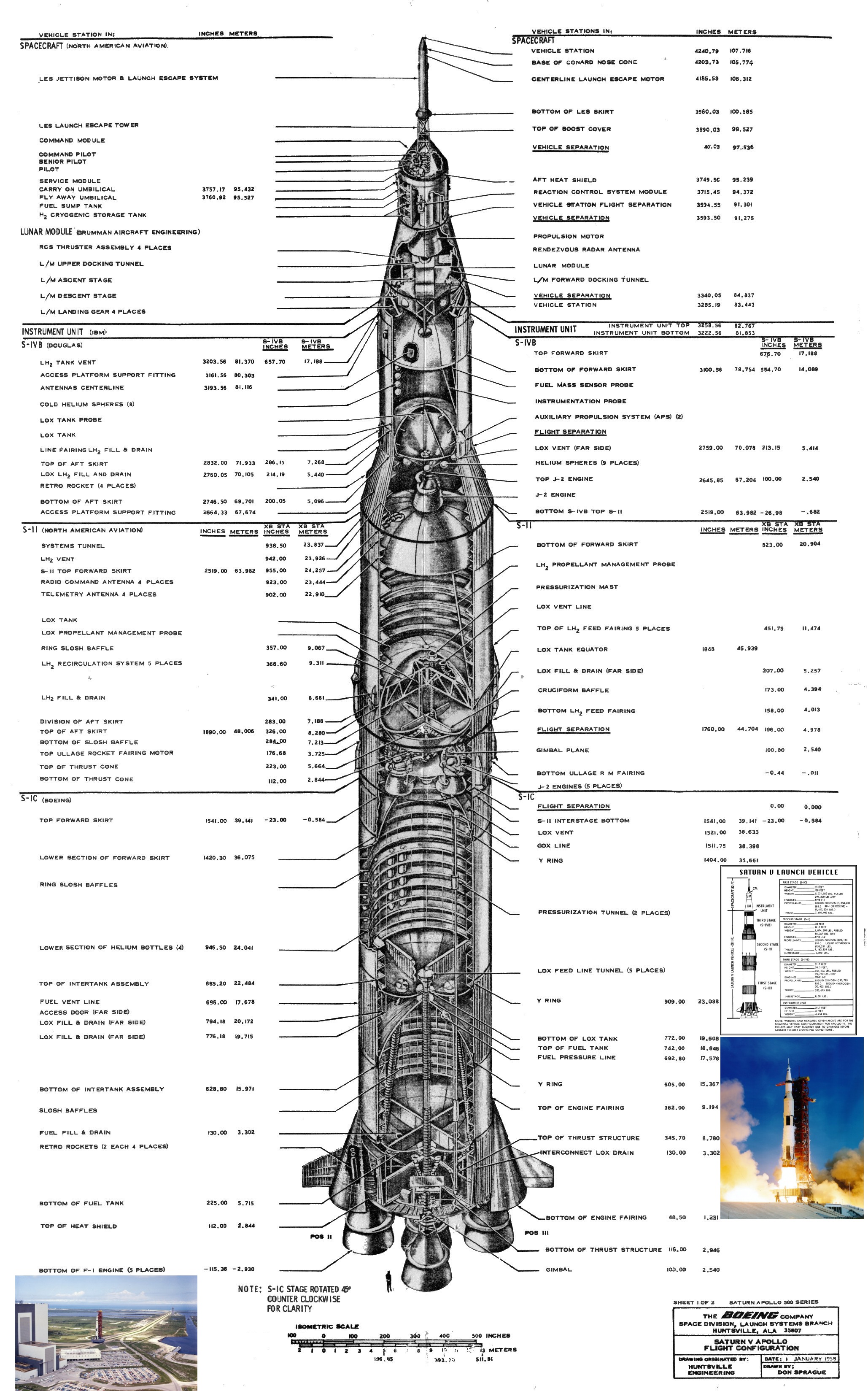
> The Saturn V rocket was 111 meters (363 feet) tall, about the height of a 36-story-tall building, and 18 meters (60 feet) taller than the Statue of Liberty. Fully fueled for liftoff, the Saturn V weighed 2.8 million kilograms (6.2 million pounds), the weight of about 400 elephants. The rocket generated 34.5 million newtons (7.6 million pounds) of thrust at launch, creating more power than 85 Hoover Dams. A car that gets 48 kilometers (30 miles) to the gallon could drive around the world around 800 times with the amount of fuel the Saturn V used for a lunar landing mission. It could launch about 118,000 kilograms (130 tons) into Earth orbit. That's about as much weight as 10 school buses. The Saturn V could launch about 43,500 kilograms (50 tons) to the moon. That's about the same as four school buses.

To get some rough idea of scale, this blueprint shows a person near the engine / nozzle / thing.

http://jleslie48.com/0206pr/saturn5allclean2.jpg

Re: Falcon 9 GEO Transfer Mission

#70

Just love to see things like this. Makes me wonder what it was like to look at those huge rockets for the apollo missions...

I was eight, and it was awesome. And I don't mean the kind of "awesome" people use these days when they find out the fries don't cost extra; I mean the "inspiring actual jaw-dropping awe" kind we used back then. Scale made no sense; it was huge in ways that rockets (who hasn't fired a rocket of some kind as a kid?) shouldn't be, and your brain told you that it wasn't up to walking speed yet when it cleared the tower, so it was definitely coming back down any second now. Unfortunately, the best I could come up with at the time was "ho... ly... cow!!!"
Post reply on HN