If you like this then you'll probably enjoy the visualizations on this site[0].
Ulam spiral
11–20 of 28 posts
Re: Ulam spiral
#12Another perhaps surprising aspect, to me at least, is the apparent uniformity of the density of prime numbers in the plane. It's my understanding that the density of the prime numbers decreases as you go higher [1], so why does the plane look so uniformly covered? [1] http://en.wikipedia.org/wiki/Prime_number_theorem
The density of primes is 1/log(n), so it does drop off, but not so fast that it would be obvious for small numbers.
I tried creating giant Ulam spirals one time, and I did correct for this, which made it look a lot more uniform.
I had initially hoped to find new patterns this way, but nothing turned up. While numerical experiments are fun, there are a huge number of potential avenues that could be explored. Finding the interesting ones is basically what mathematics is.
Re: Ulam spiral
#13Another perhaps surprising aspect, to me at least, is the apparent uniformity of the density of prime numbers in the plane. It's my understanding that the density of the prime numbers decreases as you go higher [1], so why does the plane look so uniformly covered? [1] http://en.wikipedia.org/wiki/Prime_number_theorem
The density of primes is 1/log(n), so it does drop off, but not so fast that it would be obvious for small numbers. I tried creating giant Ulam spirals one time, and I did correct for this, which made it look a lot more uniform. I had initially hoped to find new patterns this way, but nothing turned up. While numerical experiments are fun, there are a huge number of potential avenues that could be explored. Finding t…
How did you correct for it? Did you just nonlinearly scale the final picture or did you scale the axis on the spiral itself and then sampled the result?
Re: Ulam spiral
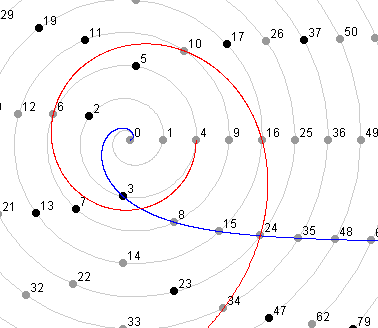
#14If you like this then you'll probably enjoy the visualizations on this site[0]. [0] http://www.numberspiral.com
Wow, those are pretty cool. Page 8 with the factor curves look really interesting.
Re: Ulam spiral
#15Earlier quoted context omitted.
The density of primes is 1/log(n), so it does drop off, but not so fast that it would be obvious for small numbers. I tried creating giant Ulam spirals one time, and I did correct for this, which made it look a lot more uniform. I had initially hoped to find new patterns this way, but nothing turned up. While numerical experiments are fun, there are a huge number of potential avenues that could be explored. Finding t…
How did you correct for it? Did you just nonlinearly scale the final picture or did you scale the axis on the spiral itself and then sampled the result?
I was producing grey scale images where each pixel represented a block of numbers. The count in each block was divided by the density of primes (1/log(n)) at the center of the block.
However, this actually made the middle turn grey, because even though the mean value of each pixel was the same, the variance wasn't. So then I corrected for this by calculating a "z-score" instead.
But like I mentioned before, it didn't turn up any interesting patterns.
Re: Ulam spiral
#16Stanislav Ulam is an incredible man. Mathematician (Ulam Spiral, Monte Carlo Method), Manhattan Project participant, and part-time astronomer who devised a method for nuclear-explosive-powered space travel [0]. [0]: http://en.wikipedia.org/wiki/Nuclear_pulse_propulsion
It's Stanislaw, since he was Polish, Stanislav would be a Russian name. He is most importantly the co-inventor of the hydrogen bomb:
http://en.wikipedia.org/wiki/Thermonuclear_weapon
There is a great autobiography by him called "Adventures of Mathematician".
Re: Ulam spiral
#17Basic explanataion: http://www.youtube.com/watch?v=iFuR97YcSLM
BTW, these guys really love numbers and math, it's fun to watch their enjoyment while explaining things like an Ulam spiral. And I think he's on crack or something.
Re: Ulam spiral
#18Here's a visualizer for the Ulam Spiral, Triangular, Pentagonal, Hilbert Curve, and many more.
You can also visualize {2-5}-factor primes, superperfect numbers, smooth numbers...
Re: Ulam spiral
#19Stanislav Ulam is an incredible man. Mathematician (Ulam Spiral, Monte Carlo Method), Manhattan Project participant, and part-time astronomer who devised a method for nuclear-explosive-powered space travel [0]. [0]: http://en.wikipedia.org/wiki/Nuclear_pulse_propulsion
It's Stanislaw, since he was Polish, Stanislav would be a Russian name. He is most importantly the co-inventor of the hydrogen bomb: http://en.wikipedia.org/wiki/Thermonuclear_weapon There is a great autobiography by him called "Adventures of Mathematician".
Agreed, linking through Stanislaw Ulam turned out to be evermore interesting, even though the Ulam Spriral itself is a good starting point, given its relevance to the field of programming.
Re: Ulam spiral
#20Stanislav Ulam is an incredible man. Mathematician (Ulam Spiral, Monte Carlo Method), Manhattan Project participant, and part-time astronomer who devised a method for nuclear-explosive-powered space travel [0]. [0]: http://en.wikipedia.org/wiki/Nuclear_pulse_propulsion
It's Stanislaw, since he was Polish, Stanislav would be a Russian name. He is most importantly the co-inventor of the hydrogen bomb: http://en.wikipedia.org/wiki/Thermonuclear_weapon There is a great autobiography by him called "Adventures of Mathematician".
> There is a great autobiography by him called "Adventures of Mathematician".
A terrific book, still available but pricey (ca. $30 for a paperback). I have a dog-eared copy acquired 40 years ago in my library.
The closest Ulam comes to revealing atomic secrets in his book is to say the method he and Teller chose to produce a thermonuclear reaction requires the "repetition of certain arrangements." I always thought that was the perfection of obscurity.