Live data from Hacker News

How traffic actually works

jliszka.github.io

111–120 of 186 posts

Re: How traffic actually works

#111

Earlier quoted context omitted.

re spinning up a new lane: the A38-M Aston Expressway into Birmingham, UK dynamically multiplexes its lanes together into variable width channels depending on the required upstream/downstream bandwidth :) - http://i3.birminghammail.co.uk/incoming/article1294911.ece/A...

aww hell no. I'd be terrified of merging into that lane with no highway divider between me and oncoming traffic. Small two lane highways are bad enough! :P

Most of the time, there's an empty lane as a separator. When it is used, they don't allow motorbikes in it just in case, but it's really no worse than a two-lane undivided road.

It's also not necessary for you to use that lane if you don't want to -- it doesn't go anywhere special :).

Re: How traffic actually works

#112
post #86

This article is so horribly incorrect and fails right at the very beginning with the wrong assumptions and a idea that isn't thought through. What the author forgot is to take by far the most important variable into account: SPEED So let's quote the author: "The important fact: there is a limit to the number of cars that can pass by a given point on the highway in a given amount of time, and that limit is one car eve…

> You can see on the right side how his "cars per second" is _exactly the same_ than on the left side.

Yes, but there are way more cars on the left side. That is the difference. Occupancy (density) determines speed when flow rate is fixed, and that graphic is actually a perfect illustration of this. You can't make the cars on the left travel at 80mph because it would not allow for a safe following distance.

One thing that is the same on both sides is that if you're the nth car back from the merge, it's going to take 2n seconds for you to get to the merge. Yes, the important thing is how many miles you can cover in that time, but this way of thinking places an upper limit on how many miles that can be, based on the occupancy of the road.

Also, pretty sure the advice at the end was tongue-in-cheek ;)

Re: How traffic actually works

#113
post #51

What an arrogant article. How can you title something 'How traffic actually works' when you don't examine actual traffic. Instead, make up a simple model, run some code, claim it shows what you want. It's not like modelling traffic is so insanely hard that we need such simplistic models. Pick as complex a model as you like; we have the computing power to simulate it!

He's derived the fundamental diagram of traffic flow: https://en.wikipedia.org/wiki/Fundamental_diagram_of_traffic... . Up next: why F = ma really, really matters for space launches. Experts don't know this!

"1 weird trick for successful space flight"

Re: How traffic actually works

#114
post #86

This article is so horribly incorrect and fails right at the very beginning with the wrong assumptions and a idea that isn't thought through. What the author forgot is to take by far the most important variable into account: SPEED So let's quote the author: "The important fact: there is a limit to the number of cars that can pass by a given point on the highway in a given amount of time, and that limit is one car eve…

Leaving space does not increase the average speed, because the average speed is dictated by the MAXIMUM speed in addition to the number of cars on the road.

--

First we must assume we live in the 3rd dimension of a physical realm, wherein objects like cars cannot pass through other objects. Cars can not drive through other cars, thus, if one car stops or slows down, all cars behind it stop or slow down.

Second, 5000 cars cannot travel 65mph over one mile of road, because it is physically impossible to fit 5000 cars inside a one lane 1-mile stretch of road. This is the bottleneck that causes the initial traffic jam.

In order to get all 5000 cars to travel the distance of a mile in the same TIME as 1 car, your only option is to increase their speed. But our speed is limited (by the speed limit of the road), so the only thing we can do is squish them together and hope for as fast a speed as possible given the dimensions.

If all the cars were linked and communicated in unison, they could react immediately and maintain a high degree of coordination in moving around each other and traveling as fast as the number of cars and speed limit will allow over a given area. Unfortunately, humans suck ass at driving, and their communication and latency make the movements of cars much much slower than is theoretically possible.

--

So what does "leaving space" actually do within our constraints of number of cars and max mph? It smooths out the errors humans make in driving. Specifically, it adds a time buffer for communication and decision-making; more time is given to driving decisions in order to prevent unnecessary stops, which would slow or stop the cars behind it.

What "leaving space" does NOT do is change the laws of our physical world. The given number of cars still have a maximum possible speed in a given distance, due to the traffic laws and physics.

Is it possible that the buffering from leaving space in the road will cause traffic to actually move faster than the starting-and-stopping of human error? Yes.

But it also uses up additional space, which is equivalent to more cars on the road, which as we know from above means a lower speed to travel the same distance.

--

You can not get away from it - until you reduce the number of cars or increase the max speed, your traffic jams will remain.

As for my personal opinion, I believe the one thing that could reduce traffic slowness is to speed up merges. If you want to help a traffic jam, merge at a speed faster than the cars around you and accelerate away from the merge area. It won't permit more cars on the road, but if a car is going 45mph and you move in front of it going 35mph, physics only allows for two results: the car behind you will hit you, or the car and all the cars behind it will have to slow down to 35mph.

The other thing that could be done is sensors in the road could detect the level of traffic (number of cars) and provide on a digital display the maximum speed humans could manage for that many cars on the road. If all cars then traveled at that speed, we would slowly but at a continuous pace travel down the highway without any stops. Until the first asshole that merges slower than that speed, which would make everyone slow down to his speed, defeating the whole thing....
Re: How traffic actually works

#115
This article accounts for some of what causes traffic jams, but have a look at this video. It shows a study done where people tried to drive on a circular track at a constant speed.

Things start out okay, but it quickly devolves into the back propagating wave.

http://www.youtube.com/watch?v=Suugn-p5C1M

Re: How traffic actually works

#116
post #96

Earlier quoted context omitted.

If you want to prevent people from jumping the gap, speed up. If you want to be safe from random edge cases (like someone in front of you slamming on the brakes), slow down.

I'd leave at least a minimum safe distance between my vehicle and the one in front. But Parent suggested that it's a good idea to leave more space in case someone jumps in. I'm not sure I understand that - if they jump in it's always dangerous because you don't know what the person behind you is going to do and you don't know when the jumper is going to jump in. Thus, you want to try to prevent them jumping. This is…

In every case, if you can't predict what people around you are going to do, it's better to leave more space in front. If the guy behind you is following closely and might rear-end you, leave more space so that you can slow down gradually, instead of slamming the brakes and inviting collision. If the car ahead of you might have to slam on the brakes, leave enough space that you can slow down gradually.

If someone in the lane beside you might cut in front of you, leave more space so that you can see them making their move and react in time. That reaction might be to speed up and prevent them before they change lanes, or to slow down and let them in, but in either case, leaving more space is a better idea than tailgating.

Re: How traffic actually works

#117
post #86

This article is so horribly incorrect and fails right at the very beginning with the wrong assumptions and a idea that isn't thought through. What the author forgot is to take by far the most important variable into account: SPEED So let's quote the author: "The important fact: there is a limit to the number of cars that can pass by a given point on the highway in a given amount of time, and that limit is one car eve…

Leaving space does not increase the average speed, because the average speed is dictated by the MAXIMUM speed in addition to the number of cars on the road. -- First we must assume we live in the 3rd dimension of a physical realm, wherein objects like cars cannot pass through other objects. Cars can not drive through other cars, thus, if one car stops or slows down, all cars behind it stop or slow down. Second, 5000…

Agreed 100%

I'm sorry if my post was confusing. I didn't really mean to go to infinity with my theory. I really only wanted to point out the flaws of the article. I didn't mean to say that traffic jams can be avoided. I simply disagree heavily with the author and agree with what's been out there in traffic theory for decades. Part of what you described well in your post!

Again, I'm not suggesting anything radical or want to emerge a new theory. The existing ones are good. I'm just trying to point out flaws from the OP.

Re: How traffic actually works

#118
post #86

This article is so horribly incorrect and fails right at the very beginning with the wrong assumptions and a idea that isn't thought through. What the author forgot is to take by far the most important variable into account: SPEED So let's quote the author: "The important fact: there is a limit to the number of cars that can pass by a given point on the highway in a given amount of time, and that limit is one car eve…

> You can see on the right side how his "cars per second" is _exactly the same_ than on the left side. Yes, but there are way more cars on the left side. That is the difference. Occupancy (density) determines speed when flow rate is fixed, and that graphic is actually a perfect illustration of this. You can't make the cars on the left travel at 80mph because it would not allow for a safe following distance. One thing…

I'm sorry for the harsh critique. I think new radical ideas are great and people should question everything that's out there. But this way was not thought out well enough IMO.

I hope you keep it up and maybe have a follow up post where you can fix some of the flaws.

Some of your ideas are correct and noble. But always remember to take into account the real world driver and his/her behavioral flaws.

Few thoughts: Interesting would be a stochastic behavior model of drivers + driving strategies and in connection with red lights, accidents, rush hour to see what happens. Thought, that model would be quite some work in python.

Cheers

Re: How traffic actually works

#119
post #97

The article claims that the maximum theoretical throughput for traffic per lane is 2,400 vehicles per hour. What if every vehicle is separated by 2 seconds of stopping time, but all vehicles are moving at the exact same speed of 200 Miles per hour? It would take one vehicle 0.005 hours to cover a mile (5,280 feet). Assuming each car had a length of 10 feet, it would take 0.005/528 = 0.0000095 hours for a vehicle to c…

Hmm? This shouldn't be surprising at all given the rather large assumption that one car passes a fixed point each two seconds. Go as fast as you like... an observer on the roadside must still wait two seconds for each car to rocket (or crawl) by. Imagine having an ethernet card that could only send one frame a second to a party on the other side of the globe: would you care if the additional network latency due to sw…

Yes, that seems to be the only possible metric we can reduce to increase the flow of traffic.

Cut that number in half from 2 to 1 seconds, and you would approximately double your throughput.

Re: How traffic actually works

#120
post #77

Earlier quoted context omitted.

He utterly fails to make that point. His simple model explains the idea of maximum throughput / congestion. It utterly fails to explain the extreme variance in real traffic throughput during congestion. The original article does.

OP here. That's a really good point. I just think the original article overreached in saying that zipper merging is a "simple cure" for traffic jams, without taking into account that the road might at or near capacity (and you hit capacity in a hurry when you lose a lane). My article doesn't account for variance in flow rates in congested traffic, but variance in car length (% of trucks on the road) might explain it.…

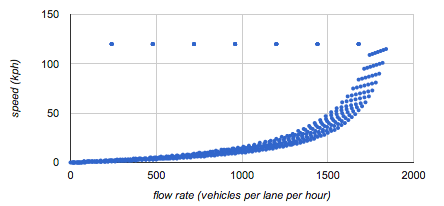
FWIW I tried this out, seeing what happens when there are varying average car lengths on the road.

http://jliszka.github.io/assets/img/traffic/speed-vs-occupan... http://localhost:4000/assets/img/traffic/flow-vs-occupancy-2...

Also added as an update to the article.

Post reply on HN