Earlier quoted context omitted.
exqueeze me?
When someone says they have the right to dictate not only how much energy I use, but also where that energy comes from, I call it fascism.
Sea Change – The Pacific's Perilous Turn
141–150 of 179 posts
Re: Sea Change – The Pacific's Perilous Turn
#142Since regulating CO2 is such a useful political tool, it's not surprising that a new hypothesis justifying regulation has been making its way into the mainstream as the global warming movement collapses. I doubt that the researchers involved are interested as much in the politics, but it's fair to say that they wouldn't be getting a fancy new media campaign if their results didn't support the movement. Remember Marco…
...
"Remember Marcott et al?"
Sorry most of us dont frequent bonkers climate denialism blogs. There's nothing there to the foaming at the mouth over Marcott:
http://arstechnica.com/science/2013/04/climate-science-once-...
Unfortunately, almost all of the controversy was completely off-target, and a lot of it displayed a significant misunderstanding of the claims of the Marcott paper.
Re: Sea Change – The Pacific's Perilous Turn
#143Earlier quoted context omitted.
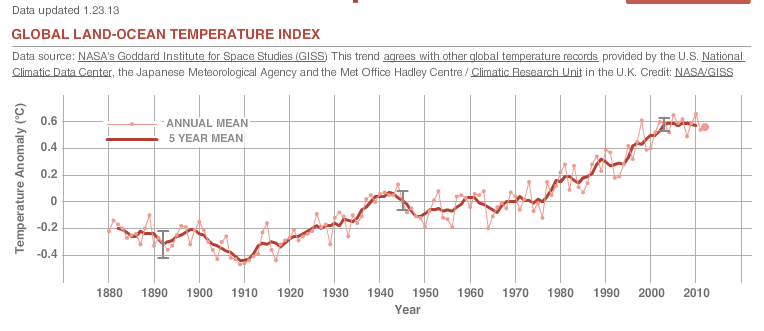
"What situation would falsify the theory of catastrophic anthropogenic global warming" A rapid unexplained significant decline in global temperatures over a decade despite increasing carbon use would clearly falsify the idea of AGW. edit: or just a theory that explains global temperature trends better than the current climate models that use anthropogenic carbon emissions. Or data that conclusively overturns the reco…
...didnt that just happen? check the data post 98 http://www.nature.com/nature/journal/vaop/ncurrent/full/natu...
No. The claim that AGW implies that mean global temperature will increase every single year is a naked straw man.
http://ete.cet.edu/gcc/style/images/uploads/GlobalSurfaceTem...
Re: Sea Change – The Pacific's Perilous Turn
#144Earlier quoted context omitted.
Rationalism is more about mental hygiene than any specific beliefs. I don't think it precludes emotion, but it definitely involves being aware of how undisciplined emotion can drive you away from actual truth: confirmation bias, tribalism etc. You can have rationalists on both sides of a debate, and I actually think society benefits a lot from such discussion. After all, each side is usually wrong about some things.
this is just too much http://plover.net/~bonds/positivism.html take this not as gospel, but as a starting point
From wikipedia's definition: Positivism is a philosophy of science based on the view that information derived from logical and mathematical treatments and reports of sensory experience is the exclusive source of all authoritative knowledge, and that there is valid knowledge (truth) only in scientific knowledge. Verified data received from the senses are known as empirical evidence.
Does global warming evidence satisfy the absolute standard of "empirical evidence" ? Well empirical evidence requires that data be produced according to the following process : 1) hypothesize 2) produce an experiment 3) accept/reject hypothesis (and goto 1, if possible)
Obviously experiments verifying global warming, or any significant part of climate theory are not possible, since we only have one earth and we can't quite produce another one with different levels. Nor are we allowed to assume that past data sufficiently isolates the factor being experimented with. Even if that were true, it is not possible to directly observe global warming without introducing potentially incorrect (or known incorrect) assumptions, like the central limit theorem.
A positivist would reject global warming, insisting only that we don't know, and that we can't know, because it's impossible to produce empirical evidence indicating either way. Since we don't even have direct measurements of the world getting warmer, only statistical proof, a positivist wouldn't even agree the world is warmer now than 100 years ago.
This sort of thing is why positivism was rejected as a viable philosophy. As your article described, this happened in programming, by the rejection of pure functional programming. But it also happened in science. The only remaining sciences that use positivism as a test of truth is first-order logic. Even second-order logic requires a less stringent standard.
Re: Sea Change – The Pacific's Perilous Turn
#145Earlier quoted context omitted.
Rationalism is more about mental hygiene than any specific beliefs. I don't think it precludes emotion, but it definitely involves being aware of how undisciplined emotion can drive you away from actual truth: confirmation bias, tribalism etc. You can have rationalists on both sides of a debate, and I actually think society benefits a lot from such discussion. After all, each side is usually wrong about some things.
this is just too much http://plover.net/~bonds/positivism.html take this not as gospel, but as a starting point
Re: Sea Change – The Pacific's Perilous Turn
#146Like many who visit HN, I am an atheist. I am coming to believe, however, that the production of CO2 is the greatest sin, in the religious sense, that exists today. It dwarfs all other problems -- Syria, terrorism, the NSA, class and economic disparity, all of them. Being technologists we tend to assume (hope?) that some solution will present itself before it is too late. I am growing increasingly pessimistic that su…
You may be too emotionally committed to listen to any skepticism, but for whatever it's worth: 1. Your language ("sin", "evil", "believe") indicates a major subjective component in what you're saying. As with everything subjective, you're probably aware that it's not provable with cold facts and logic, and it might justifiably be rejected by others' own subjectivity and take on facts. 2. A pervading feeling that the…
Re: Sea Change – The Pacific's Perilous Turn
#147Earlier quoted context omitted.
Please watch this video: http://www.ted.com/talks/hans_rosling_and_the_magic_washing_... In it Hans Rosling explains how something simple as making people able to use a washing machine to clean their clothes, will ultimately reduce population growth. This is because the knock-on effects of that are that women are more able to educate themselves, more able to keep their kids alive as a result of education and thus the…
> The key is not to educate people about overpopulation, but to educate them effectively in how to remove the need for high reproduction while increasing their life quality. This doesn't take the Population Paradox into account. I'm not saying such measures shouldn't be pursued. To do otherwise would be to abandon democratic principles and the uncontroversial advantages of education. But it won't make any difference.…
Generally because of constant attempts to flip population numbers (oh no ! too many ! oh no ! too few ! oh no ! too many ! ...) the population numbers start to fluctuate wildly. Then at some point, they hit 0. Whoops.
Keep in mind that if you do seek to reduce birthrate, to have more than extremely small changes in the rates is likely to result in outcomes vastly different from what you envisioned. So far, the most famous of those rate-adjustment fuckups have been with rabbits, cats and kangaroos. If the same happened to people, we'd be in shit so deep you wouldn't believe it.
Re: Sea Change – The Pacific's Perilous Turn
#148Earlier quoted context omitted.
What situation would falsify the theory of catastrophic anthropogenic global warming? Or the theory of catastrophic anthropogenic ocean acidification?
Those are not two theories; they are more like complimentary consequences. The ocean absorbs excess CO2 from the atmosphere. If it absorbs it as fast as we produce it, there will not be any warming, but a lot of acidification. If it absorbs it much more slowly, then there will be a lot of warming but little acidification. The truth is somewhere in between.
What is the basis for the assumption that any ocean acidification won't suddenly disappear, because some algae species decided it is now sufficiently widespread and easy to acquire to use it for lunch ?
Re: Sea Change – The Pacific's Perilous Turn
#149Earlier quoted context omitted.
Hmm, perhaps it isn't falsifiable by that standard. Only the evidence used in support is falsifiable, but the theory itself couldn't be falsified. How could you falsify the idea "things will continue to be fine"? I'm trying to assess if falsification is a good standard to use.
http://en.m.wikipedia.org/wiki/Null_hypothesis Sorry, a bit in a rush but that's the main idea. Expecting no specific change is the scientific default.
Re: Sea Change – The Pacific's Perilous Turn
#150Just out of curiosity, is there anything objectively better about colorful coral than the drab and dreary sea-life? The implication is that we should be upset that our sea life is about to get less pretty.