Live data from Hacker News

The speed, size and dependability of programming languages

gmarceau.qc.ca

21–30 of 59 posts

Re: The speed, size and dependability of programming languages

#21

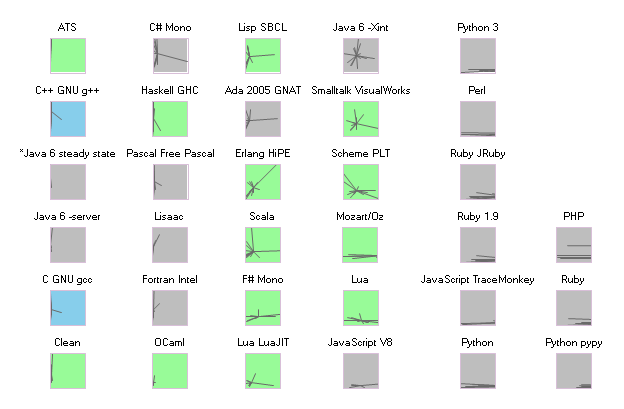
Very good graphs. Aside from X (time) and Y (code size), the center of the star implies "typical" performance, and the relative spread of the star shows specific data points. Ruby, for example, shoots out from the bottom right - to me, this says, "This is quite expressive, and if you know what you're doing, you can get reasonably good performance". It doesn't show memory usage or sample size, however - Rebol probably…

"Ruby, for example, shoots out from the bottom right - to me, this says, ... if you know what you're doing, you can get reasonably good performance" Sorry, but it does not say you can get reasonably good performance, it says this version of Ruby is slow, one of the slowest languages in the Shootout. And the graph itself says nothing about the skill level required to obtain the exhibited performance.
Re: The speed, size and dependability of programming languages

#22
post #21

Very good graphs. Aside from X (time) and Y (code size), the center of the star implies "typical" performance, and the relative spread of the star shows specific data points. Ruby, for example, shoots out from the bottom right - to me, this says, "This is quite expressive, and if you know what you're doing, you can get reasonably good performance". It doesn't show memory usage or sample size, however - Rebol probably…

"Ruby, for example, shoots out from the bottom right - to me, this says, ... if you know what you're doing, you can get reasonably good performance" Sorry, but it does not say you can get reasonably good performance, it says this version of Ruby is slow, one of the slowest languages in the Shootout. And the graph itself says nothing about the skill level required to obtain the exhibited performance.

> And the graph itself says nothing about the skill level required to obtain the exhibited performance.

In all fairness, neither do most people promoting C++'s performance-at-any-cost design.

I think a large spread in the performance correlates with requiring skill level, though -- it means that some people using the language get good results, but that many also get very bad ones. Ruby is a really slow language ("reasonably good" still good enough for many purposes, provided your algorithms are reasonable.

Re: The speed, size and dependability of programming languages

#24

This is great. If you've looked at Peter Norvig's spell checker shootout you won't be surprised much. Ex., the story on Common Lisp and Scheme implementations is the same here: MzScheme is the mediocre best of an unimpressive lot. (I want to see Clojure and Arc on this.) Python looks great again. F# looks weak here but wins big in the spell checker with reasonable-looking code. Sounds interesting. What's the deal wit…

Just a guess, but: Squeak only uses text files as an export format, and that format is more verbose than file-based source code would normally be. If you only counted the code and not the metadata, it would probably do better.

Re: The speed, size and dependability of programming languages

#25

The references to Ruby aren't entirely what they seem in here. They seem to be relating to Ruby on the older shootouts, rather than the recent ones. That is, the uber-slow Ruby 1.8, rather than the Perl-beating and PHP-matching Ruby 1.9 which is more closely related to "yarv" on this list.

rather than the Perl-beating and PHP-matching Ruby 1.9

Maybe I just can't read, but Ruby 1.9 appears to still be slower than Perl on more than half of the tests. I wouldn't call that "Perl-beating".

Re: The speed, size and dependability of programming languages

#26

The references to Ruby aren't entirely what they seem in here. They seem to be relating to Ruby on the older shootouts, rather than the recent ones. That is, the uber-slow Ruby 1.8, rather than the Perl-beating and PHP-matching Ruby 1.9 which is more closely related to "yarv" on this list.

Its great to see Ruby so much faster with 1.9 because 1.8 speed was such a stumbling block in data intensive stuff that I pushed towards it.

However don't count your chickens just yet with regards to Ruby 1.9 being "Perl-beating" ;-) Don't you think its odd that Perl 5.10.0 sits only just above Ruby 1.8.7 in the current alioth shootout? Quick look at the tests and I can see a problem with a known 5.10.0 speed issue bug. Fixing this in a quick local test here makes all the difference ;-)

Re: The speed, size and dependability of programming languages

#27
post #18

Very good graphs. Aside from X (time) and Y (code size), the center of the star implies "typical" performance, and the relative spread of the star shows specific data points. Ruby, for example, shoots out from the bottom right - to me, this says, "This is quite expressive, and if you know what you're doing, you can get reasonably good performance". It doesn't show memory usage or sample size, however - Rebol probably…

> The most interesting shape, to me, is Io's There seems to be a mistake. If you compare Io to JRuby [1], you'll find that Io is always the slower one, even though the picture in the article suggests otherwise. [1] http://shootout.alioth.debian.org/gp4/benchmark.php?test=all...

Ah, ok. Also, it seems to be missing about half the benchmarks.

Re: The speed, size and dependability of programming languages

#28

For this sort of comparison, mostly-functional multi-paradigm languages like SBCL and Ocaml should be run through the benchmarks twice; once with imperative code, once in the functional idiom. The often-repeated complaint (of which I'm skeptical) about functional languages is that they're only efficient when ugly imperative features are used, and it would be good to confirm or dispel that suspicion.

It's more complicated than "functional is slower than imperative". Functional data structures are sometimes less immediately efficient, but add persistence (since they're immutable, they share subsections of the data structure, and/or have access to snapshots of past versions of the structure being modified). Whether this gives you needed features or just means extra work and cache misses depends on what you're doing. If you have a functional data structure and you want to add "undo" or backtracking, you're already most of the way there, while adding this to an imperative data structure means extra work to keep track of state changes.

_Purely Functional Data Structures_ by Chris Okasaki is, by far, the best collected resource, if you want to read further. (His thesis (http://www.cs.cmu.edu/~rwh/theses/okasaki.pdf) is the kernel of the book.) Also, the fourth chapter of Developing Applications with Objective Caml (English translation: http://caml.inria.fr/pub/docs/oreilly-book/) discusses functional and imperative styles' strengths and weaknesses.

Reducing everything to runtime benchmarks obscures how, in practice, the trade-off is often more like "it was a huge pain in the ass to get working without bugs, but it's 2% faster" versus "it took twenty minutes and was correct on the first try". (Also, whether or not you use it in production, OCaml rules for prototyping complex data structures, in the same way Erlang does concurrency and C++ does linking errors.)

Re: The speed, size and dependability of programming languages

#30
The benchmarks used for the article was from 2005. Make sure to check out the 2009 versions:

http://gmarceau.qc.ca/blog/uploaded_images/size-vs-speed-vs-...

V8 has propelled JavaScript into the coveted bottom-left corner, which is awesome. SquirrelFish Extreme should be right up there with it, if it were included.

Post reply on HN