If the creator of the tool is reading: 1. Please add support for sequential logic with flops. 2. Minor bug: the "input" and "output" labels are reversed on the left pane.
You can simulate a flop with a pair of cross-linked NOR gates.
11–20 of 32 posts
If the creator of the tool is reading: 1. Please add support for sequential logic with flops. 2. Minor bug: the "input" and "output" labels are reversed on the left pane.
If the creator of the tool is reading: 1. Please add support for sequential logic with flops. 2. Minor bug: the "input" and "output" labels are reversed on the left pane.
You can simulate a flop with a pair of cross-linked NOR gates.
http://marcusvorwaller.com/look/Mozilla_Firefox-20090503-095...
I think you should make the simulator stopped/active control more obvious.
Would be really cool if one could define "new gates" in terms of gates, e.g. a half-adder, a full-adder.
agreed. a couple slots for your own black boxing of a component would enable fairly complex ideas to be quickly demonstrated. Could be a great teaching tool.
It is no replacement for more powerful things (e.g. FPGAdvantage), but for didactic purposes, this is quite useful.
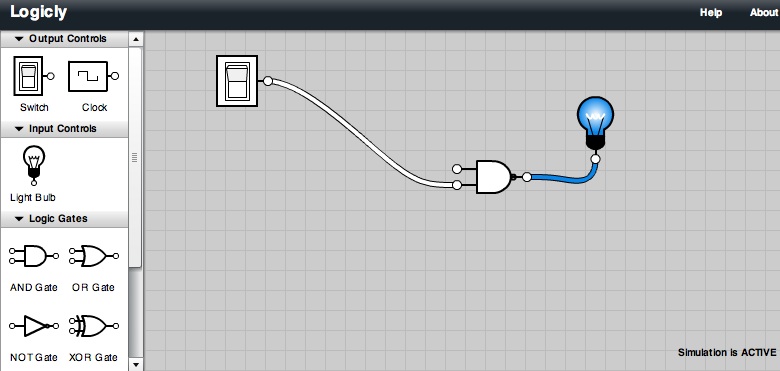
Pretty cool. I think I semi-broke it (or at least found a bug): http://marcusvorwaller.com/look/Mozilla_Firefox-20090503-095...
Confused the hell out of me at the time, especially since I had left the assignment to the last possible minute.
Edit: remembered the name of the software: http://ozark.hendrix.edu/~burch/logisim/
Pretty cool. I think I semi-broke it (or at least found a bug): http://marcusvorwaller.com/look/Mozilla_Firefox-20090503-095...
I'm not sure if it's a bug in this case, but I've used logic simulation software with the same issue and it was considered a "feature". Basically, unconnected nodes of an or-gate are considered HIGH. I suppose it makes more sense when the AND-gate has more inputs. Confused the hell out of me at the time, especially since I had left the assignment to the last possible minute. Edit: remembered the name of the software:…
Earlier quoted context omitted.
I'm not sure if it's a bug in this case, but I've used logic simulation software with the same issue and it was considered a "feature". Basically, unconnected nodes of an or-gate are considered HIGH. I suppose it makes more sense when the AND-gate has more inputs. Confused the hell out of me at the time, especially since I had left the assignment to the last possible minute. Edit: remembered the name of the software:…
No, that still doesn't make sense to me. The behavior of a logic circuit with unconnected inputs depends on the implementation; in typical CMOS, those floating inputs can do things as wacky as picking up the electrical fields of nearby people. The proper thing to do with floating inputs is to declare them unknown, and for any logic operation which depends on their values to also be unknown. Most logic simulation soft…