Live data from Hacker News

Microsoft: Internet Explorer 10 Is The Most Energy-Efficient Browser

techcrunch.com

41–50 of 64 posts

Re: Microsoft: Internet Explorer 10 Is The Most Energy-Efficient Browser

#41
post #18

How could anyone possibly care about such a thing?

If you're running Windows on a laptop, the argument here is that using IE as the browser will make your laptop last longer on a charge than other competing browsers.

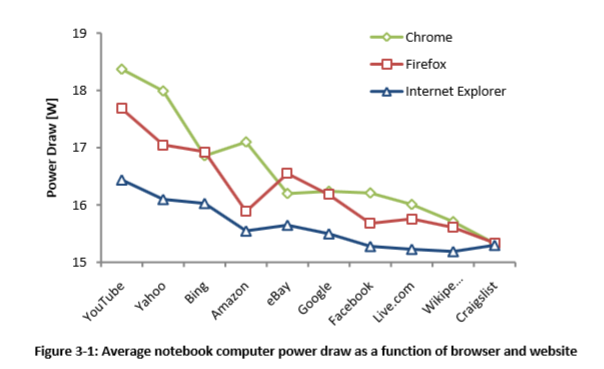
The graph linked[1] does not show that much of a difference between different browsers - the difference appears exaggerated because the scale on the Y-axis does not start at zero. Thus, it is very likely that whatever power saving that you will derive are negligible and don't make a difference in the grand scheme of things.

[1] - http://tctechcrunch2011.files.wordpress.com/2013/06/browser_...
Re: Microsoft: Internet Explorer 10 Is The Most Energy-Efficient Browser

#42
post #39

Can't believe that no one has mentioned the chart yet -- a non-zero baseline is highly misleading. http://tctechcrunch2011.files.wordpress.com/2013/06/browser_...

The misleading Y-axes on two of the charts on the IE blog post were the first thing I noticed: http://blogs.windows.com/ie/b/ie/archive/2013/06/05/internet... Here's the top chart (left) and the same chart except with a less misleading Y-axis (right): http://i.imgur.com/zI1UJeS.png

How is that misleading Y-axes? The intervals are same, only thing that will be different is the resolution, and going into that fine resolution amplifies the difference. I will not say it as misleading in a slightest bit.

Re: Microsoft: Internet Explorer 10 Is The Most Energy-Efficient Browser

#43
post #31
post #16

Earlier quoted context omitted.

In portable computing, it can help battery last longer. Just because it is not user facing, does not mean it should be ignored by engineers.

As soon as microsoft tries to release an IEbook to compete with the Chomebook, this metric will have a greater impact on battery life.

WindowsRT devices are pretty much that. See Lenovo Yoga 11" with WindowsRT.

Re: Microsoft: Internet Explorer 10 Is The Most Energy-Efficient Browser

#44
post #16
post #13

Yup, that's the first thing I look for in a browser - energy efficiency.

In portable computing, it can help battery last longer. Just because it is not user facing, does not mean it should be ignored by engineers.

Yes, but the article specifically states that the efficiency is gained by by better utilization of PC hardware. I suppose if you're using your laptop exclusively for browsing it might make a difference, but switching to a tablet would give you even more battery efficiency.

Re: Microsoft: Internet Explorer 10 Is The Most Energy-Efficient Browser

#46
post #42
post #39

Earlier quoted context omitted.

The misleading Y-axes on two of the charts on the IE blog post were the first thing I noticed: http://blogs.windows.com/ie/b/ie/archive/2013/06/05/internet... Here's the top chart (left) and the same chart except with a less misleading Y-axis (right): http://i.imgur.com/zI1UJeS.png

How is that misleading Y-axes? The intervals are same, only thing that will be different is the resolution, and going into that fine resolution amplifies the difference. I will not say it as misleading in a slightest bit.

Because it amplifies our perception of the difference, which misleads us to believe that the difference is more than it actually is.

Re: Microsoft: Internet Explorer 10 Is The Most Energy-Efficient Browser

#47
This is a very important benchmark, provided framerates and rendering quality are held mostly the same. It could easily grow to include cases like having 100 tabs open, which currently don't really appear in any benchmarks.

For almost all my devices, this is the one I care about most.

Re: Microsoft: Internet Explorer 10 Is The Most Energy-Efficient Browser

#48

Amdahl's law. You can get the browser itself down to nothing and it's totally futile because as soon as you open a page Flash Player will still peg the CPU.

They did test playing videos through both Flash and HTML5, and found that power draw still varied significantly depending on browser, with IE drawing 30-40% less power than Chrome (after subtracting out at-desktop idle power). So there's definitely still low-hanging fruit for the browser itself.

Re: Microsoft: Internet Explorer 10 Is The Most Energy-Efficient Browser

#49

It's not that hard to optimize for power draw in software if you're willing to do the work to measure and tune. Lots of simple optimizations can produce huge gains, whether it's using the correct timer APIs to allow the OS to coalesce timer events (Raymond Chen wrote a blog post about how this allows the CPU to stay in sleep mode longer on Windows by serving all timers on say, 1000ms intervals instead of 999ms/1000ms…

From the study:

"In addition, at the request of Microsoft we set the JavaScript timer frequency to “conserve power” in the Windows power options. We found, however, that the default Javascript time frequency for all computers tested was set to “maximum performance.” We did not investigate the impact of this setting upon browser power draw."

So yeah, IE got some optimization applied, and unfairly so, since the other browsers were run with default settings.

Re: Microsoft: Internet Explorer 10 Is The Most Energy-Efficient Browser

#50
post #42
post #39

Earlier quoted context omitted.

The misleading Y-axes on two of the charts on the IE blog post were the first thing I noticed: http://blogs.windows.com/ie/b/ie/archive/2013/06/05/internet... Here's the top chart (left) and the same chart except with a less misleading Y-axis (right): http://i.imgur.com/zI1UJeS.png

How is that misleading Y-axes? The intervals are same, only thing that will be different is the resolution, and going into that fine resolution amplifies the difference. I will not say it as misleading in a slightest bit.

The Y-axis should've started at 0 watts, not at (a rather arbitrary) 18 watts.

Look at the "Flash Video" and "HTML5 Video" bars in the original chart. The blue IE bars are roughly half the size of the green Chrome bars, which might lead you to believe that IE only consumes roughly half of the energy that Chrome consumes in those tests. But as the numbers show, the difference isn't nearly that great.

Starting the Y-axis at 18 watts only serves to make IE's advantage over the other browsers look greater than it actually is.

Post reply on HN