Earlier quoted context omitted.
Regarding a (at least in the US) I think a big part of the problem is a system of laws that people generally agree is unjust (i.e. the drug laws)
I find it strange that the US has laws that many people break and the law is only enforced sporadically. Some examples in California are speeding, missing front license plate, age of consent laws, use tax on out-of-state/internet purchases, and illegal immigration. Having a bunch of laws that people break with impunity has a "broken window" effect, leading to less respect for the law overall. (Whether or not these la…
Data journalism busts speeding cops, wins Pulitzer
141–150 of 158 posts
Re: Data journalism busts speeding cops, wins Pulitzer
#142I'm just going to throw this out there, people don't pass marked cars so a marked car driving the speed limit causes traffic to back up behind them for no other reason than to alleviate traffic congestion, it probably makes sense for them to drive 15-20 miles over the speed limit (that obviously doesn't excuse driving 130 mph)
I would argue that for the sake of the law, having a backup of cars behind an officer all doing the speed limit is a good thing. It's called the speed limit , not the speed range. As in, the maximum you're allowed to do on that road in perfect conditions. If we want to enforce the laws, having everyone follow a pace car going exactly the speed limit is a good thing. Having an officer going 65 in a 55 just to relieve…
Re: Data journalism busts speeding cops, wins Pulitzer
#143Earlier quoted context omitted.
I find it strange that the US has laws that many people break and the law is only enforced sporadically. Some examples in California are speeding, missing front license plate, age of consent laws, use tax on out-of-state/internet purchases, and illegal immigration. Having a bunch of laws that people break with impunity has a "broken window" effect, leading to less respect for the law overall. (Whether or not these la…
Not all cars are required to have a front license plate, just FYI. For example, when I got the license for my MINI, they only sent me one, and said that I didn't need to have one on the front.
Re: Data journalism busts speeding cops, wins Pulitzer
#144Earlier quoted context omitted.
So all I need to do to be a great journalist is to win a Pulitzer?
Yes, and all you need to do to be a great mathematician is to win the Fields Medal. All you need to do to be a great jurist is to become the Chief Justice of the SCOTUS.
Re: Data journalism busts speeding cops, wins Pulitzer
#145Earlier quoted context omitted.
Well then, let them stop pretending that they're looking out for our safety when they put up a speed trap. If you want to talk about having more reasonable road markings, speed limits, and fines for speeding that's great. It's a conversation that we need to have. But to have a bunch of guys driving around like jerks, on and off duty, extracting a tax from the working stiffs is an insult, and nobody should be surprise…
My reasoning in that speed traps are for revenue generation instead of safety is over the thought that a visible police presence on the road would more likely cause people to slow down and obey traffic laws. Hiding to ambush a speeder is the same tactic used by a highwayman out for money.
Re: Data journalism busts speeding cops, wins Pulitzer
#146Earlier quoted context omitted.
Not all cars are required to have a front license plate, just FYI. For example, when I got the license for my MINI, they only sent me one, and said that I didn't need to have one on the front.
Sort of ironic. When I bought my mini, it only had one license plate, and I've since received several tickets for that reason. #california
Re: Data journalism busts speeding cops, wins Pulitzer
#147Earlier quoted context omitted.
You can't go by the capabilities of the individual car. You have to also account for the capabilities of the other cars on the road. If a Ferrari is speeding along at 120 MPH, which might be easily within its capabilities, there will be problems when it encounters the small Hyundai that can only achieve 90 comfortably. Plus there's the issue of driver's ability as well. Can you look in your side mirror and successful…
I agree with you in general. There needs to be a common speed for all cars because difference in speed is, I believe, the real cause of danger. However, there is one common case where the speeding law seems unnecessary at best. I live in Texas. Florida is similar in that there can be large stretches of empty highway. When I travel outside the city there is often very little traffic and very open country. If I can see…
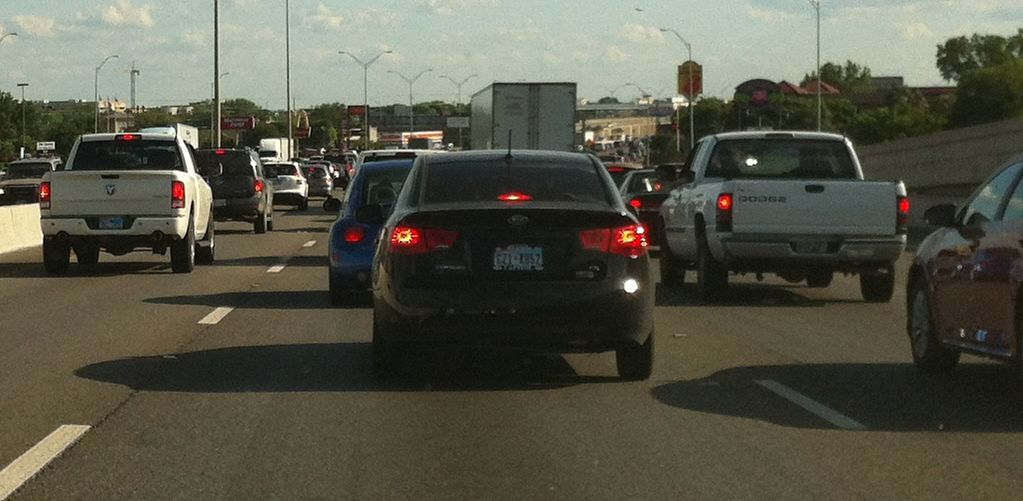
http://cbsdallas.files.wordpress.com/2010/10/i-35-texas_6713...
(Ok, that's downtown Austin; how about this one:
Re: Data journalism busts speeding cops, wins Pulitzer
#148Earlier quoted context omitted.
I would have to see a study that shows that the speed limit is the source of traffic congestion. I seriously doubt it is. Most sources of congestion seem to be more along the lines of disabled vehicles, accidents, several roads converging in the same area, merging issues, and just stupid drivers at any speed. Increasing the speed limit by 10 or 15 MPH doesn't address any of that and in fact would likely make it worse…
I don't have a study to link to but I'm seen how one slow driving cop can cause a bottle neck behind him as noone wants to pass him some links about about how seemingly minor factors can cause traffic jams http://auto.howstuffworks.com/car-driving-safety/accidents-h... http://www.amazon.com/Traffic-Drive-What-Says-About/dp/03072...
By that logic, any street that has two or more cars following the speed limit in close proximity to each other could be classified as congestion.
Once you have a buildup of cars that are traveling slower than the intended speed of the road that causes further slowing up the line that eventually creates bumper-to-bumper traffic with little movement, then you have congestion.
Re: Data journalism busts speeding cops, wins Pulitzer
#149Earlier quoted context omitted.
You can't go by the capabilities of the individual car. You have to also account for the capabilities of the other cars on the road. If a Ferrari is speeding along at 120 MPH, which might be easily within its capabilities, there will be problems when it encounters the small Hyundai that can only achieve 90 comfortably. Plus there's the issue of driver's ability as well. Can you look in your side mirror and successful…
I agree with you in general. There needs to be a common speed for all cars because difference in speed is, I believe, the real cause of danger. However, there is one common case where the speeding law seems unnecessary at best. I live in Texas. Florida is similar in that there can be large stretches of empty highway. When I travel outside the city there is often very little traffic and very open country. If I can see…
There are examples of US interstates with no speed limits within, to some people, reasonable limits:
http://www.motorists.org/press/montana-no-speed-limit-safety...
They even discuss how in some cases fatalities go up with new road laws and speed limits.
I have driven that stretch of road between Austin and Dallas as I live in the Dallas area. I have also lived in Florida with it's stretches of long, boring roads. Plus, I've lived in Vegas with that incredibly boring route into Los Angeles. In every case I would agree with you that the idea of being able to go a bit faster would have been nice.
But the question that will come up is how do you determine the maximum speed that you can safely manage? What if your assessment of your max speed differs with that of the police officer who witnesses what he feels is a dangerous amount of speed? What about other people on the road that you will eventually come across that can't handle the situation that you present if you decide that the person can handle a speed that in truth they cannot? I'm sure you're thinking you'll just slow down when you see someone but you cannot foresee the possibilities plus your reaction time dwindles quite effectively the faster you go. A mile at 60 MPH is one thing, a mile at 120 MPH is another.
My example against this, which is interesting considering the topic of this thread, is when I was in Vegas an off-duty cop was speeding (I forget how much but in excess of 100 MPH) on one of the interstates outside of the main part of town and rear-ended a family in their car. The resulting accident killed a number of them including children. Therefore, I personally don't like the idea of a free-for-all on the interstate where different cars can drive at different speeds based on criteria that will be different for each individual driver and car. I would rather we all agree on a maximum speed that makes sense for the conditions of the road and expected traffic. Now if a road has too slow of a speed limit for the typical conditions of that road, then that is a different discussion.
Re: Data journalism busts speeding cops, wins Pulitzer
#150Earlier quoted context omitted.
Yes, you were doing something wrong like not understanding physics involving the coefficient of friction, acceleration formulas, and the inability to see through solid objects to know that a child is about to step out on the road in front of your car at a distance where you could have stopped had you not been speeding.
So how does a number on a sign at the side of the road have anything to do with any of those things?
That's how the number on the sign relates.