What kind of server did you guys use for your rails test? Thin, Puma, Unicorn? Are you sure you ran it in production environment? Update: Looks like passenger in development mode. Good job you benchmarked a web server that no one uses wile reloading all code between requests. Update2: Ok it seems to run in production mode but still, passenger is not an idiomatic choice.
I'm not familiar with Rails. Could you explain what you mean in layman terms? Why is code being reloaded on every request by default?
Web Framework Benchmarks
151–160 of 415 posts
Re: Web Framework Benchmarks
#152Earlier quoted context omitted.
I'd be interested to see performance for Vert.x on its other hosts (this is the JVM version, I believe).
Interesting point. You're correct, we've only tested Vert.x as a Java/JVM platform.
Re: Web Framework Benchmarks
#153Numerous irregularities plus a strong vested interest in the JVM make me doubt they have given adequate shrift to Go, here. Given the amount of interest in Haskell and Yesod around here, it is strange that it is missing.
>Given the amount of interest in Haskell I see more people making uninformed "haskell sucks" posts than expressing interest in it. >and Yesod Really? Yesod is the anti-haskell haskell framework.
There are also regular posts about Yesod.
I conclude that you know perfectly well that Haskell and Yesod are regularly mentioned on HN, but find it inconvenient to have mentioned for some reason I do not fathom.
Re: Web Framework Benchmarks
#154Re: Web Framework Benchmarks
#155Earlier quoted context omitted.
I'd love to see your framework optimization index. Honestly, all of this would be a wonderful thing to automate and put in a web app - a readily-accessible, up-to-date measure of the current performance of the state of the art in languages and frameworks. I bet it would really change some of the technology choices made.
Here's a quick version of the framework optimization index. Higher is better (ratio of framework performance to raw platform performance, multiplied by 100 for scale): Framework Framework Index Gemini 87.88 Vert.x 76.29 Express 68.85 Sinatra-Ruby 67.88 WebGo 51.08 Compojure 45.69 Rails-Ruby 31.75 Wicket 29.33 Rails-Jruby 20.09 Play 18.02 Sinatra-Jruby 15.96 Tapestry 13.57 Spring 13.48 Grails 7.11 Cake 1.17
cake 18.9% (312 vs 59)
compojure 12.1% (108588 vs 13135)
django 16.8% (6879 vs 1156)
express 16.9% (42867 vs 7258)
gemini 12.5% (202727 vs 25264)
go 13.3% (100948 vs 13472)
grails 7.1% (28995 vs 2045)
netty 18% (203970 vs 36717)
nodejs 15.6% (67491 vs 10541)
php 11.6% (43397 vs 5054)
play 20.6% (25164 vs 5181)
rack-jruby 15.6% (27874 vs 4336)
rack-ruby 22.7% (9513 vs 2164)
rails-jruby 22.7% (3841 vs 871)
rails-ruby 20.7% (3324 vs 687)
servlet 13.4% (213322 vs 28745)
sinatra-jruby 21.2% (3261 vs 692)
sinatra-ruby 22.2% (6619 vs 1469)
spring 7.1% (54679 vs 3874)
tapestry 5.2% (75002 vs 3901)
vertx 22.3% (125711 vs 28012)
webgo 13.5% (51091 vs 6881)
wicket 12.7% (66441 vs 8431)
wsgi 14.8% (21139 vs 3138)
I found it interesting that something like tapestry took a 20x slowdown when going from dedicated to ec2, while others only took ~5x slowdown.
Edit: To hopefully make it clearer what the percentages mean - if a framework is listed at 20%, this means that the framework served 1 request on ec2 for every 5 requests on dedicated hardware. 10% = 1 for every 10, and so on. So, higher percentage means a lower hit when going to ec2.
Disclosure: I am a colleague of the author of the article.
Re: Web Framework Benchmarks
#156Re: Web Framework Benchmarks
#157What kind of server did you guys use for your rails test? Thin, Puma, Unicorn? Are you sure you ran it in production environment? Update: Looks like passenger in development mode. Good job you benchmarked a web server that no one uses wile reloading all code between requests. Update2: Ok it seems to run in production mode but still, passenger is not an idiomatic choice.
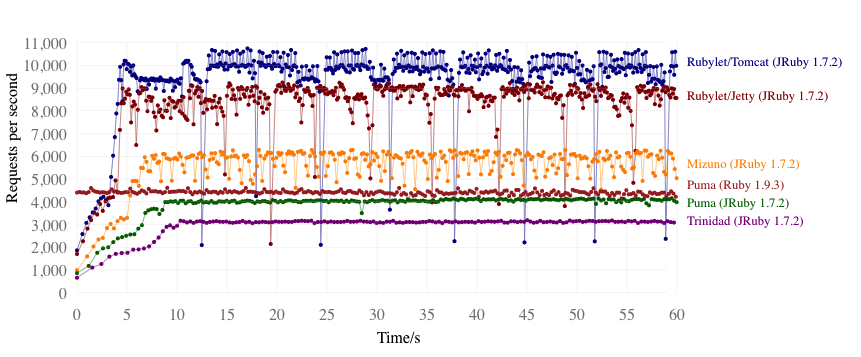
They were all run in production mode with logging disabled, etc.
http://polycrystal.org/~pat/scratch/microbenchmark.png
Note that a difference from 10k requests per second seems huge compared to 3k, but if you invert it, you get 100 and 333 micro seconds per request, respectively. In a real, non-"hello world" app, these differences are going to be negligible.
Though perhaps it would be more interesting if instead of just responding "hello, world", the app parsed some query parameters or something. But I was mostly interested in the overhead of different JRuby servers, not comparing different app servers (i.e. overhead from Sinatra should be more or less identical whether you're on Puma, Trinidad, or whatever).
Re: Web Framework Benchmarks
#158Earlier quoted context omitted.
Wow, directly on tip? That seems to speak very highly of the day-to-day development stability of Go.
A good tip build tends to be more stable then 1.0.3 and has hugely improved performance (most importantly for large application in garbage collection and generation). To select a suitable tip build we use http://build.golang.org/ and https://groups.google.com/forum/?fromgroups#!forum/golang-de... . My recommendation would be to find a one or two week old build that passed all checks, do a quick skim of the mailing li…
Re: Web Framework Benchmarks
#159Earlier quoted context omitted.
I think this is a much needed and excellent point to make. Just take a look at how Go dips down when using Webgo.
I'm not sure many people would use webgo in real life. I don't know... maybe some people... certainly not pros. Also, the 1.0.3 thing is probably dragging on the numbers a bit. 1.1 would boost it a little. Not enough to get it into the top tier... but a little. Also, for Vert.x, they seem to be only running one verticle. Which would never happen in real life. Play could be optimized a bit... but not much. What they h…
Re: Web Framework Benchmarks
#160Oh really? Then why did Zed write such an angry rant about how you are doing it wrong?
http://zedshaw.com/essays/programmer_stats.html
Can we please see some standard deviations, at least?