Live data from Hacker News

No bullshit guide to math and physics

minireference.com

21–30 of 160 posts

Re: No bullshit guide to math and physics

#21
post #11

The website isn't readable in IE9.

http://www.mozilla.org/en-US/firefox/new/ https://www.google.com/intl/en/chrome/browser/

I'm sure halo knows there are other browsers. Remarking that a website is unreadable in a widely-used browser is a legitimate comment that doesn't deserve snark.

Re: No bullshit guide to math and physics

#22
post #9

I actually clicked "Buy Now" before I realized this was a physical textbook and cancelled. To me, it's almost inexcusable to market this sort of text to this type of audience and not have a digital copy. Shouldn't the barriers to entry be much lower for the author to get this out electronically? I see that the author is responding to comments here, so if you're like me and will buy it if it comes out electronically,…

I have the PDF version ready and will setup a shopping cart (ejunkie?) very soon (like tonight) because several people asked for this. Reading math in print is really good: you can flip back and forth through the pages. How much should the PDF cost? 29$ sounds a bit steep for a PDF no?

I have few suggestions on this matter,

1) If a book is interesting and its priced around 15$, I would purchase it no question asked.

2) I hope you can release a EPUB/Mobi version of the book in the future and make it available to people who bought the PDF.

3) This might be pushing it but if someone has purchased the ebook and wants to get the paperbound after certain period of time, it would be sweet if you can offer major discount on paperbound for those people (look at Oreilly for an example)

4) Similarly offer ebook version of the book with the paperbound copy, almost every publisher does it these days.

Re: No bullshit guide to math and physics

#23
I was just discussing writing this same exact book for/with my wife. Se^(2^(x))^e does not interest her. The standard in my past has been mathematics books that use equations that do not/rarely occur in nature. The concepts are priceless, but the problems/solutions do not use common integers.

Breaking a problem down six times to actually start applying the principle I am learning is my largest downfall. It makes me lose interest in the subject at hand. I would rather understand and be able to reference the concepts.

Like many others, an ebook would be more delightful. Yet, I may buy the paperback this weekend.

Re: No bullshit guide to math and physics

#24
post #9

I actually clicked "Buy Now" before I realized this was a physical textbook and cancelled. To me, it's almost inexcusable to market this sort of text to this type of audience and not have a digital copy. Shouldn't the barriers to entry be much lower for the author to get this out electronically? I see that the author is responding to comments here, so if you're like me and will buy it if it comes out electronically,…

I have the PDF version ready and will setup a shopping cart (ejunkie?) very soon (like tonight) because several people asked for this. Reading math in print is really good: you can flip back and forth through the pages. How much should the PDF cost? 29$ sounds a bit steep for a PDF no?

Hi Ivan, glad to hear it. You can count on my purchase.

Regarding pricing, yeah, you probably want to go cheaper than your print version. Maybe $19 or $9, depending on how much profit you are expecting to make on the physical copies.

To be honest, you're probably best off a/b testing the price, as it can be very surprising how consumers will react to various price points. I've seen situations were significant price hikes result in much higher sales, presumably because of the implied value of the product.

Re: No bullshit guide to math and physics

#25
post #19

Earlier quoted context omitted.

I have the PDF version ready and will setup a shopping cart (ejunkie?) very soon (like tonight) because several people asked for this. Reading math in print is really good: you can flip back and forth through the pages. How much should the PDF cost? 29$ sounds a bit steep for a PDF no?

You don't need to pay for a physical copy, so it would make more sense to charge so you get the same profit from each, or maybe a bit less.

Pricing based on cost (with fixed "this is a fair amount of profit") is a terrible pricing scheme.

patio11 talks about this a lot. Here's a podcast where he talked about it (more in the context of B2B software, but many principles still apply): http://www.kalzumeus.com/2012/09/21/ramit-sethi-and-patrick-...

If you scroll through his comments, you'll see many instances of him telling people to charge more for things and explaining some of this stuff news.ycombinator.com/threads?id=patio11

Re: No bullshit guide to math and physics

#26
post #9

I actually clicked "Buy Now" before I realized this was a physical textbook and cancelled. To me, it's almost inexcusable to market this sort of text to this type of audience and not have a digital copy. Shouldn't the barriers to entry be much lower for the author to get this out electronically? I see that the author is responding to comments here, so if you're like me and will buy it if it comes out electronically,…

I have the PDF version ready and will setup a shopping cart (ejunkie?) very soon (like tonight) because several people asked for this. Reading math in print is really good: you can flip back and forth through the pages. How much should the PDF cost? 29$ sounds a bit steep for a PDF no?

For reference have a look at the % price difference for other book sellers, like O'Reilly: http://shop.oreilly.com/product/9780596802363.do

I'd be selling it for $24 for Ebook (and make it available in PDF/Epub/Mobi to cover all readers), $29 for print, $32 for Print + Ebook.

Re: No bullshit guide to math and physics

#27

Earlier quoted context omitted.

http://www.mozilla.org/en-US/firefox/new/ https://www.google.com/intl/en/chrome/browser/

I'm sure halo knows there are other browsers. Remarking that a website is unreadable in a widely-used browser is a legitimate comment that doesn't deserve snark.

Agreed.

The getElementById got me! Will jQuerify that ASAP.

Re: No bullshit guide to math and physics

#28

I would buy it, but it appears you don't have an ebook version? I can't really keep physical books because they take up too much space (small apartment).

@cameronh90 @veeti @Who828 I hear you guys. I will have the PDF version ready by later tonight. How much should the PDF cost? Is a DRM-free PDF good enough or should I do the .epub format? (in the meantime, check out the free preview: http://cnd.mcgill.ca/~ivan/miniref/miniref_v3_preview.pdf about one third of the book is there)

An ebook being cheaper isn't a big deal for me, since my view is the price more to do with the content than the format. For other people it does seem to be more significant though. Maybe it should be the price of the physical book less the costs of printing/binding/etc. such that you get the same amount of money in the pocket at the end? (I don't know if that's how it works, having never published a book!)

PDF is good for PC viewing and will work on pretty much everything, though EPUB and Kindle formats will make things better on e-readers and phones/tablets since they support re-flowable content, but I guess would probably require more work on your part to support.

Re: No bullshit guide to math and physics

#30
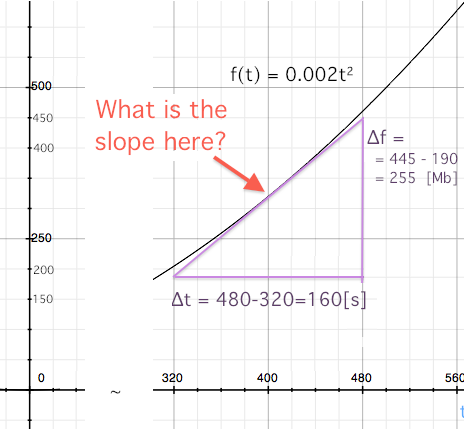
Here's a picture from the examples:

http://minireference.com/miniref/lib/tpl/miniref/landings/im...

I'm not a big fan of that picture. We're trying to compute f'(400), judging by the text (scroll down a bit on the first page). What the image suggests, afaict, is that f'(400) that can be computed as the limit [f(x+h) - f(x-h)]/2h with x=400 and h -> 0 (in the picture, we see the case h=80). At least the graphic appears to connect the two somehow.

Nothing to that effect is mentioned in the text... just the cookbook recipe 'at^n becomes ant^{n-1}'. So why is there even a triangle here? Two things are fishy here. The limit and the triangle.

The limit: Taking the aforementioned limit for the derivative is rather weird. If the function is differentiable, you'll get the right result, namely f'(x). If you consider the limit for the function x -> |x| at x=0 e.g., you'll get a limit as well, even though that function is not differentiable.

The triangle: I would expect it to connect the three points [x-h,f(x-h)], [x+h,f(x-h)], [x+h,f(x+h)]. Instead, we get three points whose X-coordinates match the ones I mentioned with Y-coordinates that are chosen to have the slope of the triangle match the slope of the function. Why? (If this were about the mean-value theorem... but it's not!)

So what I'm left with is a plot with a triangle, no text that explains any of that, and nothing I can make of it myself.
Post reply on HN