Earlier quoted context omitted.
> Because they study architecture. If the architecture they're studying is divorced from the preferences and needs of the uneducated masses then who cares? They may as well be studying their own butts.
> divorced from the preferences and needs of the uneducated masses then who cares? Preferences, perhaps, but needs, I'm sure not. On this, I much prefer being divorced from preferences, than designing soul-less buildings designed solely to cater to preferences, without leveraging the knowledge gained through years of study.
Most people prefer traditional architecture
171–180 of 382 posts
Re: Most people prefer traditional architecture
#172Modernism is the act of using cheaper resources and more standardized/cheaper methods of production. The aesthetic is more of a side-effect of those limits. Ugliness has become a cultural norm in order to suit the modern economy. It may come as a surprise but it required years of cultural development and education for most people to accept the work of Dieter Rams as some aesthetic pinnacle rather than soulless mass p…
I don't think this computes. Modern 'efficient' industrial design can absolutely fail at efficiency. I have lived in spartan, utilitarian apartments that you could tell were built without any regards for efficient use of living space, and ended up wasting huge swaths of their floor area to interior corridors, winding tunnels between rooms, random walled off mystery areas and overall such poor planning that I'm sure d…
This is true, but usually fewer people die in the construction of those utilitarian housing projects
Re: Most people prefer traditional architecture
#173Modernism is the act of using cheaper resources and more standardized/cheaper methods of production. The aesthetic is more of a side-effect of those limits. Ugliness has become a cultural norm in order to suit the modern economy. It may come as a surprise but it required years of cultural development and education for most people to accept the work of Dieter Rams as some aesthetic pinnacle rather than soulless mass p…
One consequence of this was the decimation of skilled craftsmen. Millions of them were sent off to become machine-gun fodder, to never return to their respective trades.
Along with them was their craft. The next generation of apprentices never had the mentors they needed, hence that was that, the end of what you might call traditional architecture.
There was another minor disagreement that began at various times depending on one's nationality. In the UK this meant 1939, and with it a second 'double tap' on the skilled craftsmen that the building trade used to rely on.
Many of the survivors did get to work on war memorials, and every village has one, carved in stone, and often kept in immaculate condition to this day.
In my local station there are two memorials, and I struggle to hold it in as I walk past. Needless to say, we lost a lot of good railway workers too. Sad.
There wasn't a lot of money after each of these minor disagreements and heavily blitzed cities still bear the scars. There can be a wonderful parade of shops with flats above, with wonderful craftsmenship, which is truly wonderful considering they didn't have motorised vehicles as we know them, or cherry pickers, or any machine that is big and yellow (JCB in the UK).
Nowadays there can be a huge 1870s building, with four storeys, all with big rooms and high ceilings, next to some 'rubbish' that was built in the post-disagreement years.
Some places were physically removed from the map. A 500 bomber raid on the special crane used to hoist big guns onto the ships of the Royal Navy happened one night. They completely missed the crane to destroy the entirety of Clydebank, a district of Glasgow. People are sore about that to this day.
The crane still stands, albeit idle, since shipbuilding went to Asia in the post-disagreement years. That crane, once the largest and most capable in the world, has a soul. It speaks of sorrow to me.
So yes, you are correct, but there is more to the story than just a Modernist story of cheap mass production. The limit was not resources as you can see the quarries that were abandoned after the first minor disagreement, and there is enough stone in any given mountain to make millions of homes. The limit was the loss of men as well as the loss of European colonies, on which the wealth of European cities came from.
Moving swiftly on, I am no Ferrari fan under normal circumstances, however, Lewis Hamilton currently drives for their Formula One team and he is a hero of mine. Hence I am willing to defend the loathed Luce!
The Luce does have Mr Ive's design input and I don't think anyone is critical of the interior. It is well understood that serious tax avoidance vehicles need to stay away from having big screens on the dashboard since they are not going to age well (and F1 cars don't have such things). Having four seats rather than just the two makes sense to me, since the car needs to have some length to it for high speed stability and there is no need for a massive red V12 engine in the middle of the car.
The Luce brings much from the world of F1, including high performance cooling systems that cost 100x the price of the radiators in your car. People like older cars because they can tune them, the Luce is the first EV that is what you might call tune-able, with the owner able to set the car up for a given track or just the road, with them also able to do what they want with it.
The aerodynamic package is ahead of its time, and, as such, it will draw criticism. We have been here before, notably in the UK with the Ford Sierra. This was a 'jelly mould' shaped version of the three-box saloon that had gone before, the Cortina. Initially the press hated on the Sierra and people did have genuine misgivings. However, it did not take long before the Sierra rose to the top of the sales charts to set the trend for the 'jelly mould' look, these being the 'peak car' maintainable vehicles that people wish they had today.
Fortunately I will never be a customer for Ferrari, however, if I was a tax-dodging benevolent dictator with the wealth to put together a motor museum, I would not hesitate to buy a Luxe for the collection, to go alongside an OG Tesla Model S, with the faux grille, and a Xiaomi SU7. I would like to add a Ford Cortina and a Ford Sierra too, however, millions were made and millions rusted away, leaving none for my fantasy museum, particularly in the desired Saluki Bronze colour.
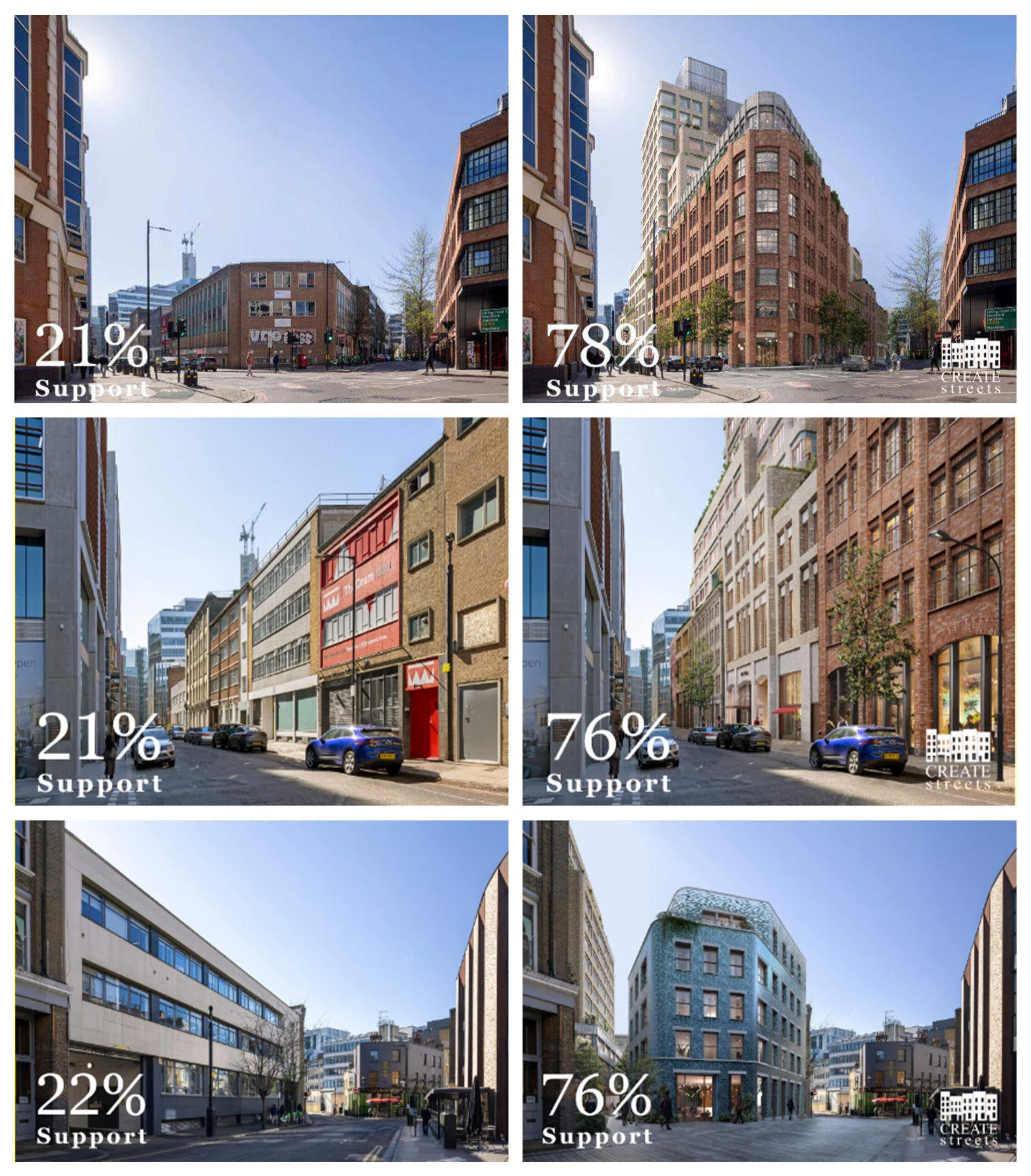
Re: Most people prefer traditional architecture
#174https://substackcdn.com/image/fetch/$s_!5kYm!,f_auto,q_auto:...
Which side is modern and which is traditional? The examples on the right are clearly more modern than the examples on the left to my eye: the left looks like it's from the '70s while the right is unmistakably 21st century. But the examples on the left are run-down, plain, and feature advertisements and bricked-up windows and steel shutters and security doors, while the examples on the right are brand new and shiny and walkable. There's graffiti in the first example and in the last one they replaced the asphalt with pavers!
Hard to take the conclusions seriously when the authors have their thumbs on the scale.
Re: Most people prefer traditional architecture
#175Earlier quoted context omitted.
I don't think this computes. Modern 'efficient' industrial design can absolutely fail at efficiency. I have lived in spartan, utilitarian apartments that you could tell were built without any regards for efficient use of living space, and ended up wasting huge swaths of their floor area to interior corridors, winding tunnels between rooms, random walled off mystery areas and overall such poor planning that I'm sure d…
> The Empire State Building was famously built in a year. Nowadays the most utilitarian housing project takes longer. This is true, but usually fewer people die in the construction of those utilitarian housing projects
Re: Most people prefer traditional architecture
#176“Yes, God damn it, the Parthenon!”
The ruler struck the glass over the picture.
“Look,” said Roark. “The famous flutings on the famous columns—what are they there for? To hide the joints in wood—when columns were made of wood, only these aren’t, they’re marble. The triglyphs, what are they? Wood. Wooden beams, the way they had to be laid when people began to build wooden shacks. Your Greeks took marble and they made copies of their wooden structures out of it, because others had done it that way. Then your masters of the Renaissance came along and made copies in plaster of copies in marble of copies in wood. Now here we are, making copies in steel and concrete of copies in plaster of copies in marble of copies in wood. Why?”
Re: Most people prefer traditional architecture
#177Like what? A shadowy cabal of liberal elites pulling the strings from the shadows? Stripe (who own Works In Progress) founder Patrick Collision donated to the Trump campaign in 2024. Tiresomely obvious what this "piece" is trying to do. Find a new gimmick imho.
Re: Most people prefer traditional architecture
#178Next thing you're gonna tell me that English speakers overwhelmingly prefer novels written in English. Cultures have visual languages just the same as they have written and spoken (and signed) languages. The crucifix symbol has an understood meaning in most European cultures, because of how foundational Christianity is to their cultures. Is it really so surprising that people prefer buildings in a visual language the…
Seems to me that your positions are in opposition to each other. 1. There’s a traditional visual language that people instinctively prefer. 2. Modern architectural sensibilities have superseded traditional visual language through repetition. I’m reading this to mean something like “people like their own traditional foods but since they've been drowning in pizza for the last 70 years, they’ve forgotten about their tra…
The article even seems aware of this possibility when it mentions that architecture students prefer modernism (with the semi-covert implication that their education is poisoning their aesthetic sensibilities). I claim its at most partially because they've been taught to prefer modern designs, but mainly because they've been taught to think about visual languages consciously, so they are able to recognize what a given architect is trying to do, in a way that a layperson might not. That's certainly why Thomas Kinkade gets as much hate as he does (that and the dodgy business practices...).
I'm also not claiming that people have been starved of traditional architecture entirely, just that nobody is building things in the traditional style now. They're not tearing them down either, the White House East Wing not withstanding. This is a novelty bias, nothing more. If you only ever see neoclassical architecture in buildings that are designated as "fancy" or "special" or "august", and all these modern, ordinary buildings do not, you're going to assume that the style itself, and not simply the age and intent at construction are what contributes to that.
I mean, 39 out of 50 US state capitol buildings have domes, as does the nation's capitol building. I think anybody in the US can be forgiven for thinking that dome = legitimate seat of authority. Certainly, that was the hypothesis behind the design decision.
Speaking only for myself, I found Washington DC, which is all neo-classical all the time, just really boring. All the buildings look the same, and I couldn't escape the sense that I was in museum that hadn't been updated in a long time. Chicago's Fields Museum has the same quality.
Re: Most people prefer traditional architecture
#179Earlier quoted context omitted.
Yes, every time people get grumpy about modern architecture and look over to see if I agree I tell the story about how I used to work at a company in Boston which moved from a beautiful 19th century building to a soulless Modernist steel-and-glass skyscraper. And thank fucking god: the old building was too hot in the summer, too cold in the winter, had too little natural light, and was too cramped. The Modernist buil…
I'm pretty sure that some kind of hybrid can be found where the exterior could look nice and the interior would be very nice as well. Now, not every modern building has to look like a glass and steel colorless brick. For example, I really like the look of Oodi [0], Helsinki's new library: it reminds me of wood covered with snow, and the interior is exactly what you would expect from a modern building (built in 2018).…
The article reads like the author picked a conclusion and made things fit his opinion.
Re: Most people prefer traditional architecture
#180There's more to architecture than just the façade, which is what people are rating when they are just looking at photos of the exterior. The interiors, structure, and services, etc. of modern building are often far superior to older ones, and i suspect many 'ordinary' people would agree.
Right but that's not because modern architectural style has made the interiors better. It's mainly technological improvements that allow larger windows, bigger space, better insulation, etc. You can totally have a traditional style building with a modern interior without a hint of brutalism or concrete.