Live data from Hacker News

Cartesian – AI 3D Modeling for Design

formas.ai

41–50 of 87 posts

Re: Cartesian – AI 3D Modeling for Design

#41
post #34
post #18

Earlier quoted context omitted.

CAD is a different beast than mesh modeling. For product design you need a parametric model that can have precise dimensions and is constructed mathematically step by step. Mesh modeling is just moving a pile of triangles around in a very imprecise way. Works fine for 3D printing or digital assets, but if you want something that can be manufactured that's not good enough. And there isn't a good way to go from STL ->…

It's just a matter of time. Astra was trained on a new 3D modelling dataset. They will surely train it on CAD apps (if they have not already done so). I don't hold out much hope for competitors hoping to get in front of that train.

[deleted]
Re: Cartesian – AI 3D Modeling for Design

#42
post #40
post #9

Earlier quoted context omitted.

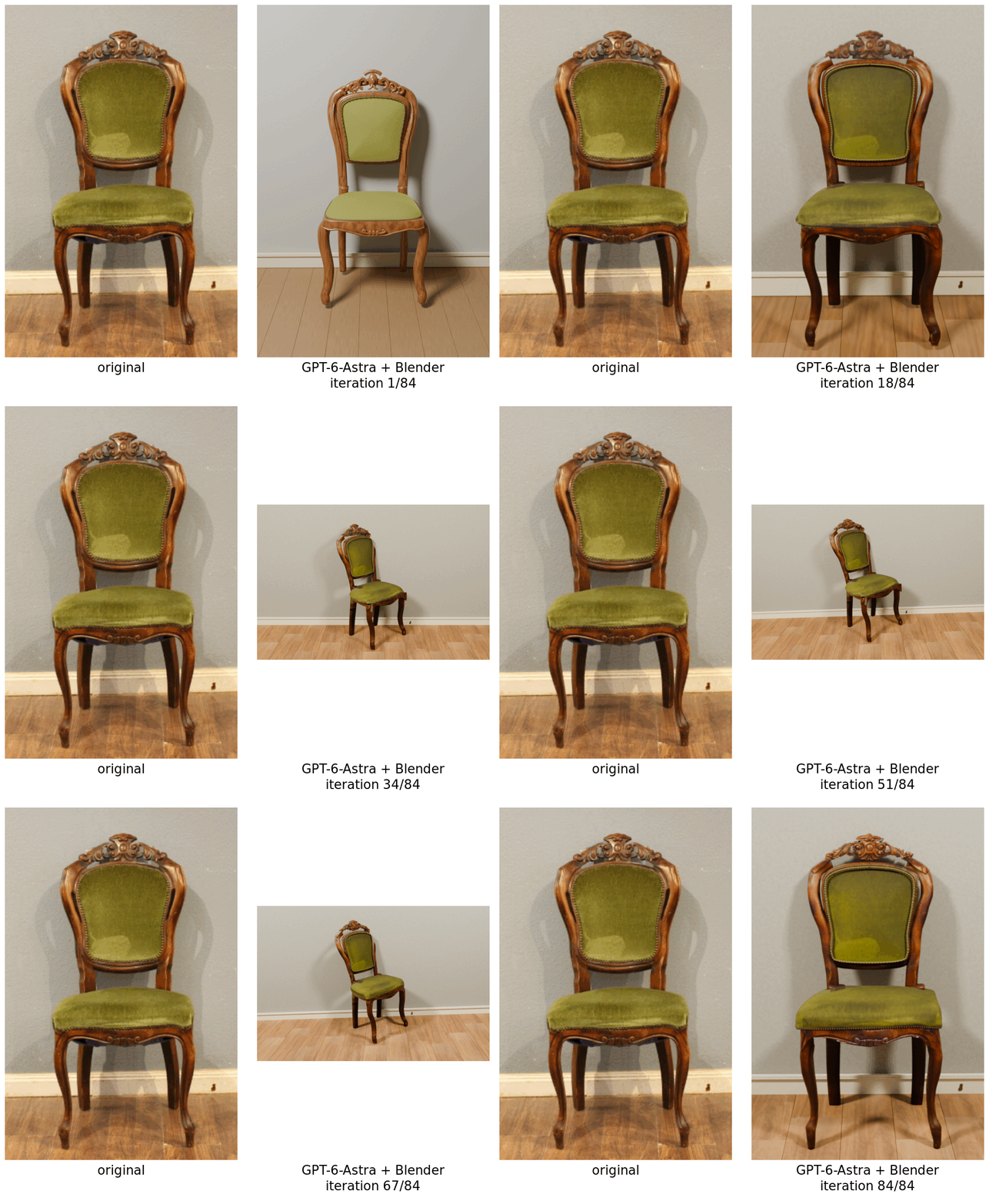
Exactly. I just give Astra an image such as furniture, and it creates an 3D reproduction in Blender. You don’t even need computer use. Codex and Blender’s scripting engine is enough.

Can you do this with the 20 dollar plan?

Yes, but it eats your 5-hour quota really quick.

Re: Cartesian – AI 3D Modeling for Design

#43
post #21
post #15

These products are still in their early stages, but it is clear that the AI wave is reaching 3D modeling as well. It will impact mechanical and civil engineering just as it has impacted software development.

I don't think so. As a mechanical engineer, CAD is only half of the design process. The other half is actually building and assembling your design and testing/debugging what you've created. You still need the mechanical knowledge and intuition to take something in the physical world, figure out why it doesn't work, and apply that to the CAD design to improve it. It would be incredible to have AI help me model faster,…

> As a mechanical engineer, CAD is only half of the design process.

Same thing can be said about animation and games.

Re: Cartesian – AI 3D Modeling for Design

#46
post #40
post #9

Earlier quoted context omitted.

Exactly. I just give Astra an image such as furniture, and it creates an 3D reproduction in Blender. You don’t even need computer use. Codex and Blender’s scripting engine is enough.

Can you do this with the 20 dollar plan?

I have an example here. Took 3 hours with Pro Plan.

https://simulationcorner.net/chair/chair-evolution.gif

Re: Cartesian – AI 3D Modeling for Design

#47
post #38
post #35

Earlier quoted context omitted.

Astra can use build123d, too. You'll get a STEP out of that.

I've tried Sol on build123d and it was completely unusable, I should take another stab with Astra though.

I had a similar experience, but it worked just well enough that I wanted to try my own similar experiment, but using a functional API in Elixir and giving the agent some introspection tools. I'm very much a novice to this space and learning as I go, but I've been able to make some interesting projects with the library so far, which is all I really want to do: https://smith.hexdocs.pm

If you want to build by hand, there is a Kino renderer to build your projects interactively in Livebook, which is actually surprisingly helpful for learning.

Re: Cartesian – AI 3D Modeling for Design

#48
post #18

I've been using Astra to just create things in Blender. It's great. Kill the scroll jacking. It's a sign you're on Windows.

CAD is a different beast than mesh modeling. For product design you need a parametric model that can have precise dimensions and is constructed mathematically step by step. Mesh modeling is just moving a pile of triangles around in a very imprecise way. Works fine for 3D printing or digital assets, but if you want something that can be manufactured that's not good enough. And there isn't a good way to go from STL ->…

CATIA has had mesh import with canonical feature detection, and automatic replacement with parametric part features, for at least 25 years. It's in the "Quick Surface Reconstruction" and "Basic Surface Recognition" tools. They even work sometimes.

https://3dswym.3dexperience.3ds.com/wiki/catia-user-communit...

https://resources.rand3d.com/insights-from-within/scanned-da...

Unfortunately the P3 license costs like $15k per year, and it is f'in ugly clunky software.

Re: Cartesian – AI 3D Modeling for Design

#50
post #31

Earlier quoted context omitted.

None of the things you list in the "other half" are out of reach for AI. Also: disagree about the lack of validation loop: a) AI can actually build one for you in many cases b) if you give agents an actual validation toolkit, you'll be surprised what AI can do Of course, if you expect to prompt "give me a NURBS model of a complete, working v8 motor" and get a result, then yeah, sure, we're not there yet. I've actuall…

AI cannot physically build anything in the real world, what are you referring to? That's a huge part of mechanical engineering. And you can give it simulation tools, but those are far far away from accounting for everything in real-world physics. You can simulate very tightly constrained problems, but you can't simulate "assemble this actuator and test it", there are so many more variables in the real world that are…

This is how LLMs have been since the beginning. They can be really okay at the most surface level information, but as soon as you dig any bit beyond that, it all falls apart. Inquire any chatbot about something that you're an expert in and it becomes quickly apparent.

I'm here for using LLMs to take some of the tedium out of product design/mechanical engineering, but I just haven't seen a good proof of concept yet. It always seems to be some variation of "Design a sphere. Oh wow, this is incredible!"

Post reply on HN