Live data from Hacker News

No Man's Sky Cosmos

nomanssky.com

241–250 of 434 posts

Re: No Man's Sky Cosmos

#241
post #51

Earlier quoted context omitted.

A big name in proc gen is Kate Compton who coined the term "10,000 bowls of oatmeal" to describe this phenomenon of technically unique but not different enough to matter - I googled "10000 bowls of oatmeal" to see if there was a good article and the second link was about it and nms https://www.challies.com/articles/no-mans-sky-and-10000-bowl...

That's pretty much the perfect description of NMS. Every planet is 'different', every site on the planets are 'different', but not different in any meaningful way. Oh look...this planet has 4 legged animals that are green and bumpy and the last one they were brown and spiky...but they move the same and act the same. Yawn.

I played it about a year ago for the first significant time after having bought it some point a long time back.

It's... fine? It kept me engaged until it didn't. Part of the "didn't" came about because I was being paper-cut to death by bugs that googling showed me had been reported for a long time, if not since the very beginning.

I kept feeling like it was a game on the verge of happening throughout, and it never quite made it. Lots of things to go do to serve.. no purpose. Nothing was that unique or memorable, and I often had very little clue where I was in relation to anything. At one stage I was overseeing a town but that seemed to do nothing for me other than make me go back and make a snap decision for no discernible reason, occasionally fight hostile creatures, and also act as a sink for resources I was gathering.

I kept thinking "Why am I even doing this" until it really sunk in "Why am I even doing this?" and quit.

It also exasperated me that even though I was using a pretty fast gaming system, on a regular basis assets would take ages to appear, including buildings. "Fly to this place on the planet, land at this archaeological dig, wait 3 minutes for the dig to bother to appear before you can do anything." (saw identical behaviour on my steamdeck too, so doesn't seem "my machine" per se?)

Re: No Man's Sky Cosmos

#242
post #209

Earlier quoted context omitted.

Roguelikes are the ultimate in procgen technology, and should be the basis of any design. (DF is the ultimate simulation but uses procgen as a tool to achieve it; a different vein than NMS trying to explore the procgen and its direct outcomes itself) 1. Any imaginary world needs to be internally consistent to be interesting. Procgen does not void this rule; randomization needs to be gated to that internal consistency…

You can work around 12. with constraint satisfaction solvers. After generating the level structure, emplace an entrance and exit such that they are maximally apart. And emplace a strong monster in one of the rooms around the exit. And emplace a health potion in one room before the strong monster. And emplace treasure in the exit room. That sort of stuff and be specialized and coded towards your particular games struc…

The problem is setups like in slay the spire, if we imagine there was no path selection, you can run into scenarios that are functionally unwinnable (I recall someone finding a seed in StS that was literally unwinnable, but ignoring that). Eg Act1 elites that counter your build, but too early for you to consistently have secondary options/workarounds.

Obviously people have high consistent wins in StS1/2 so it’s not like they’re guaranteed unwinnable, but for the average human (mostly just boils down to “path to do act1 elites until after you probably have a counter to all of them)

Your options are:

1. All scenarios are easy enough that you can get away with just about anything sensible

2. You don’t have any counter mechanics, which is basically the same as 1, and is difficult to do anything interesting with

3. You announce up-front what you’re going to deal with, so the onus is now on the player to find a solution in the meantime

4. You give the player a NOPE utility

In a roguelike, I think 4 is the better design, but 3 is also reasonable. 1 & 2 just makes things less interesting.

Re: No Man's Sky Cosmos

#243
post #219

Earlier quoted context omitted.

A big name in proc gen is Kate Compton who coined the term "10,000 bowls of oatmeal" to describe this phenomenon of technically unique but not different enough to matter - I googled "10000 bowls of oatmeal" to see if there was a good article and the second link was about it and nms https://www.challies.com/articles/no-mans-sky-and-10000-bowl...

I haven't played it myself, but surely an article written one month after the game's release doesn't do it justice, considering there have been multiple major updates attempting to address the gripes players initially had with the game in the 10 years since then (And review trends on steam indicate that these attempts were successful)

I played it in VR and it still does.

No Man's Sky suffers from planets being "deserts", they have different attributes but it's still a fairly lifeless empty world.

Ironically this is realistic but also not terribly fun as a player.

Re: No Man's Sky Cosmos

#244
post #234
post #5

It's amazing how, every time i come back to NMS, the whole thing feels like... nothing. It's a very cool and ambitious project, but there's fundamentally nothing substantial to it in terms of gameplay. It still feels to me, a decade later, more like a very very impressive tech demo than a video game

I've heard it described as "wide as an ocean, deep as a puddle"

bout 5 months ago i gave it 2 hours of my life and asked for a refund once i realized i had basically seen the whole game in that first like 30 minutes of playing.

the only game that seems to hit the mark of what im actually itching for is star citizen that is in a perpetual state of never-finished but i can't even quite put a finger on what it is i'm after. beauty, art, real weather, being able to fly up through the atmosphere and just let me escape into a sci fi movie. i can acknowledge star citizen has actually come a long ways and i think they do deliver that, though i haven't played it myself just going off vids ive seen.

NMS somehow feels like a visual and playable interpretation of depression to me with a Dr. Seuss world backdrop lol. Like it reminds me of times in my life where I've just been stuck in the motions, unhappy, resigning myself to the fate of doing absolutely nothing of inspiration because I felt like I had no other options and gave up.

Shout outs to steam for refunding when my reason was "This game is actually depressing"

Re: No Man's Sky Cosmos

#245

Earlier quoted context omitted.

I think people are regurgitating takes from early in the game's development - the game of the last few years is absolutely nothing like the early one and I agree, there is a surprising amount of stuff to do.

I have never played, but I watched all the drama unfold on reddit. It makes me wonder, is this what happens when you have an underwhelming launch? "You only make a first impression once" - and there is a huge price to pay for that? In SaaS and YC, it's ship early and ship often, right? Is that absolutely not the case in games? Also, how true is it in SaaS? Genuinely curious here.

No Man's Sky and Cyberpunk 2077 are actually proof you can have an awful launch and still pivot into a large player base and continued sales via updates.

Reception for both games is largely positive despite their poor initial response.

Re: No Man's Sky Cosmos

#246
NMS is an amazing game with no soul. A metaverse. A monument to technology without the depth or people or narrative (prewritten or emergent) that makes it interesting.

I'm certain there are some people whose brain is wired exactly right to love it.

But I have more fun playing the n100th Call of Duty clone hearing real voices on the headset in a tight, fun game loop.

But the company behind it deserves to be applauded. Might be the best value for money / care / support of any game, especially one so poorly received initially...

Re: No Man's Sky Cosmos

#247

NMS is an amazing game with no soul. A metaverse. A monument to technology without the depth or people or narrative (prewritten or emergent) that makes it interesting. I'm certain there are some people whose brain is wired exactly right to love it. But I have more fun playing the n100th Call of Duty clone hearing real voices on the headset in a tight, fun game loop. But the company behind it deserves to be applauded.…

In a way, it might reflect accurate space and our universe. We really might be alone.

Re: No Man's Sky Cosmos

#248
post #51

Earlier quoted context omitted.

That's pretty much the perfect description of NMS. Every planet is 'different', every site on the planets are 'different', but not different in any meaningful way. Oh look...this planet has 4 legged animals that are green and bumpy and the last one they were brown and spiky...but they move the same and act the same. Yawn.

Spore had that but I kind of liked it. I guess that was 20 years ago almost, maybe my standards were lower. It felt charming seeing others' animals, some of them looked pretty cool.

There's a fundamental difference between procedurally generated worlds and how Spore actually works.

The creatures, vehicles, and buildings weren't generated -- they were created by other players and exchanged asynchronously, then seeded into your procedurally generated galaxy.

Spore is a Massively Single Player Online Game: no real-time multiplayer, but your galaxy fills with other people's content.

That's the opposite of the oatmeal problem. Procgen gives you infinite bowls that all taste the same. Spore gave you a finite but large set of bowls, each made by someone who cared about it. Different tradeoff, different failure mode -- but not the one this thread is about.

GDC 2005, Will Wright, The Future Of Content:

https://www.youtube.com/watch?v=N4ScRG_reIw

>[...] Also I want to apologize for the title of this talk in the description, which I know was kind of hopelessly vague.

>What usually happens every year is GDC, they call me up, and they say "we want you to do a talk" and I say okay, and then a week later they say "what's your talk about" and so then I think about it for a while and oh, get a rough idea of what I'm going to talk about, and I give them some kind of generic title in that area.

>That's what usually happens. But this year was different. This year when they asked me what I was going to talk about, I just flat out lied.

>But, so I'm not really going to talk about the future of content. I'm really more in fact going to talk about a possible future of content you know.

>It seems like the theme that I'm coming away from this conference with so far is that the next generation titles are going to be incredibly expensive, we're going to have to build mountains of content, and it's going to drive most of the smaller players out of the market.

>And I'd like to offer potentially an alternate vision of that. You know I think that there is a way to deal with that more creatively. So maybe a more accurate title for this talk would be "What I learned about content from The Sims".

That was 21 years ago. The same argument is being made again right now, with a different machine offered as the answer, and Will's alternative is still the one nobody is trying.

Will's advice for game designers and creative humans in general, from my notes on the talk:

>If you have a weird idea that's so outside of the box, don't forget it. You should go back and revisit your weird ideas later, because you can never know where they might lead to.

In February 2007 PopSci, Will explains the whole design rationale:

https://www.popsci.com/entertainment-gaming/article/2007-02/...

>We thought about it. In fact, technically, based on all the stuff we've already done for it, it wouldn't be very hard at all. We've already solved all the hard problems we would need to do a persistent online world version of Spore. The hard part is, what happens when you come to a planet and the planet's offline? Which would be the case. In fact, one of the reasons why I kind of went down this path is that nobody has really explored the hybrid model. And this really is a hybrid, it's what we call a massively single-player game, where we try to get the benefits of an online game, which is all the people building the world collectively together, without the liabilities, which is that the 14-year-old can kill you or that you've invested all this time in your planet and somebody comes along and blows it up, and therefore you had to put everybody on the same level treadmill. And I hate these level treadmill games, and I wanted the players to feel really empowered.

GDC 2005 Report: The Future of Content

https://www.gamedeveloper.com/design/gdc-2005-report-the-fut...

I posted more details on the Spore Stats discussion in 2023:

https://news.ycombinator.com/item?id=36280275

>Here are my notes and summary of the GDC 2005 talk where Will Wright first revealed Spore, which I asked Will to review and check for accuracy. It's interesting to compare the design he described in the talk with what Maxis eventually shipped. Video of the hour long talk:

https://www.youtube.com/watch?v=N4ScRG_reIw

>One of the essential problems with designing a Massively Multi Player Online Game like Spore is that players at different levels of the simulation run at different time scales.

>Maintaining time synchronization between players is also the reason The Sims Online doesn't have a "Pause" button or speed controls, or automatically pause in build and buy mode, like The Sims.

>So instead, Spore is a Massively Single Player Online Game. Users don't interact with each other in real time, but instead users can create their own content, and it exchanges that content between users asynchronously.

>That's also how The Sims Exchange lets players asynchronously upload and download their Sims save files along with web pages describing their house, sims, and photo album.

https://donhopkins.medium.com/the-future-of-content-will-wri...

>The Future of Content — Will Wright’s Spore Demo at GDC 3/11/2005

>What I learned about content from the Sims. …and why it’s driven me to procedural methods. …And what I now plan to do with them. Talk by Will Wright, Game Developers Conference, 3/11/2005.

>Based on notes taken by Don Hopkins at the talk, and other discussions and review by Will Wright. The title of the talk “The Future of Content” was purposefully vague, because Will wanted to show Spore in public for the first time, but he had to flat out lie about the title and send a fake set of slides for the EA executives to review, so they didn’t know what he was about to do. A more accurate title for the talk would be “What I Learned About Content from The Sims, and Why it’s Driven Me to Procedural Methods, and What I Now Plan to Do With Them”. [...]

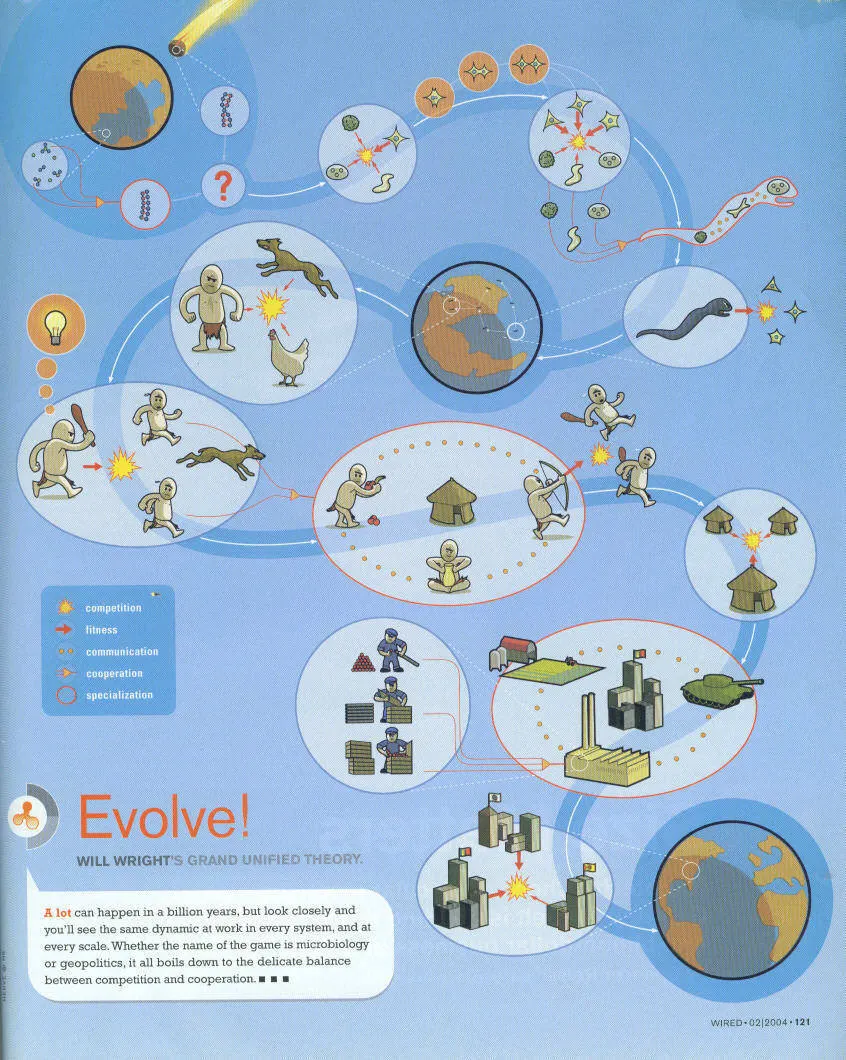
>Wired asked for an illustration to print in the magazine, anything he wanted. So he made a diagram of Spore that Wired published, but he didn’t tell them what it was. The design docs for Spore have been out in Wired Magazine for a year now. (It’s in the Feb 2004 issue of Wired.)

>Will’s Secret Diagram of Spore published in February 2004 Wired:

https://donhopkins.com/home/WiredSporeDiagram.jpg

[...]

https://news.ycombinator.com/item?id=36280831

>And that is the whole point, how you win the game: become involved with the content creation community!

>The powerful but easy to use direct manipulation editor tools, the automatic content sharing system, and the online community around user created content, were together the most innovative and successful things about Spore. (As contrasted with the not as well realized gameplay and storytelling design goals.) [...]

>Chaim Gingold, A Brief History of Spore:

http://www.levitylab.com/blog/2011/02/brief-history-of-spore...

>Creativity

>Of course, these aren’t any old aliens we ask players to invest in — they’re your creation, your aliens. Once you start customizing, and design your creature, emotional investment is generated. It’s magic. Even the ugly ones are loved by their parents. Many games thrive on the interest generated by players’ creative investment. Console role playing games, for example, get this effect when players invest time in equipping and naming characters. I’ve always felt more attached to my characters as I fuss over their outfits and equipment. Creative interaction seems to always generate emotional involvement and attachment. Psychologically, it would seem that part of this stems from the sunk cost fallacy — we become attached to things we’ve invested time and energy into. Of course, it’s not just the hundreds of hours invested in a World of Warcraft character, their relationships, and possessions that generate attachment, it’s the sense that our fabrications are extensions of ourselves. As recipients of our attention and creative energy, our handiworks are reflections of who we are, tangible manifestations of our personalities. It’s no wonder we become attached to what we make, and take the success or failure of our own work and ideas very personally.

>Spore neatly solves the alien attachment problem by asking the player to design them. If a player makes a creature, and it’s appealing, they’ll be quite invested in it. Reflecting on the success of The Sims Exchange, where players shared stories, characters, houses, and objects for The Sims, Will realized that shared creativity would give Spore a broader appeal. Why not build creative exchange into the game, rather than as a website that orbits it? Player created assets are constantly being uploaded and downloaded by Spore, enough material to fill a galaxy. There’s nothing like taking home your latest finger painting, and having mom hang it on the fridge for everyone to see. Sharing not only fills up the galaxy with cool stuff, but allows the entire world to see your fridge, motivating you to continue creating.

>Of course, a lot of deep magic must work properly for something like Spore’s creature creator to function properly. It must be natural to use, easily producing satisfying results for anyone, from beginners to advanced users. And these aliens, lumps of polygons that no animator has ever seen before, must be brought to life. These are rather complicated endeavors, from a design, aesthetic, and technical point of view, but the player should never notice any of it. The game design implications are also challenging — the game must be playable and interesting, regardless of the creatures dropped into it.
Re: No Man's Sky Cosmos

#249
post #43

at the time of posting, i think every top-level comment except one is negative. so, i'd like to balance it by saying that i have never seen a better executed turnaround than what the no man's sky team did. they cratered their reputation on launch, worked hard and long to restore it, and then continued to offer free updates long after they needed to. lots of respect there. (i will reward the effort by purchasing their…

no matter what, that always happens with this game. Any news about it causes the people who played for 10 minutes at launch however long ago come back to tell you how much they didn't like it.

Many of the day 1 game breaking bugs still exist and every time I play it every couple years, they’re still there.

Re: No Man's Sky Cosmos

#250
post #216
post #86

Earlier quoted context omitted.

"I have never thought to myself that realism is fun" - Gabe Newell

True realism is often interesting though, which provides more long term engagement than fleeting shallow fun. Look at some of the hard core 3rd party addons for flight sims, for instance, which are so realistic they actually ship licensed versions of the real aircraft training manuals and checklists - because every switch and procedure works.

True realism at the right place and time.

Fly out of SeaTac or Chicago O'Hare in most flight sims at sunrise, and you'll get a richly detailed airport, realistic traffic, realistic surrounding terrain, etc. with hopefully jaw-dropping views.

Pick a random airport at a random time with an obscure name or location in the US Midwest, and they all start to look the same (even with detailed, realistic geography): a mostly flat expanse with some hills, and either just the local city lights (if that) or a dull mid-day sun.

To be fair, those checklists are also largely there for so many pilots and those in training whom want to get the experience.

Post reply on HN