Live data from Hacker News

Initial effects of AI technology on employment look positive

economist.com

151–160 of 164 posts

Re: Initial effects of AI technology on employment look positive

#151

I was laid off as a senior product manager in December of 2025. I’ve been looking for a new job in clean energy (which is supposedly “having a moment” due to data centers) since then. There is no “jobs boom”. There are certainly job openings — black holes into which you can lodge your resume. Occasionally, multiple rounds of interviews that go nowhere. I’ve been paying my bills as an art fabricator and live event ele…

> There are certainly job openings — black holes into which you can lodge your resume

And recruiters are just flat out creating fake job listings on Indeed, with no pretense, describing them as "an opportunity to register your interest in similar roles", and Indeed are allowing it.

Re: Initial effects of AI technology on employment look positive

#153

Earlier quoted context omitted.

This is indeed HN, so comments are of course skewed to a particular upper echelon of knowledge work, but I'll ask anyways: When you say (and perhaps you might speculate across other businesses) "hiring extra people... To handle AI initiatives" does that mean you're hiring Very niche and specialized AI people to handle these initiatives? I'm curious because I have seen some versions of this sentiment on HN and it sort…

No we are not hiring AI experts, just people we think can be trained to think AI-natively. It’s a different mindset that presumes whatever work you’re doing now is ultimately going to be used to train AI to do it later.

Ahh I see. Any spots for philosopher / educators?

Re: Initial effects of AI technology on employment look positive

#154
post #104

No they are not, try to change jobs and if you can't or takes a really long time you know this is some of the finest baloney. And no, it's not creating a lot of jobs, one one of the kind that will be destroyed by AI no, and that's the point... you built something that removes the pricey laywer, software developer, insurance policy writer, designer, etc... and replace it with a ONE TIME go work under the sun with no a…

"you built something that removes the pricey laywer, software developer, insurance policy writer, designer" This statement is untrue. The people have the judgement, the AI does the rote work. The rest is marketing fluff and/or leadership fumbles. You can't get rid of judgement (unless of course leadership is fumbling). With more AI, you got more radiology requests, and more radiologists [1] and better health results…

Jevons Paradox doesn't say more radiologist will have more work and will be paid at the same price, it says that there will be more work for radiologists because now they are paid less and because of that people is able to afford more radiologists.

"This statement is untrue. The people have the judgement, the AI does the rote work. The rest is marketing fluff and/or leadership fumbles. You can't get rid of judgement (unless of course leadership is fumbling)."

Let me refine it more... now the same lawyer/marketing/software engineer can work just approving the work of AI, reviewing it's correct so the exact same lawyer/marketing/software engineer can now perform X more times the amount of work they previously did, IF we don't triple the amount of work, then the rules of "free market" means that offer now exceeds by X the demand and you can now depress wages as much as you want because you can fire (x-1)/x of the people doing the work and the pool of people willing or needing to do that is increased.

This does not contradict at all what I stated above.

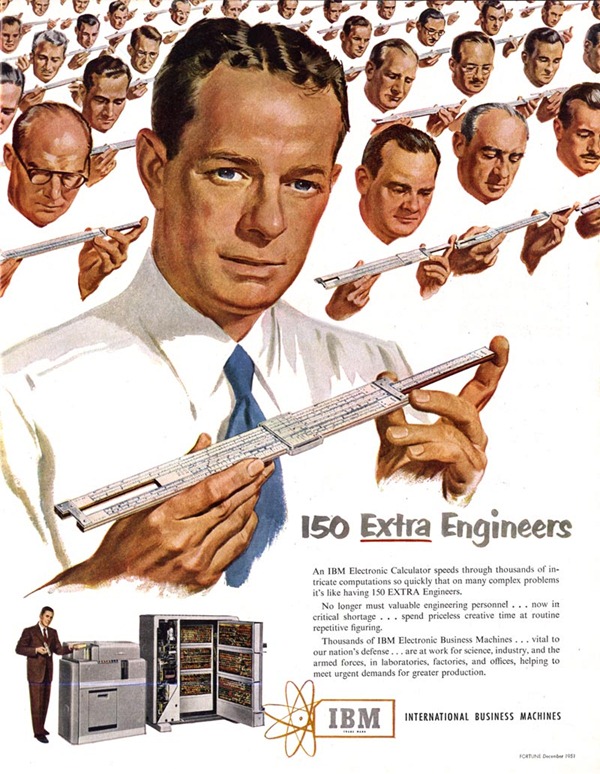
The ultimate proof of this is how much the "calculator people" now earns now that calculators were created... and for reference this old ad about the effect of calculators on the number of engineers

[0]: https://www.globalnerdy.com/wordpress/wp-content/uploads/200...

Re: Initial effects of AI technology on employment look positive

#156
post #154

Earlier quoted context omitted.

"you built something that removes the pricey laywer, software developer, insurance policy writer, designer" This statement is untrue. The people have the judgement, the AI does the rote work. The rest is marketing fluff and/or leadership fumbles. You can't get rid of judgement (unless of course leadership is fumbling). With more AI, you got more radiology requests, and more radiologists [1] and better health results…

Jevons Paradox doesn't say more radiologist will have more work and will be paid at the same price , it says that there will be more work for radiologists because now they are paid less and because of that people is able to afford more radiologists. "This statement is untrue. The people have the judgement, the AI does the rote work. The rest is marketing fluff and/or leadership fumbles. You can't get rid of judgement…

"radiologists because now they are paid less and because of that people is able to afford more radiologists."

But again, the opposite is happening. Radiologist salaries are up 9% YoY [1]. And you can now get your radiology done more cheaply [2]. Literal win-win.

Radiologists are not human calculators, neither are lawyers, accountants or insurance adjusters. As we learned very quickly, their job is judgement and human relationships and you can't cut that out

You did correctly lay out that if you can't grow your business by increasing demand, you are shrinking. And yes shrinking leads to layoffs regardless of AI.

Very cliched now but: You are not being replaced by AI, you are being replaced by someone who's using AI, who is more productive with it. But specifically, this is true for individuals and company-wide. Less productive organizations will be pushed out if they can't lower their prices and meet the increasing demand, and the only way they do that for modern white-collar work (not rote 1950's calculator churning) is to hire more AI-ready staff.

FWIW, The IBM ad is literal marketing fluff. More engineers were employed in the immediate aftermath of the mainframe than anytime before.

EDIT: I'm not trying to argue with you, I'm trying to show you things most headline news refuses to show because it's boring and counter-narrative. Shoutout to the economist.

[1]: https://fortune.com/article/ai-godfather-radiologists-obsole...

[2]: https://pmc.ncbi.nlm.nih.gov/articles/PMC10986240/
Re: Initial effects of AI technology on employment look positive

#157
post #75

Earlier quoted context omitted.

Are you serious about this imbalance? it's the seriously rich that have taken all of the spoils, that's where the massive imbalance is. I'm not disagreeing that some manual work require forms of intelligence that are undervalued in our society, and don't get me started about nurses, but still: What the Jeff Bezos!

> it's the seriously rich that have taken all of the spoils, that's where the massive imbalance is. It depends on how you define “spoils.” People define it to include notional paper wealth, and I think that doesn’t reflect the actual mechanics of economic imbalance. On paper, NVIDIA’s shareholders have increased their wealth by $4.8 trillion in five years, enough to buy all the residential real estate in New York Cit…

The bigger issue is weak competition. When a few companies dominate a market, they can raise prices, suppress wages, and capture more of the gains from economic growth.

That is also a big part of why wealth has become so concentrated at the top. If there were ten real cloud competitors, eight GPU makers, or several serious Office competitors, those companies would have a much harder time keeping such a large share of the profit. Instead, concentrated markets create enormous profits, and concentrated ownership turns those profits into enormous fortunes.

In my opinion, that has a bigger impact on the bottom 90%, and even on the upper middle 10% you are talking about, than the direct consumption of the top 10% ever could. It would be much better to raise the purchasing power of the bottom 90% than to reduce the consumption of the top 10%.

Re: Initial effects of AI technology on employment look positive

#158
post #107
post #104

No they are not, try to change jobs and if you can't or takes a really long time you know this is some of the finest baloney. And no, it's not creating a lot of jobs, one one of the kind that will be destroyed by AI no, and that's the point... you built something that removes the pricey laywer, software developer, insurance policy writer, designer, etc... and replace it with a ONE TIME go work under the sun with no a…

AI has completely broken interviewing as well. The asks I am getting in the few interviews I can achieve are schizophrenic. They have pretty uniformly wanted me to demonstrate using AI but then freak out and interrogate me for every prompt and then want me to demonstrate I can do the task by hand. And that’s only after getting through the AI run filtering that gives a different score everytime your unchanged resume i…

I don’t know if those companies are doing it for the right reasons but I’ve implemented a policy of showing me that you can do the job manually as well.

The reason being that if you can’t then you probably can’t tell when the AI is wrong.

My company is strictly Cybersecurity/IR though so that may vary with other specialties.

Re: Initial effects of AI technology on employment look positive

#159
post #75

Earlier quoted context omitted.

> it's the seriously rich that have taken all of the spoils, that's where the massive imbalance is. It depends on how you define “spoils.” People define it to include notional paper wealth, and I think that doesn’t reflect the actual mechanics of economic imbalance. On paper, NVIDIA’s shareholders have increased their wealth by $4.8 trillion in five years, enough to buy all the residential real estate in New York Cit…

This is really a point that I think goes so misunderstood by so many. Yes billionaire's are bad, but people making 3x the median have a much bigger impact on those making median or less.

[dead]

Re: Initial effects of AI technology on employment look positive

#160
post #107

Earlier quoted context omitted.

AI has completely broken interviewing as well. The asks I am getting in the few interviews I can achieve are schizophrenic. They have pretty uniformly wanted me to demonstrate using AI but then freak out and interrogate me for every prompt and then want me to demonstrate I can do the task by hand. And that’s only after getting through the AI run filtering that gives a different score everytime your unchanged resume i…

I don’t know if those companies are doing it for the right reasons but I’ve implemented a policy of showing me that you can do the job manually as well. The reason being that if you can’t then you probably can’t tell when the AI is wrong. My company is strictly Cybersecurity/IR though so that may vary with other specialties.

If the interview was specifically about doing it manually that’s one thing.

I called them schizophrenic because the companies I’ve interviewed with seem like they desperately want to be on the AI bandwagon and want you to demonstrate the ability to effectively use AI, but they don’t currently know how to evaluate that and panic and default back to their old heuristics.

It is very difficult in 45-50 minutes to complete a task when the criteria change partway through.

Post reply on HN