[deleted]
How an MIT research project became the Julia programming language
71–80 of 142 posts
Re: How an MIT research project became the Julia programming language
#72Earlier quoted context omitted.
It was a great idea for a language. In practice though,it's hard to recommend. Great pet project for some mit professors to make a bunch of side money on top of their salaries though. Everyone else riding it is pretty much trying to niche their career rather then build something people can rely on unfortunately. It's the most unstable language I've ever used. In production I watched companies spend millions of dollar…
This depends a lot on what you're trying to do with it. There have been companies which did what you described, but there's also companies happily using it. If you reach into unstable language internals, yes there is a lot of churn. If you use public language interfaces, the language has been extremely stable for a long time. The ecosystem quality and quantity depends a lot on what you're trying to do. If you're far…
[deleted]
Re: How an MIT research project became the Julia programming language
#73Yet another example of MIT taking far too much credit for something...
MIT gonna MIT. That's a known issue. But HN users are still upvoting articles that are literally MIT press releases.
Re: How an MIT research project became the Julia programming language
#74Earlier quoted context omitted.
> More like breaking changes That certainly has not been my experience with the language since 1.0 > weird issues with basic transitive dependencies breaking after a minor version bump to the language. Not sure what exactly this is referring to, but I suspect it was some bugs that happened when some stdlib packages were taken out of the sysimage and started being treated more like regular packages which are pre-insta…
Yea this wasn't user error which is the common gaslight trope from the Julia community. Yes some of these instances post dated 1.0 . Yes the average person is sick of being told there's nothing wrong with the technology when there's been a serious track record of it being a disaster. For companies an expensive one. It's really not early days. The language is about 15 years old. That excuse gets really tired. It's cra…
Not trying to gaslight you. Especially if you were hitting that issue with the stdlibs, as I said, I don't think we should have allowed a release to go out with that problem. It was treated as bug though and fixed (though it also took longer than hoped).
The manifest thing is a good example of a hard situation. You have a file format that's not designed to be portable across versions, but the usage pattern around it heavily encourages that, so of course it gets used across versions and bad stuff happens. I'm sure theres also some other examples like this one can pull up.
Of course there's cases where we should be doing better. I'm just also saying that this isn't the only experience out there, and the negative experience you're reporting isn't my experience.
> It's really not early days. The language is about 15 years old. That excuse gets really tired.
Please don't twist my words. I was responding to what you said about webdev, and I said there was some interesting things happening in that space, but still early days. I was explicitly referring to the webdev ecosystem being immature, not the language.
Re: How an MIT research project became the Julia programming language
#75Do you think the criticism in the article "Why I no longer recommend Julia" about correctness is still valid? * there are too many correctness and composability bugs throughout the ecosystem to justify using it in just about any context where correctness matters * https://yuri.is/not-julia/
I think that article has been discussed to death and there's not much value in resurrecting it on every single post that mentions Julia. ultimately if you think the language might be a fit for your use case, I'd recommend trying it out and see how you like it first-hand.
I strongly recommend listening to others experiences and not forwarding some conversion metric for the languages share holders. Maybe there's a lot of wisdom in smart people being vocal enough to say "yea no" about it. It's not like it's one person...
Re: How an MIT research project became the Julia programming language
#76Do you think the criticism in the article "Why I no longer recommend Julia" about correctness is still valid? * there are too many correctness and composability bugs throughout the ecosystem to justify using it in just about any context where correctness matters * https://yuri.is/not-julia/
I think that article has been discussed to death and there's not much value in resurrecting it on every single post that mentions Julia. ultimately if you think the language might be a fit for your use case, I'd recommend trying it out and see how you like it first-hand.
[deleted]
Re: How an MIT research project became the Julia programming language
#77I did some Julia benchmarking over the weekend against a bunch of languages if anyone is interested. The workload is an EKF on an Apple M1, I'm trying to do as many as possible in parallel:
https://raw.githubusercontent.com/mech-lang/mech/codex/taich...
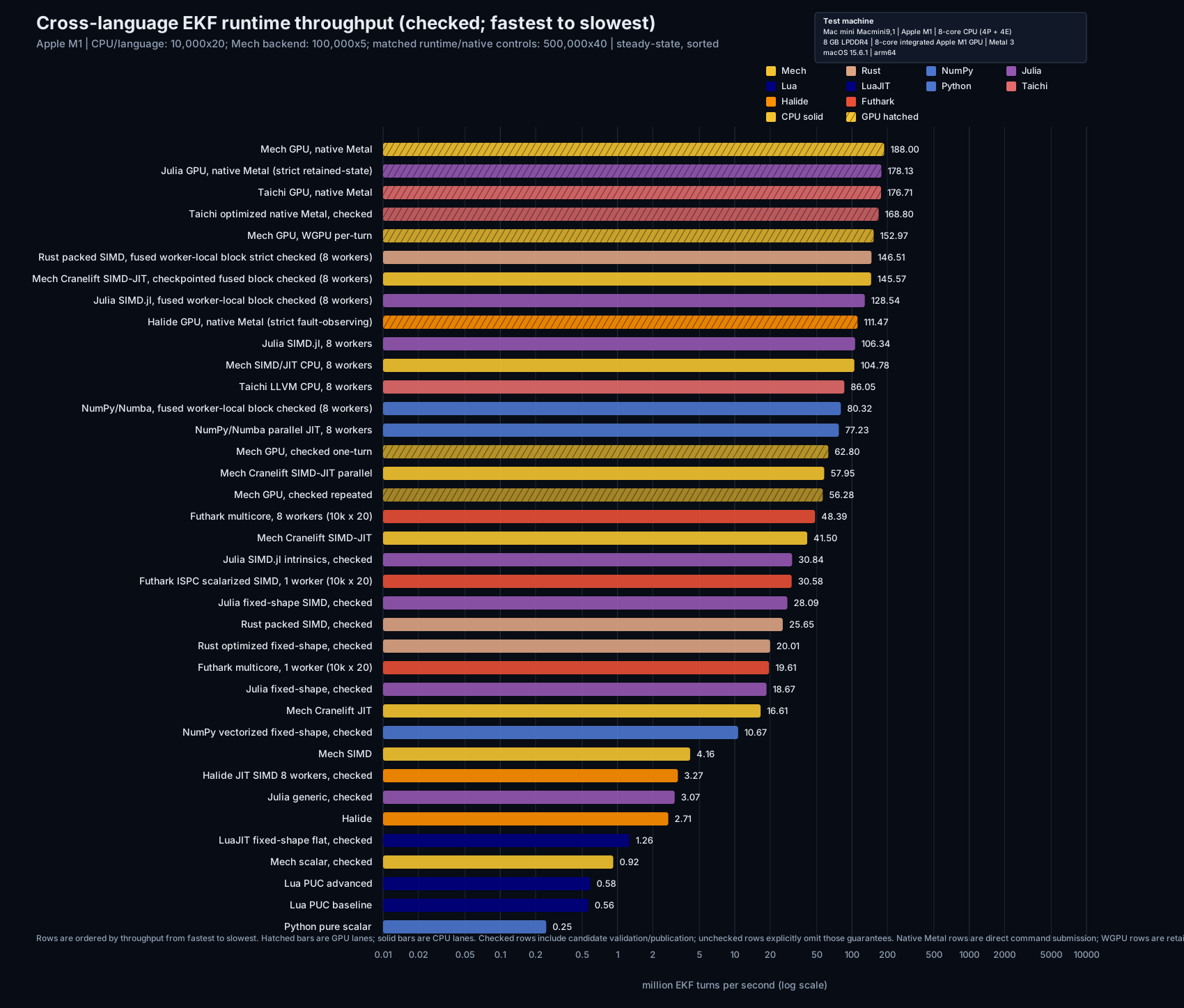
Compared against Taichi, Halide, Futhark, Rust', Lua, LuaJIT, Numpy and pure scalar Python. Julia holds up great it can run basically as fast as you'd like! (These are not apples-to-apples comparisons, picture this as a basket of fruit)
'The Mech results should be understood to be a lower bound on how Rust would perform.
Re: How an MIT research project became the Julia programming language
#78Earlier quoted context omitted.
I think that article has been discussed to death and there's not much value in resurrecting it on every single post that mentions Julia. ultimately if you think the language might be a fit for your use case, I'd recommend trying it out and see how you like it first-hand.
I strongly recommend listening to others experiences and not forwarding some conversion metric for the languages share holders. Maybe there's a lot of wisdom in smart people being vocal enough to say "yea no" about it. It's not like it's one person...
I don't have any financial interest in Julia so I'm a bit confused about the reference to "share holders." I'm just a user.
I'm sure there are lots of smart people who found that the language didn't suit their needs. there are also lots of smart people who love using Julia. both things can be true at the same time.
Re: How an MIT research project became the Julia programming language
#79Earlier quoted context omitted.
The third hole is _offset_ by 2, but if you ask a carpenter to add number labels to your pigeonholes, they are going to start at 1. Indexes start at 1, offsets start at 0.
Well, of course. And offsets are the measurements that get you to an element - the question was explicitly phrased as "how do I get to " ...
Technically they explicitly said “how do I get the”
Re: How an MIT research project became the Julia programming language
#80Unfortunately Julia is now a vibe coded project where Claude has moved to the #1 spot for Jun-Aug 2026. Of course their sponsors demand it. So it is in the same place as Ruby: interesting but out of the question.
nobody "demanded" anything. it's just the most productive way to write code these days. the same is true at the vast majority of software companies (that can afford the $$ on tokens) as well.