[deleted]
The Teaser Period: Why the AI Boom Is Hitting a Reset Wall
41–50 of 88 posts
Re: The Teaser Period: Why the AI Boom Is Hitting a Reset Wall
#42Earlier quoted context omitted.
> The next problem is making the models efficient enough to run a profitable business. In that world, what does Oracle do with a bunch of data centres which 1. It needs to pay for and 2. nobody needs. This is what the article is about: building supply far in advance of demand.
I don't know, but unless that contract is public, not many people know. I get the impression Oracle got a little bit of market pushback on the risk, as theirs seems to be one of the largest.
What contract? It's mostly corporate debt. Seems pretty plain and simple to me.
The contracts I guess you're talking about are compute obligations which frontier labs have. I don't need to know what those obligations are to know what happens to Oracle.
Re: The Teaser Period: Why the AI Boom Is Hitting a Reset Wall
#43Earlier quoted context omitted.
The economic value may be real but the profits may not be. One thing that's clear is that there is no leading vendor in this space and there may never be one. To some extent premium models can charge a premium price but it's going to be a competitive market and the likes of Anthropic and OpenAI will not be able to sustain monopoly pricing.
The AI debate has often been flattened into "Do you believe in the long term viability of the tech?" when there is also another question that needs to be asked in "Do you believe in the long term viability of these companies' business models?" It's a lot easier to believe the former than the latter. It's entirely possible for this tech to be humanity altering in the long term while we are also in a huge bubble that c…
As of now the compute is fully utilized, progress is rapid, and both OpenAI's and Anthropic's revenue is growing fast.
This could change, but there is no sign of it yet.
No one knows whether other companies are going to catch up, with what compute, or if OpenAI or Anthropic will be able to conquer robotics or medicine.
Re: The Teaser Period: Why the AI Boom Is Hitting a Reset Wall
#44Re: The Teaser Period: Why the AI Boom Is Hitting a Reset Wall
#45This feels like Claude thought to me—assertions and comparisons that look impressive on the surface, but kind of make me scratch my head the more I think about them.
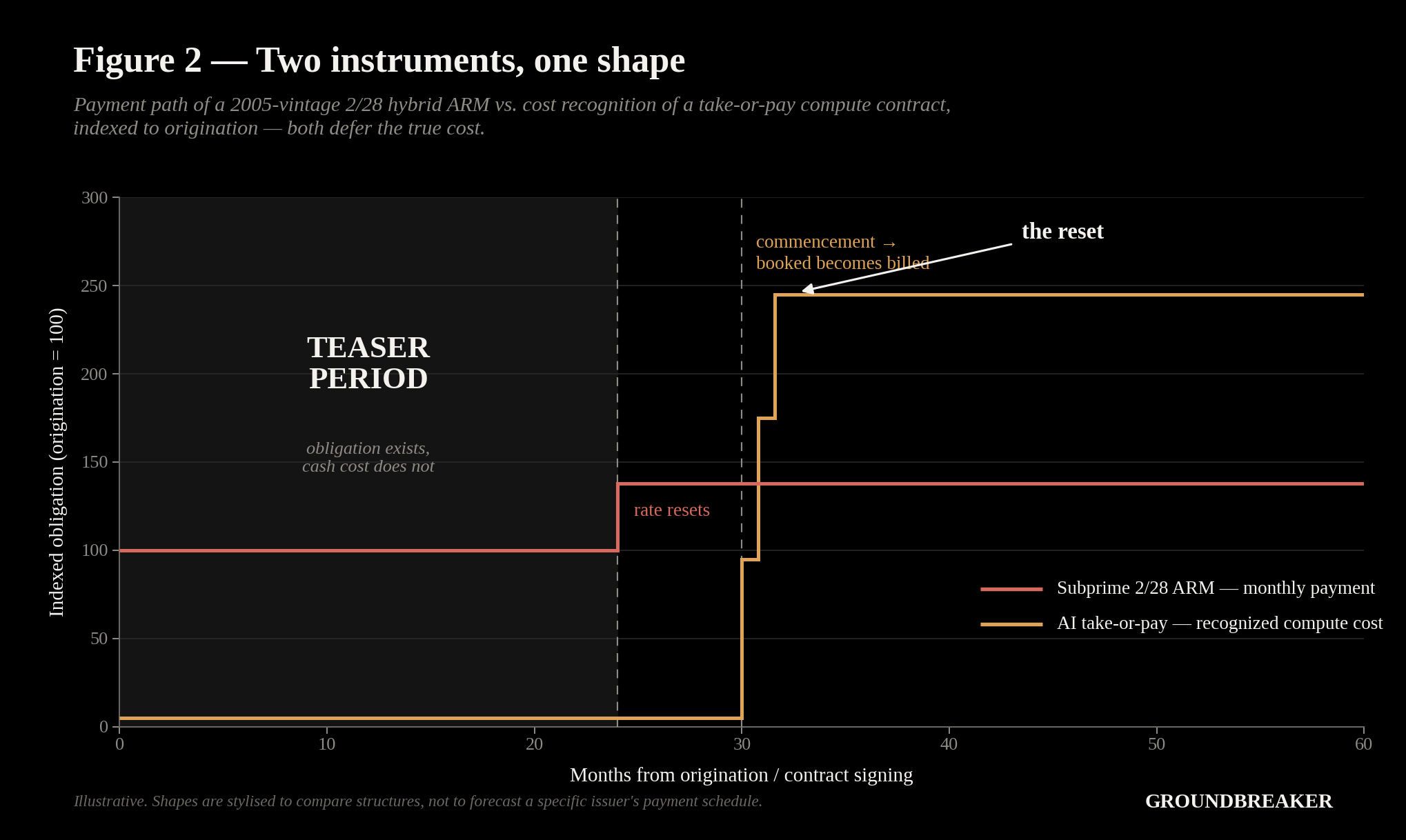
I think what made me throw in the towel was “Figure 2 — Two Instruments, One Shape” [0]. That chart comparing when contracts reset. Weirdly consistent norms! [looks at the sourcing] Oh… it’s… not from data at all… it’s just notional…
Is there anything here other than “the people financing the factory are betting that it’ll be able to sell what it makes once it’s built”?
I mean… isn’t “an instrument that splits time in two” kind of… what capital financing is? And this risk is what earns investors their interest, and the rest of the financial system involves different ways for people to calibrate their bets on the risk materializing?
Including derivative instruments that allow investors to smear out the point-in-time “cliffs” this writer is concerned about? If you think the revenue is never going to come, you can bet on that now. Or go into the distressed datacenter acquisition business to prepare! Conversely if Payment Day comes and you think they just need a couple more months, you can adjust the loan or make them a new loan to cover those first few months’ payments, etc., right? Since both parties stand to lose if it blows up completely, unless it’d be worth more to sell to somebody else?
These are also not individual homeowners’ “investments.” The risk is coordinated, and it’s big, but we know that already, right? Yes we know the revenue, yes it’s different from the costs of paying down their capital investments, yes both are reported on the financial disclosures.
How is the claim here any stronger than “all this depends on them actually being able to sell this crap once they get it built”?
[0] https://substackcdn.com/image/fetch/$s_!-2DS!,f_auto,q_auto:...
Re: The Teaser Period: Why the AI Boom Is Hitting a Reset Wall
#46Someone who only knows finance trying to apply that logic to the singularity. There is no comparison. AI does not obey money, money obeys AI, or rather, the operating force of commodified intelligence will not just evaporate when inconvenient obligations for payment come around.
Also it seems evident the article is largely AI written, which makes it even funnier.
Re: The Teaser Period: Why the AI Boom Is Hitting a Reset Wall
#47Earlier quoted context omitted.
The economic value may be real but the profits may not be. One thing that's clear is that there is no leading vendor in this space and there may never be one. To some extent premium models can charge a premium price but it's going to be a competitive market and the likes of Anthropic and OpenAI will not be able to sustain monopoly pricing.
The AI debate has often been flattened into "Do you believe in the long term viability of the tech?" when there is also another question that needs to be asked in "Do you believe in the long term viability of these companies' business models?" It's a lot easier to believe the former than the latter. It's entirely possible for this tech to be humanity altering in the long term while we are also in a huge bubble that c…
Yes exactly the same as during the Dot com bubble.
Re: The Teaser Period: Why the AI Boom Is Hitting a Reset Wall
#48Someone who only knows finance trying to apply that logic to the singularity. There is no comparison. AI does not obey money, money obeys AI, or rather, the operating force of commodified intelligence will not just evaporate when inconvenient obligations for payment come around. Also it seems evident the article is largely AI written, which makes it even funnier.
[deleted]
Re: The Teaser Period: Why the AI Boom Is Hitting a Reset Wall
#49wow excellent piece. Gary Marcus had a long post about this article on his substack. scary stuff "And look at what this implies about OpenAI’s valuation as it moves toward an IPO: OpenAI’s equity - valued north of $850 billion - is functionally the junior tranche of a capital structure whose senior claims, the take-or-pay compute obligations, exceed any revenue path management itself has articulated. On those numbers…
Marcus believes that the underlying technology doesn't work. If that's true, then of course the whole thing will crash as soon as everyone realizes this. This article is mostly making a different argument (though it contradicts itself in some places), which is that even if the underlying technology does work, and is ultimately going to create quadrillions of dollars of value and transform society, if it takes more th…
There's a third possibility between works and doesn't work:
Works but not quite good enough to make the case against commoditization.
If open source or on-device AI gets good enough for 80% of consumers, then this stops being a consumer product and the only real market is people who need the high-end models. If those models are slow and expensive, certain tasks like scientific and math research can tolerate slowness, but they run up against the costs. If they're expensive, the tech industry can afford them but runs up against their inefficiencies.
We need to talk about how well these improving models work in multiple dimensions: Accuracy, performance and cost. All three have to improve considerably before the debate dies down.
Re: The Teaser Period: Why the AI Boom Is Hitting a Reset Wall
#50I get the structural comparison they are trying to make. But mortgages are not a frontier AI lab. They try to draw a comparison to the valuation of the real estate and the valuation of the hyper scalers in the markets. I would argue that the demand and valuation of a house is less elastic than AI. While a house’s value may continue to appreciate in the market there is an upper bound for the price of a house set by pe…
1. The massive amounts of GPUs being purchased have far shorter valuable lifespans than a house. 2. A model's value seems to be depreciating at an unbelievable rate. The most expensive top SOTA models (GPT-5, Opus 4.1) a year ago are far less capable than GPT-5.6 Luna. Compared to when those models were new, Luna costs 85% less than GPT-5 and 98% less than Opus 4.1. That's good for us consumers, but if a lab stumbles…
I feel like the idea that GPUs wear out in 3 years is as far as I can tell, generally unfounded.
The GPU build out will keep pumping tokens until the cost to replace is less that the cost to maintain. It is effectively sunk cost.