I’ve found that ch and ex units are heavily influenced by latin characters. They just give weird results with non-latin characters leading to magic numbers. But the concept is really solid: use them if you want the spacing relative to text.
Nobody uses ch, let's be honest.
Until design tools like figma use these other units, people will be stuck to rems and pixels.
px is still a useful unit. the user's operating system applying a scaling fator doesn't make it not useful. if the user's operating system is configured to draw pixels at a 1:1 ratio, your pixels will be drawn at a 1:1 ratio. if the user's operating system is configured to draw pixels at a 2:1 or 3:1 ratio, you as a web developer don't get to override that, but you're still addressing pixels directly. if you want to…
The spec fafs around a bit talking about how the px is a "visual angle unit" But I am unable to form an interpretation where the "reference pixel" is anything other than 1/96 inch. https://drafts.csswg.org/css-values/#absolute-lengths I guess theoretically a tv could say "this tv will be viewed at 12 feet away so our reference pixel is 1/16 inch" and still be in spec. Which sounds like it has messy implications, Does…
what the spec says doesn't really matter though, the spec is just nonsense people wrote down to try to back-explain decisions that the browsers had already made.
pixels are pixels, and no browser implements them as a fractional-inch measurement. in every actual implementation i'm aware of, they're a hardware based unit.
The spec fafs around a bit talking about how the px is a "visual angle unit" But I am unable to form an interpretation where the "reference pixel" is anything other than 1/96 inch. https://drafts.csswg.org/css-values/#absolute-lengths I guess theoretically a tv could say "this tv will be viewed at 12 feet away so our reference pixel is 1/16 inch" and still be in spec. Which sounds like it has messy implications, Does…
what the spec says doesn't really matter though, the spec is just nonsense people wrote down to try to back-explain decisions that the browsers had already made. pixels are pixels, and no browser implements them as a fractional-inch measurement. in every actual implementation i'm aware of, they're a hardware based unit.
They aren't hardware based. As I say in the first link, pixels mostly don't exist in hardware.
Screens very rarely contain a matrix of individual squares.
What I want to know is who decided to break px, the last thing we need is yet another screwball physical measurement, css was already full of them. But what "tut tut, everybody is using px and these new hi-dpi displays are rendering things really tiny, we can't have that" and now px as a useful unit is ruined. Is there a way to use real pixels? My, admittedly quick, search says no. at least nothing jumps out at me fr…
You could set the CSS zoom property to 1/window.devicePixelRatio with JavaScript but I think you can't do it with CSS only. If you do that then px is physical px. This doesn't include browser zoom though or mobile pinch to zoom. You could also get those with JavaScript but then people would be really confused by the behavior of your website. You definitely can't get pure integers though it's always a float even if yo…
That is sort of where I ended up, Not that it matters, Pixels should probably never actually be used. It just offends me that a unit that is sort of messy and tied to physical hardware but does provide measurement that can not be found elsewhere. gets neutered and we end up with another useless absolute unit, inch, point, millimeter, pica, the Q(did we really need the Q?) and now the pixel.
I'm still waiting for operating systems to adopt true physical units. You know, that trick PostScript printers have doing since the 80s (running at 300dpi no less). I realize there are large screen projectors in the wild, that's solvable problem. Bitmaps icons are also an issue, but again, solvable.
px is still a useful unit. the user's operating system applying a scaling fator doesn't make it not useful. if the user's operating system is configured to draw pixels at a 1:1 ratio, your pixels will be drawn at a 1:1 ratio. if the user's operating system is configured to draw pixels at a 2:1 or 3:1 ratio, you as a web developer don't get to override that, but you're still addressing pixels directly. if you want to…
The spec fafs around a bit talking about how the px is a "visual angle unit" But I am unable to form an interpretation where the "reference pixel" is anything other than 1/96 inch. https://drafts.csswg.org/css-values/#absolute-lengths I guess theoretically a tv could say "this tv will be viewed at 12 feet away so our reference pixel is 1/16 inch" and still be in spec. Which sounds like it has messy implications, Does…
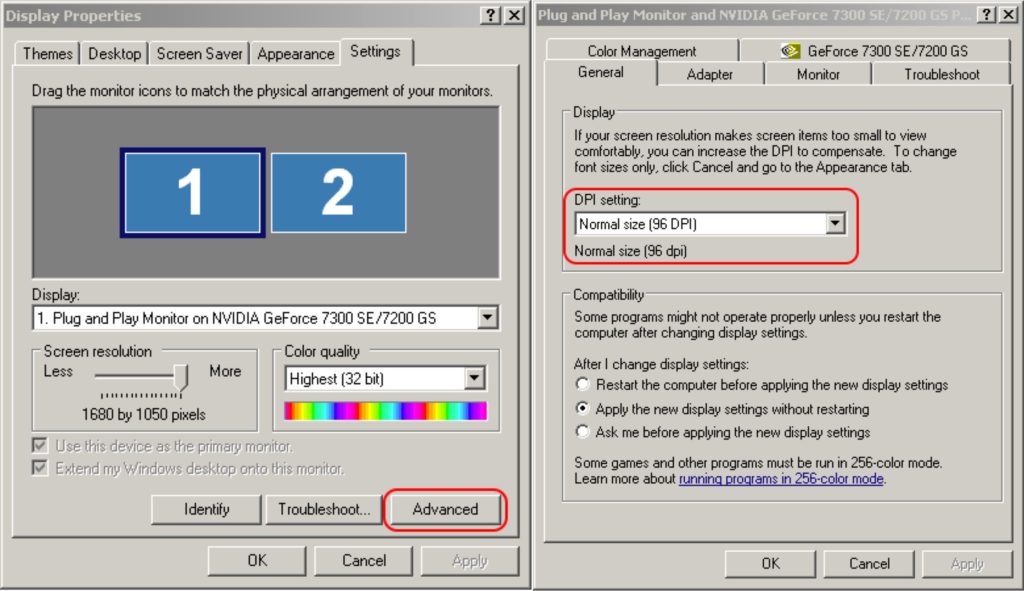
Windows used to let you set the DPI setting of the monitor, circa Win95-WinXP. Software tended to only expect a value of 96dpi, so it wasn't a very practical setting to change, and eventually windows introduced display scaling (which leaves old software in the belief that you are on a 96dpi screen, while allowing software to opt in to knowing about the real device pixels)
I guess you could use that setting on an old version of windows to set a screen to 16dpi, and now a CSS reference pixel is 1/3rd of a real pixel? But more realistically, what the spec is getting at is that a mobile device should set its dpi setting close to the real device setting, and a reference pixel is now something that looks about as big as a pixel on a 96dpi screen. That nobody actually sets their screen dpi on desktops is probably of secondary importance to them