Live data from Hacker News

Most countries provide between 20 and 40 paid days off

not-ship.com

51–60 of 96 posts

Re: Most countries provide between 20 and 40 paid days off

#51

Earlier quoted context omitted.

Assuming you're serious, as a European, I applaud your willingness to hurt yourself so we can have transistors and also have 40 days off each year.

US inventiveness peaked in the 50s and 60s, when corporate taxes were much higher, education, housing and healthcare were far cheaper, wealth was more evenly distributed, and government investment in infrastructure and R&D was more about delivery than corporate/academic grift. Perhaps there's a reason it has declined since.

Also post war Europe had to rebuild, the US didn't - and lots of scientists headed west.
Re: Most countries provide between 20 and 40 paid days off

#52

What is going on in the US is nothing short of shameful.

I've never worked at a job that didn't offer some form of PTO, only exception is when you are doing contract work and not a full time employee, you simply take time off when the rest of the company does for no pay during those windows of time.

Re: Most countries provide between 20 and 40 paid days off

#53

Earlier quoted context omitted.

https://www.bls.gov/charts/employee-benefits/paid-leave-sick... Could be better for sure, but a graph showing the US as having 0 days of paid days off because the federal government doesn't mandate anything is misleading at best. Average US worker after 1 year of employment earns 7 sick days and 11 vacation days. And likely has some state and federal holidays off as well, and could very well qualify for state require…

> earns 7 sick days Including sick days makes the calculation worse, not better. Sick days typically don't exist in Europe. If you're sick, you obviously just don't go to work. What's the point of infecting the whole office? On average, workers in Europe take about 2 to 3 weeks off each year due to sickness in addition to their vacation. In fact, if you're sick during vacation, that doesn't count as vacation time, at…

Except for some drastic cases I've not seen people taking more than 2/3 single days a year.

In most places in Europe the first sick days are not comped, so any missed day is a missed paid day. When social security comes into play they tend to pay the base pay of the position.

That would mean that if you miss a week because of an illness you might see a salary reduction close to a fifth of your monthly salary. That's something that most people don't have the luxury.

Apart of that most companies treat any medical leave after the third (yearly) as suspicious, which needs extra investigation.

So as we might not have a limit, and it's relatively paid, most people do meagre use of it.

Re: Most countries provide between 20 and 40 paid days off

#54

The US has generally higher wages than Europe and lower taxation rates. Those paid days off are not free.

You're assuming that's due to more days off? I have my doubts. I think the US could offer more paid days off, and it would retain its higher wages and lower taxation rates.

Re: Most countries provide between 20 and 40 paid days off

#55
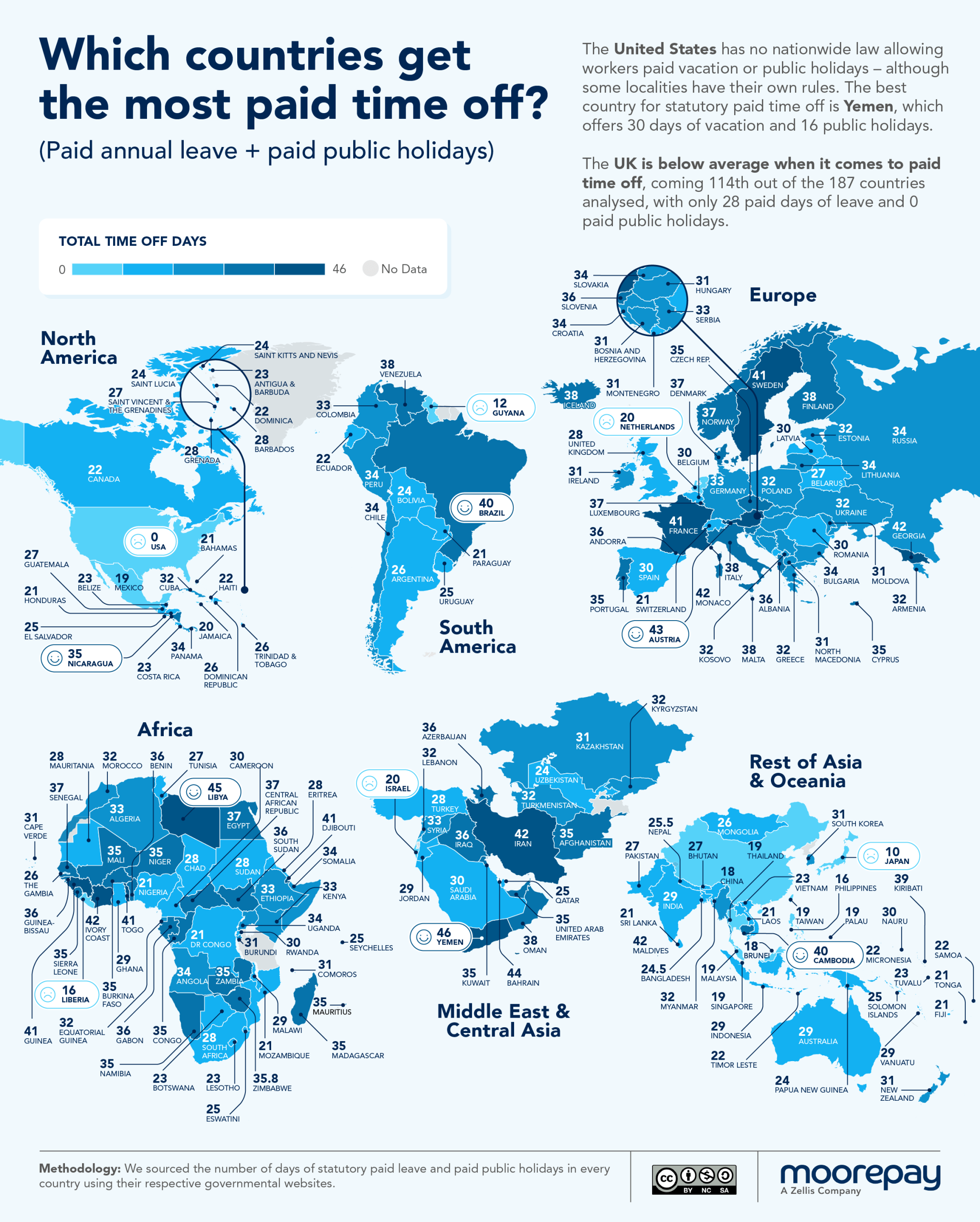
All I wanted from this article was a table with the list of countries and the amounts of paid days off, but the chart labels only 16 countries.

The referenced source includes an image with all of the values: https://www.moorepay.co.uk/app/uploads/2025/07/01_Which-Coun...

Re: Most countries provide between 20 and 40 paid days off

#56

Of course, nobody really gets paid for days off, anywhere, ever. Salaries are prorated, people are paid for the days they actually work.

Of course not, but there is a strong default option effect.

And more often then not an employee _has to_ take the exact amount of vacation that's mandated in their country.

Re: Most countries provide between 20 and 40 paid days off

#57
post #5

The country that does not, invented more or less every modern technology (transistors, ICs, wifi, microwaves, cellular). Mayhaps there is something to it.

You didn't invent microwaves. Well, your lot invented the klystron. Know what a klystron is? No? Well there you are. But I bet you know what the cavity magnetron - invented in Scotland - is. You probably used one today already. Cellular phones were invented in the UK and Finland. The US didn't even have them until the first couple of generations were obsolete here. Transistors were invented in Germany, although they…

also jet engine

discovered penicillin

Re: Most countries provide between 20 and 40 paid days off

#58

Earlier quoted context omitted.

> earns 7 sick days Including sick days makes the calculation worse, not better. Sick days typically don't exist in Europe. If you're sick, you obviously just don't go to work. What's the point of infecting the whole office? On average, workers in Europe take about 2 to 3 weeks off each year due to sickness in addition to their vacation. In fact, if you're sick during vacation, that doesn't count as vacation time, at…

I included them to show that, on average, PTO does not need to be used for sick time and to show that the vacation time is vacation time. > "workers in Europe take about 2 to 3 weeks off each year due to sickness in addition to their vacation" It looks like in Germany it's 20 days a year - https://www.dw.com/en/germany-sick-days-absentees-mental-hea... Are you all really that sick? Shouldn't the availability of lots…

Sick days as other wrote is prescribe by a doctor. It doesn't have a limit (e.g. .y college broke his leg and was on sick leave for 1.5 year). And his vacation time accumulated, he didn't use his 26 days first year so the next he had 52 days to use.

Sick leave in my country is not full paid, it is 80%, so people are not that keen on getting it if not needed. On the other hand they are not hit that dramatically if they are sick.

Re: Most countries provide between 20 and 40 paid days off

#59

Earlier quoted context omitted.

Assuming you're serious, as a European, I applaud your willingness to hurt yourself so we can have transistors and also have 40 days off each year.

US inventiveness peaked in the 50s and 60s, when corporate taxes were much higher, education, housing and healthcare were far cheaper, wealth was more evenly distributed, and government investment in infrastructure and R&D was more about delivery than corporate/academic grift. Perhaps there's a reason it has declined since.

100% disagree.

SmartPhones, Cloud, AI.

Just three things that happened in the past 20 years and were brought to the world by US companies.

Re: Most countries provide between 20 and 40 paid days off

#60

Earlier quoted context omitted.

> earns 7 sick days Including sick days makes the calculation worse, not better. Sick days typically don't exist in Europe. If you're sick, you obviously just don't go to work. What's the point of infecting the whole office? On average, workers in Europe take about 2 to 3 weeks off each year due to sickness in addition to their vacation. In fact, if you're sick during vacation, that doesn't count as vacation time, at…

I included them to show that, on average, PTO does not need to be used for sick time and to show that the vacation time is vacation time. > "workers in Europe take about 2 to 3 weeks off each year due to sickness in addition to their vacation" It looks like in Germany it's 20 days a year - https://www.dw.com/en/germany-sick-days-absentees-mental-hea... Are you all really that sick? Shouldn't the availability of lots…

I wouldn’t use the number of sick days as some form of “national health metric” since there’s probably a bunch of factors that influence it as much (if not more) than actual sickness, like for example: how many sick days are you actually allowed to take, how much do you get paid on sick days, what’s the culture around taking sick days?

If you want to measure general health, you could go for example for life expectancy. Or if you care about the healthcare system itself you could go for infant/maternal mortality. Or if you want to measure efficiency you could go for spending per capita.

Post reply on HN