Live data from Hacker News

2x, not 10x: coding with LLMs in 2026

obryant.dev

71–80 of 260 posts

Re: 2x, not 10x: coding with LLMs in 2026

#71

While I agree with the premise, I think this angle only applies on work one was going to do no matter what. The real power of these tools is that there are so many ideas people would like to try, but never have the time or motivation to pursue. So the comparison is not only "built with and without LLM" but "would you even build this if you didn't have the LLM?". The gap in productivity in this case is much more wide.

Yes, I work in hardware design ans the cost to code up the RTL for an idea and compare it to the existing code in terms of PPA, its very expensive in terms of engineering time. This week I had 5 different architecites coded, pushed through a functional test bench, bit accurate models created and then run through ppa analysis all done via llms. So its a task tbis project could not afford to do without llms, but can save us 10% in ppa

Re: 2x, not 10x: coding with LLMs in 2026

#72
post #16

The way I see it you should calibrate the way you work with LLMs based on how confident you are on that specific area, and if it's your responsibility to own/understand it. Here's how it feels for me: * Learning stage: 0.5x - 1x. I change my system prompt to teacher mode, taking the productivity hit for actually learning the system/tool pays off dividends later. I change my system prompt to "teacher mode" and slowly…

> * Mastered: 10x+ This really needs to be calibrated to the type of work and complexity. I can actually believe that LLMs would speed up basic web dev work in small, simple codebases 10X for simple requests. These conversations usually turn into people talking past each other because they’re working on different things. For other less routine and more complex work, expecting a 10X productivity boost is not realistic…

> Some times the true nature of the problem is revealed while implementing it and by deferring everything to an LLM you spend days throwing tokens at the wrong thing.

If you look at the code the LLM spat out (and you really, really should!) you will immediately notice that its shape is not what you thought it should be. You might not notice immediately if you're learning, but if you really "mastered" the domain, you will "just" see it. You will also recognize the problem with your assumptions, and immediately (or after some research) correct the prompt.

Looking at the diffs for everything the LLM does slows you down, of course. Not looking - or looking and not recognizing problems, for one reason or another - can be initially faster, but a single pathological case can eat both the time saving and tokens. For domains you truly "mastered", the current models can generate code as if they read your mind (because you can be that precise in the prompt, and quickly), so it's really glaring and very hard to miss when they somehow misread your mind.

It only works at the "mastered" / "unconscious competence" stages, and only in those narrow domains you truly mastered, but it does seem to work. Is it 10x? No idea, but there is a marked change in the speed boost when crossing from conscious to unconscious competence area, with everything else (harness, model) staying the same.

Re: 2x, not 10x: coding with LLMs in 2026

#73

While I agree with the premise, I think this angle only applies on work one was going to do no matter what. The real power of these tools is that there are so many ideas people would like to try, but never have the time or motivation to pursue. So the comparison is not only "built with and without LLM" but "would you even build this if you didn't have the LLM?". The gap in productivity in this case is much more wide.

Yes but I’ve seen some devs waste a lot of time using AI to build something that was a bad idea to begin with. Without AI they might have first spent more time validating the idea was worth it.

> Without AI they might have first spent more time validating the idea was worth it.

Seems optimistic

Re: 2x, not 10x: coding with LLMs in 2026

#74
post #16

The way I see it you should calibrate the way you work with LLMs based on how confident you are on that specific area, and if it's your responsibility to own/understand it. Here's how it feels for me: * Learning stage: 0.5x - 1x. I change my system prompt to teacher mode, taking the productivity hit for actually learning the system/tool pays off dividends later. I change my system prompt to "teacher mode" and slowly…

Hey, could you share the prompt you're using for "teacher mode"?

[flagged]

Re: 2x, not 10x: coding with LLMs in 2026

#75
post #5

This reminds me of themes I recently saw in [Harness Engineering is not Enough: Why Software Factories Fail]( https://www.youtube.com/watch?v=Ib5GBkD555M ) (Warning: the last 3 slides seem like an advertisement). One thing I liked is how Dex has a little graphic he glossed over showing software development is - 25% planning & aligning with other teams - 25% coding - 25% testing/verifying - 25% code review/rework One…

> So maybe there's 2x speedup in coding. But that's only a small speedup in the totality of everything software engineers do. Amdahl's Law should be familiar to anyone with a 4y computer science/engineering degree. Why aren't they applying it to their own throughput?

Let's apply it:

- 25% planning & aligning with other teams

- 25% coding

- 25% testing/verifying

- 25% code review/rework

I'd say that thanks to LLM assistance I'm 10x faster at coding, code review/rework, and testing/verifying. (LLMs can partially automate testing/verifying too, and the code is higher quality now as well so less testing/verifying is necessary).

So that leaves us with:

- 92.5% planning & aligning with other teams

- 2.5% coding

- 2.5% testing/verifying

- 2.5% code review/rework

Obviously, that makes zero sense as a split. If you saw any organization doing that, you'd suggest having fewer teams, more silos, etc. Maybe you have designers produce code, instead of showing the designs to coders and having the coders implement it. Maybe you force all your engineers to dogfood the product that way they can identify issues themselves rather than needing QA teams to do it. And so on. so the last category, "planning & aligning with other teams", falls too.

Re: 2x, not 10x: coding with LLMs in 2026

#76
post #5

This reminds me of themes I recently saw in [Harness Engineering is not Enough: Why Software Factories Fail]( https://www.youtube.com/watch?v=Ib5GBkD555M ) (Warning: the last 3 slides seem like an advertisement). One thing I liked is how Dex has a little graphic he glossed over showing software development is - 25% planning & aligning with other teams - 25% coding - 25% testing/verifying - 25% code review/rework One…

Agentic tools changed the workflow in our org, we were very tense before with a simple yet careful team process.. Since last winter we're now pushing a lot more but the teamwork (which was brittle before) is now mostly gone, everybody can roll on its own, but the review process didn't scale and now monthly deliveries are full of "seems to work". nobody checks properly, nobody reviews, nobody tighten any bolts.. and nobody cares much anyway, the system allows it.

Re: 2x, not 10x: coding with LLMs in 2026

#77
Personally i'm only using local LLMs that i can run on my 7 year old PC (that also has a GPU with 24GB VRAM because reasons :-P) so i'm not sure how much that experience matches what others are doing (though roughly speaking what i see people complain about Claude doing doesn't feel that different from what i see the local stuff doing, so i guess the drawbacks aren't scaled down as model sizes increase).

I'm not sure about 1x, 2x or 10x increase as these metrics are about code written but that isn't a productivity metric (something pretty much every half-decent programmer would agree with before LLMs - remember stories about Bill Gates saying that more LoCs being good for software is like more weight is good for airplanes or Bill Atkinson's story about adding -2000 LoCs to improve QuickDraw?).

But they can certainly help "get you going" faster in that if you're stuck on something (for whatever reason - including "that feels too much drudgery") or have issues starting something, you can have an LLM take a stab at it and it'll produce "something". Sometimes it is enough by itself, but more often than not it'll need tweaks (either directly or having the LLM do it). I got to make a bunch of things i couldn't convince myself to do - e.g. an image viewer that doesn't suck (based on my arbitrary judgement), a game database, a script to convert a git repository into static html pages that kinda look like GitHub, etc.

They can also help find (and sometimes fix) bugs or other "code smell" issues. They're not that great for exact results (without tool calling -and knowledge on how to use them effectively- at least) but when it comes to fuzzy / vague stuff like "check out this code can you spot any issues?" they always tend to find some stuff (even if it is hallucinations :-P but sometimes they find actual issues too or whatever hallucination they come up with reveals some actual issues with the code that you didn't spot by yourself). I've been dabbling with Rust recently and asked Qwen 3.6 35B-A3B to judge my code and it wrote "6.5/10, will compile but looks like C in Rust" :-P.

The article says:

> Never write READMEs, docstrings, or comments. I will write those myself later. And yes, I really mean this.

And sure, LLMs aren't that great about those (i do let them leave whatever comments they want though and remove them later myself - i think those comments help during the generation/prediction - basically how they "think", kinda like the reasoning phase), but they can be very good at things like "here is the code, here is the documentation for it, spot discrepancies" (i had Devstral Small 2 do this and it hallucinated a few discrepancies but also found real stuff i missed in the docs).

I've tried to use Devstral Small 2 for some API docs but found it'd sometimes make assumptions about what function do or how. One approach that might work, but i haven't tried yet, is to write the "guide" myself, then have the LLM write the function docs using both the guide and the code as reference. The reason i think this will work is because it got things 95% correct just having access to the function code alone (and without the rest of the codebase), so the "guide" would help it reach 99%. I do not expect it to get to 100% so a manual edit pass will need to be done anyway (and i have an idea for a tool to assist in the manual edit pass for that - a tool that i'll probably get an LLM to write - BTW good luck coming up if all that stuff would increase or decrease productivity for an actual product and not some random stuff i'm toying with :-P).

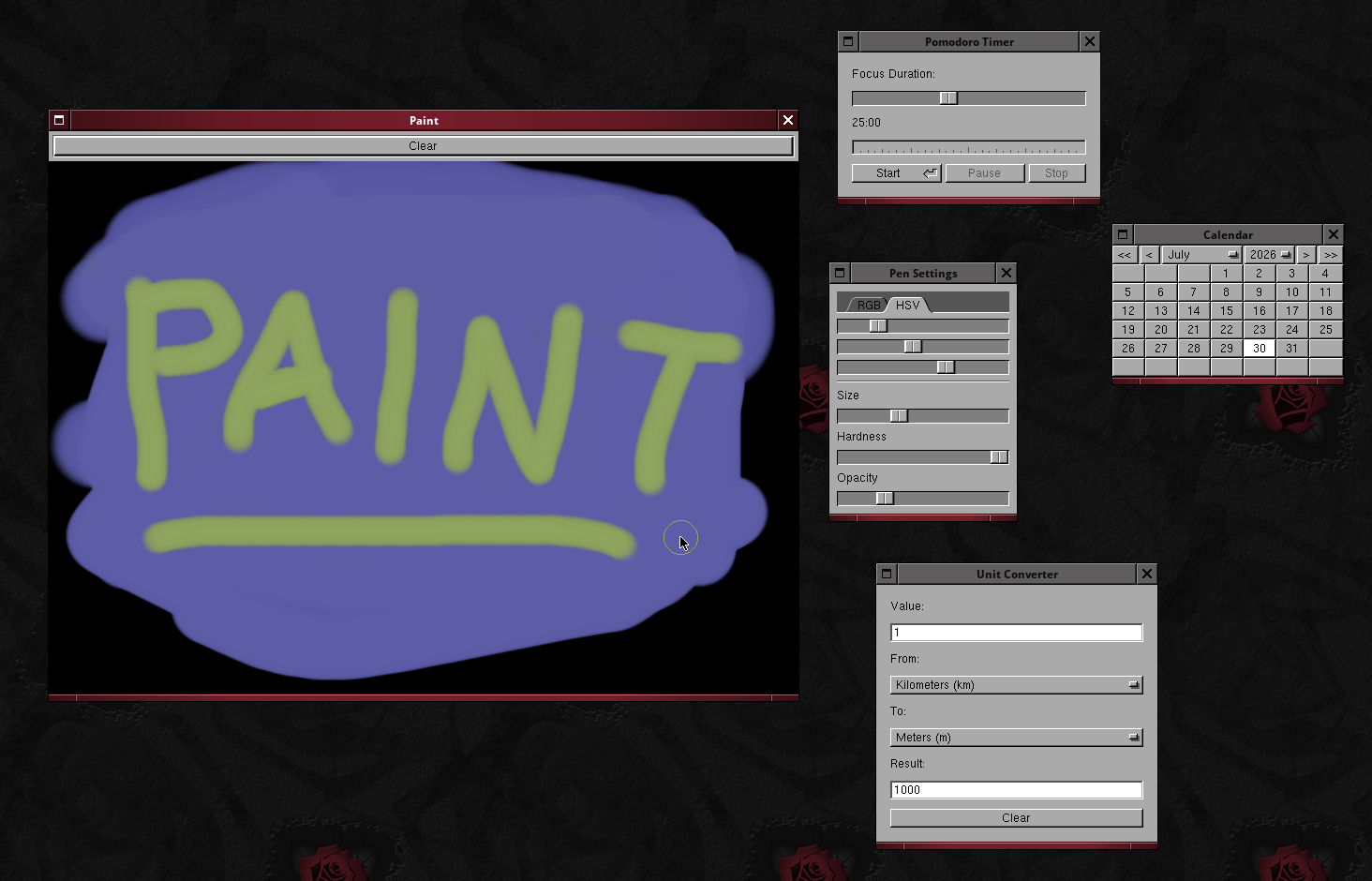
One other thing i've also found LLMs useful recently is to have them use the stuff you make and see how they try to use it. I have an old project, a GUI toolkit i've been hacking on every now and then since 2011 or so, though it was never a priority. Yesterday i decided to dump all the header files to Qwen 35B-A3B (i use 4bit quantization that gives me a 256k context - it isn't particularly smart but it is neat to not have to micromanage context size like i have to do with Devstral Small 2 or Qwen 27B where both of them aren't very usable speedwise at anything above 32k context sizes).

Then i asked it to just make a few small programs and it did[0] (the shot shows a paint app, a calendar, a todo list and a unit converter). Pretty much every program found bugs in the library :-P and gave me ideas on how to improve things.

In general i get the impression that LLMs aren't great at architecting things but if you do the architecture yourself and write them a framework to use, they should do a fine job at it.

[0] http://runtimeterror.com/pages/iv/images/d50c436990db203a07f...
Re: 2x, not 10x: coding with LLMs in 2026

#78
post #54
post #51

I'm not sure about the x, but the first thing that arises from that is, I feel like in my case it's way higher than 2. The 2nd thing is, how do I measure that. --- In my case, the details of my work (Kinda DevOps, kinda Senior Dev) makes it that having an LLM to do the heavy lifting allows me to do things not only faster, but better, and across domains I do not hold expertise on. An example of the effect of LLMs in m…

> allows me to do things not only faster, but better, and across domains I do not hold expertise on. How would you know it's better when you have no expertise?

Because it produces the desired output. The purpose of a program.

There are many domains where an intelligent human can act as a discriminator for output without knowing exactly in precise detail how the process itself works.

Re: 2x, not 10x: coding with LLMs in 2026

#80

While I agree with the premise, I think this angle only applies on work one was going to do no matter what. The real power of these tools is that there are so many ideas people would like to try, but never have the time or motivation to pursue. So the comparison is not only "built with and without LLM" but "would you even build this if you didn't have the LLM?". The gap in productivity in this case is much more wide.

that and 2x is "i'm 5'10" and i round up to 6'" low.
Post reply on HN