Live data from Hacker News

Commodification of Intelligence: Good, Bad, and Ugly Circular AI Deals

emergingtrajectories.com

21–30 of 52 posts

Re: Commodification of Intelligence: Good, Bad, and Ugly Circular AI Deals

#21
post #18

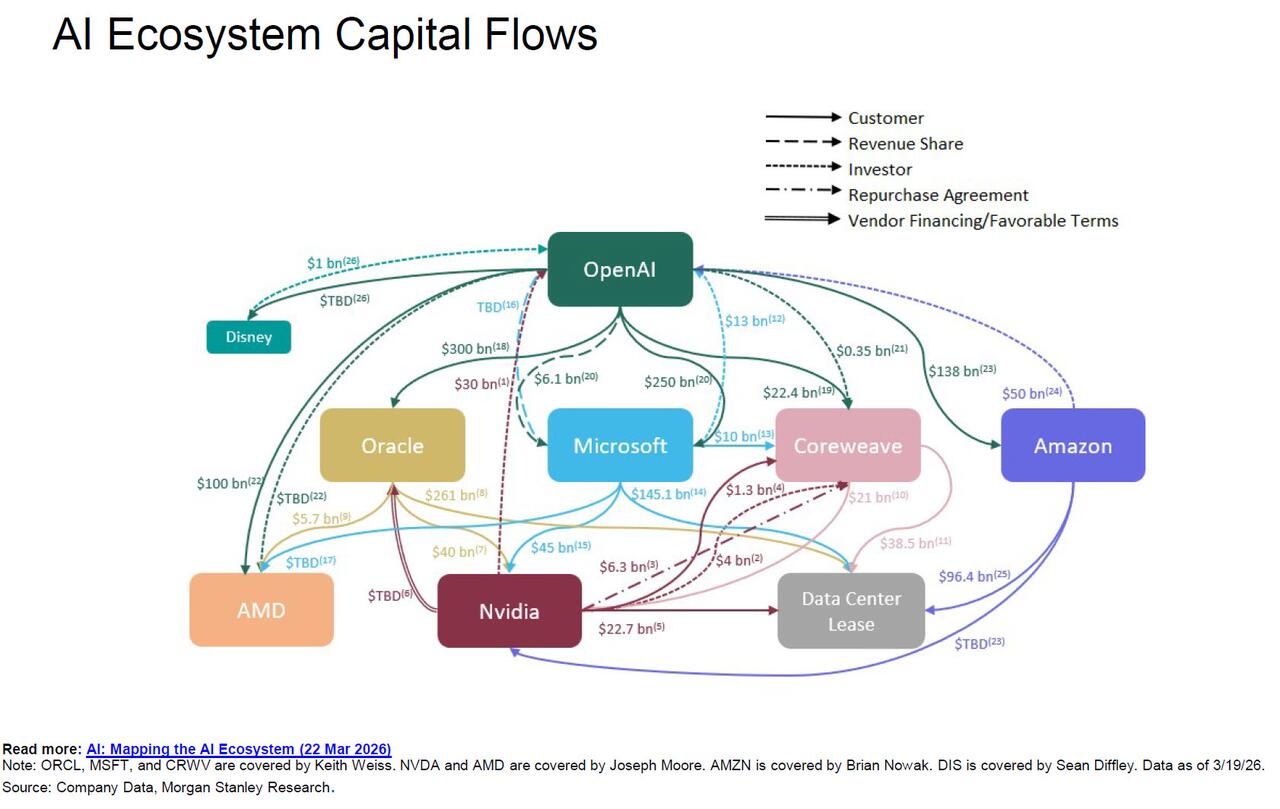
Has a competent economist modeled the circularity of these deals ? [ numerically or analytically ] It seems a healthy economy has a lot of wide circularity .. money circulating is a good thing, a result of a functioning market, tracking the flow of real goods / services. But large corps circulating paper 'self-deals' or debt-swaps seems like a bad thing - a creative accounting practice designed to pump up their stock…

you'd need to look at prior work associated with the Dot com boom and Enron. Economists rarely look into today's actual activity because America makes it nigh impossible to actually understand who owns what around the fringes; contracts arn't required to be publically disclosed and a bunch of other dark interests make it impossible to really know.

MLMs exist in the same murky waters and tread the same ephermal economics by pushing useless product but hiring people to hire people to hire people, etc.
Re: Commodification of Intelligence: Good, Bad, and Ugly Circular AI Deals

#22

> commodification of intelligence Is HN really this fast!? Everybody already skipped the hard questions whether LLMs are intelligent? 'It' can already be commodified? So how much time and effort it took from these companies? A couple of years and millions spent on PR? And LLMs are "intelligent" all of a sudden, is what everybody says nowadays? Especially applicable for programmers: naming things is not only hard, it'…

Intelligence doesn't require sentience. Think of it like this: if you can offload a task to an AI model that requires reasoning or representing a nonlinear system, you are offloading intelligence.

The problem is that this doesn't distinguish LLMs from other forms of software! The whole point of computers is to offload tasks requiring reasoning, and they've always helped us understand complex nonlinear systems is that computers work through the hideous details.

More significantly: many major advances in scientific or mathematical programming were heralded as a thinking computer! 50's numerical scientific programming, 60's Lisp+ symbolic programming, 70's logic and symbolic algebraic programming, 80's unifying all this with encyclopedias and NLP like Mathematica - all of this is clearly useful and cool, all designed to offload intelligence... and, with modern eyes, we see plainly that not a single shred of intelligence is required to execute any of it. The AI researchers of yesteryear consistently made cool computer programs and consistently overestimated their progress at cracking human intelligence. It is plain as day to me that ANN researchers are making precisely the same scientific and philosophical mistakes as yesteryear's symbolics researchers, and even Alan Turing. This does not diminish from the coolness of the computer programs. But pretending these systems are intelligent, even "verbally" intelligent, is bad for society.

It's bad for computer science, too. None of the progress in LLMs or ANNs gets us any closer to making a robot as smart as a cockroach. I doubt any of us will live to see that milestone.

Re: Commodification of Intelligence: Good, Bad, and Ugly Circular AI Deals

#23
post #18

Has a competent economist modeled the circularity of these deals ? [ numerically or analytically ] It seems a healthy economy has a lot of wide circularity .. money circulating is a good thing, a result of a functioning market, tracking the flow of real goods / services. But large corps circulating paper 'self-deals' or debt-swaps seems like a bad thing - a creative accounting practice designed to pump up their stock…

Also these deals are not circular - NVIDIA has to pay a lot of money for chips and foundry capacity just as an example, so money leaves the circle and participants have to raise capital to replace it, which means if this were just a financialy trick, it would be very expensive to maintain.

Re: Commodification of Intelligence: Good, Bad, and Ugly Circular AI Deals

#25
So, companies are just prepaying with seemingly large parts of their livelihood for (use of) potential value.

Expecting demand to stay equal over longer stretches of time in IT is an interesting bet as both hardware and software tend to depreciate in value extremely rapidly, unlike oil from the example. Or water. Both are limited in nature.

Commodifying something that is the fraction of its value the next year might be possible, but I don’t see how. Perhaps MS Windows or Office are such things, but might not compare.

There are more limits to demand. For example what humans can process. The AI might write the finest prose and the best software but have nobody to read or use it.

Re: Commodification of Intelligence: Good, Bad, and Ugly Circular AI Deals

#26

> commodification of intelligence Is HN really this fast!? Everybody already skipped the hard questions whether LLMs are intelligent? 'It' can already be commodified? So how much time and effort it took from these companies? A couple of years and millions spent on PR? And LLMs are "intelligent" all of a sudden, is what everybody says nowadays? Especially applicable for programmers: naming things is not only hard, it'…

I'm pretty skeptical of the LLM hype, but I'd say it's fair to describe LLMs as displaying some form verbal intelligence.

[dead]

Re: Commodification of Intelligence: Good, Bad, and Ugly Circular AI Deals

#27
We don't have an Artificial Intelligence yet. It is not intelligent, yet.

Here's a quick reality check. Several companies have formed with a goal of creating and AI engine that can think for itself and reason through difficult or previously intractable problems.

In order to accomplish this goal they have used scrapers to hoover up content from a multitude of sources, many of which can be seen as being the ground truth source for their discipline. A lot of this content, most of it, was copied and is being used without attribution to the original sources, without permission from the content owners or publishers, and in violation of copyright laws.

Look at all of this for what it is. It is a knowledge base, like a collection of Lego parts, each of which is important to the goal but none of which will get you there without the other parts in the proper relative position. Once you have collected all these parts and stuck them together you have an LLM. If you are careful in your parts selection, that LLM can be useful for answering specific questions that are properly framed so that the LLM can make use of the contextual information in formulating a response.

There's nothing intelligent about being able to answer a question correctly when the answer is effectively right on the tip of your tongue. You're just drawing from your knowledge base and regurgitating.

Glomming all of it together only gives you a huge knowledge base. There is nothing intelligent about that knowledge base. Knowledge is not intelligence.

You have an AK today, an Accumulated Knowledge base.

We may never reach the point where it is ever intelligent enough to reason alongside of, or better than those whose life's work went into the foundation of the AK base.

Re: Commodification of Intelligence: Good, Bad, and Ugly Circular AI Deals

#28
post #18

Has a competent economist modeled the circularity of these deals ? [ numerically or analytically ] It seems a healthy economy has a lot of wide circularity .. money circulating is a good thing, a result of a functioning market, tracking the flow of real goods / services. But large corps circulating paper 'self-deals' or debt-swaps seems like a bad thing - a creative accounting practice designed to pump up their stock…

Also these deals are not circular - NVIDIA has to pay a lot of money for chips and foundry capacity just as an example, so money leaves the circle and participants have to raise capital to replace it, which means if this were just a financialy trick, it would be very expensive to maintain.

Many people are calling them circular, eg bloomberg, BIS :

https://www.youtube.com/watch?v=lwcM0By4aJQ

https://www.zerohedge.com/markets/bursting-ai-bubble-collaps...

diagram : https://cms.zerohedge.com/s3/files/inline-images/AI%20ecosys...

My point is, Id like to know how circular or not they are - clearly a lot of money is actually being spent on GPUs/datacenter build/electricity, Id like to know what fraction that is.

Re: Commodification of Intelligence: Good, Bad, and Ugly Circular AI Deals

#29
post #28

Earlier quoted context omitted.

Also these deals are not circular - NVIDIA has to pay a lot of money for chips and foundry capacity just as an example, so money leaves the circle and participants have to raise capital to replace it, which means if this were just a financialy trick, it would be very expensive to maintain.

Many people are calling them circular, eg bloomberg, BIS : https://www.youtube.com/watch?v=lwcM0By4aJQ https://www.zerohedge.com/markets/bursting-ai-bubble-collaps... diagram : https://cms.zerohedge.com/s3/files/inline-images/AI%20ecosys... My point is, Id like to know how circular or not they are - clearly a lot of money is actually being spent on GPUs/datacenter build/electricity, Id like to know what fraction that…

Two contradictory thoughts based on the article:

1. One thing you could do is look at free cashflow. The actual cash a company generates and keeps on its balance sheet would be a clear indicator of retaining profit or resources after circular deals.

2. The above doesn't preclude a company from committing to backstops and offtake agreements, so you still need to track those.

... so you'd want to look at how much cash a company is retaining and whether it is committing to act as a sort of lender of last resort.

Up until this week, I'd argue that Nvidia is was a pretty solid player in this space. If it's generating $10s of billions in cash, then who cares if it put $10 billion into a risky startup? It can afford it.

Now, however, it is also exploring committing $250 billion as a backstop for OpenAI's data center projects, which moves it to the riskier side of things.

I know I'm not providing you with data; I don't have that... But I think the above is a signpost to watch out for.

Re: Commodification of Intelligence: Good, Bad, and Ugly Circular AI Deals

#30
post #8

Whether inference hardware will be a commodity remains to be seen. We had twenty years of most servers being x86-64. That's commodity compute. Inference hardware isn't a mature architecture yet. There will be progress and obsolescence.

It will be in less than 5 years. You can already buy second hand RTX3090 TIs and with most of modern Macs being able to run some mind of AU locally already, in 5 years, things will be very commodified once you get the Chinese start rolling out Cuda-compatible GPUs.
Post reply on HN