Live data from Hacker News

Show HN: Physically accurate black hole you can put in your room

blackhole.plav.in

151–160 of 204 posts

Re: Show HN: Physically accurate black hole you can put in your room

#151

Earlier quoted context omitted.

Sure, see https://blackhole.plav.in/ar_example.mp4 for an example. Should work on most Android phones, even old ones (mine is 7 years), the Chrome browser is generally best for AR. Interestingly, Firefox seems to be better for the camera mode – for me, Chrome only gives one camera feed at a time, while Firefox allows both front & rear cameras. And AR + camera warping don't work together, unfortunately – browser API l…

Okay either I'm stupid or not seeing the "relativistic effects". This looks the same as on my device. I was expecting some distortion or bending of the background?

> AR + camera warping don't work together, unfortunately – browser API limitations.

So, you either choose AR and see the simulated emission from around the black hole, properly warped/boosted – but the camera feed remains flat, the browser itself does the overlaying.

Or, alternatively, choose the camera mode, and see the warping of your camera feed.

Not both at once!
Re: Show HN: Physically accurate black hole you can put in your room

#152
post #37

Earlier quoted context omitted.

Some are fair – of course this is a simplified visualization! Observationally, we don't really know how fast a given black hole is rotating, and here I indeed assumed a non-rotating one. It's not an inaccuracy per se, more like a missing feature. The camera mode has a (half-hidden) toggle to enable Kerr metric and set spin, but even there it's not a default. I consider the colormap choice to be completely arbitrary t…

Great job. Please consider turning on rotation by default (for those who missed it, it's in the parameters). The overwhelming majority of astrophysical black holes are expected to be spinning (Ker) black holes.

That option for rotating (Kerr) black holes generally works, but not on all devices in my experiences. Debugging on someone's phone is not that straightword, so I went with the most accessible experience by default.

Also note that the visual difference for the camera warp is really marginal between rotating vs non-rotating black holes.

Re: Show HN: Physically accurate black hole you can put in your room

#153
post #114
post #50

Earlier quoted context omitted.

> Its titled a "physically accurate black hole"! Please don't do this, if its intentionally not physically accurate and heavily simplified! It also doesn't exert the gravity an actually accurate black hole should :) And also, even on a phone with two cameras, they only cover a part of sphere – while a real black hole would bend light coming from all 4pi directions. Some simplification is generally required ("the map…

Always funny when people claim that scientific term apply to their software and then disregard any founded criticism in a non scientific way.

Its frustrating because these issues are all fixable, and some of them are just bugs, but there's a mentality in this kind of science communication that ehh it doesn't matter because its just for the public. This does a real disservice to what people are trying to actually achieve in educating the public. Its also, unsurprisingly, a lot of hard work and validation to get from visualisation-grade, to physically accurate, and its a lot easier to not do that

Re: Show HN: Physically accurate black hole you can put in your room

#154
post #37

Earlier quoted context omitted.

Some are fair – of course this is a simplified visualization! Observationally, we don't really know how fast a given black hole is rotating, and here I indeed assumed a non-rotating one. It's not an inaccuracy per se, more like a missing feature. The camera mode has a (half-hidden) toggle to enable Kerr metric and set spin, but even there it's not a default. I consider the colormap choice to be completely arbitrary t…

> completely arbitrary You agree that it isn’t “physically accurate”, then… but seem to argue that you shouldn’t be called out for the false title? It’s fair enough to be called clickbait when you really did score extra clicks with a slick falsehood, surely?

Arguing about colormap choice seems very strange to be – this is such a common practice in astronomy (and other fields!). The vast majority of images you see in published papers apply some arbitrarily-chosen colormap and color scheme. No matter if you look at observational or theory papers, it's very rare to find a real true-color image. And for a bunch of good reasons!

The only difference here is that I don't show a colorbar with explicit color-number mapping, for simplicity sake.

Re: Show HN: Physically accurate black hole you can put in your room

#155
post #97
post #34

If anyone's interested in the accuracy, this is very 'visualisation grade' software. Its a bit of a pet peeve of mine that people present these sims as being very physically accurate, when they contain major inaccuracies, some of which are very obvious and/or deliberate. This one has some serious physical limitations I wouldn't mind at all if it didn't say that this was a *physically accurate* black hole specifically…

I think you're being very harsh. I read it as a side project of a scientist meant to entertain as much as educate. Holding it to the same standards as the Event Horizon project seems pedantic and excessive.

All they need to do is not put the label physically accurate on it then. If you call something physically accurate and decorate it with your credentials as a harvard phd in astrophysics building radiative transfer sims, people expect it to have a degree of accuracy. This sim, from a physical perspective, is wrong

That's 100% fine if you present it as a visualisation with limitations and I absolutely love people making fun side projects like this and presenting them. I built a whole tutorial series on doing this, because I think people getting stuck into the field is absolutely great, and more power to everyone who wants to write anything no matter how accurate it is

Its the fact that this is being presented and stated as if its a physically accurate sim made by someone with experience in the field so it must be spot on, when in reality its little better than an artists impression of a black hole, that bothers me. Its science miscommunication. Coming away from this, you might think:

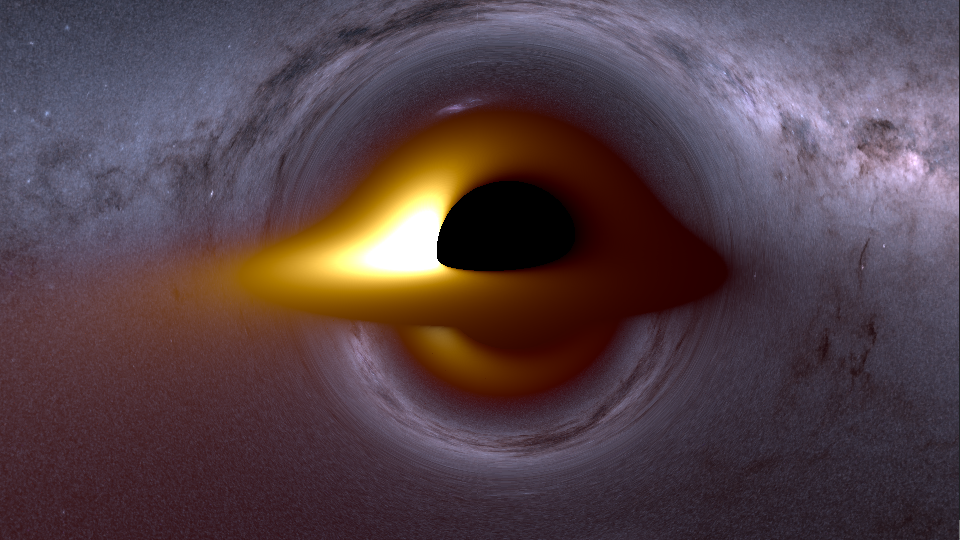
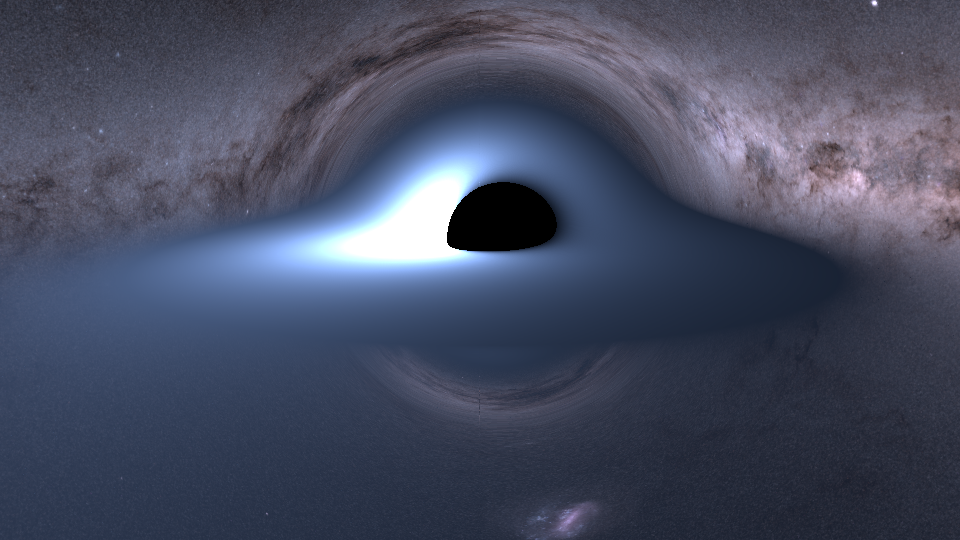
1. Black hole accretion disks are red

2. Black holes do not warp the background around them, only the accretion disk

3. You might get notions about the intensity distribution of the doppler shift, or the way that cameras work near black holes etc

None of which is particularly correct, and there's a lot more wrong with it too

Re: Show HN: Physically accurate black hole you can put in your room

#156
post #153
post #114

Earlier quoted context omitted.

Always funny when people claim that scientific term apply to their software and then disregard any founded criticism in a non scientific way.

Its frustrating because these issues are all fixable, and some of them are just bugs, but there's a mentality in this kind of science communication that ehh it doesn't matter because its just for the public. This does a real disservice to what people are trying to actually achieve in educating the public. Its also, unsurprisingly, a lot of hard work and validation to get from visualisation-grade, to physically accura…

Note that most of the points you raised are clearly not bugs – most notably, things like non-rotating black hole or colormap choice. At the very most, these can be considered missing features, but they don't affect correctness in any way.

Re: Show HN: Physically accurate black hole you can put in your room

#157
post #34

If anyone's interested in the accuracy, this is very 'visualisation grade' software. Its a bit of a pet peeve of mine that people present these sims as being very physically accurate, when they contain major inaccuracies, some of which are very obvious and/or deliberate. This one has some serious physical limitations I wouldn't mind at all if it didn't say that this was a *physically accurate* black hole specifically…

at 1 - is it red due to red shifting due to gravity?

They're blue, in general black hole accretion disks are very hot, and anything past a certain temperature looks pale blue as follows:

https://20k.github.io/assets/kerraccrete.PNG

This is a colour and relative brightness accurate example of a hot accretion disk. The size, emissivity and absorption are set to arbitrary parameters, but this is human-eye-colour accurate with correct doppler and radiative transfer for a spinning black hole. Its as correct as I can make a specific model, for what a human would see standing next to a black hole taking into account the limitations of the human visual system

You can get a red accretion disk like this:

https://i.postimg.cc/pV8VWKhw/verycold.png

But it requires the disk to be extremely cold, which is physically pretty suspect

One interesting feature is that the temperature and brightness scale differently, so that its actually hard to observe the colour shift, as the brightness changes much faster than the colour. So its not something you ever really see to the human eye

That said these don't do accretion disk within the ISCO, which is a major limitation

Re: Show HN: Physically accurate black hole you can put in your room

#158

Earlier quoted context omitted.

Keep your need for simplified representations of reality (which claim to be complete) out of our information-based community.

Running a simulation in a browser is not going to be a complete representation of reality. To think that is possible is really weird. So really, what is happening, we are arguing over the 'Title'?

I've done this as have many other people, its absolutely possible and there are good sims floating around. The OPs simulation is just presenting itself as more than what it is

Re: Show HN: Physically accurate black hole you can put in your room

#159
post #153
post #114

Earlier quoted context omitted.

Always funny when people claim that scientific term apply to their software and then disregard any founded criticism in a non scientific way.

Its frustrating because these issues are all fixable, and some of them are just bugs, but there's a mentality in this kind of science communication that ehh it doesn't matter because its just for the public. This does a real disservice to what people are trying to actually achieve in educating the public. Its also, unsurprisingly, a lot of hard work and validation to get from visualisation-grade, to physically accura…

I don't understand what you are saying.

The only criticism is to call that accurate, when it's simplified. OP ist defending the use of accurate with dumb arguments. The fix would simply be to not claim "accurate" and continue to provide a probably great visualisation (idk, haven't looked at it)

Post reply on HN