Not bad. I don't like its tone of approval, TBH. I much preferred the « raucous bazaar, teeming with variety. » I hate the way the PC « the IBM PC and its successors paved over all of that » I really did not like... « he strange boxes at the electronics store labeled “Amiga” and “Atari ST” (the last gasps of dying giants) » That is not merely unfair, it's wrong. It's a very American viewpoint. I only discovered in re…
The IBM PC, Part 1: Arrival
11–20 of 25 posts
Re: The IBM PC, Part 1: Arrival
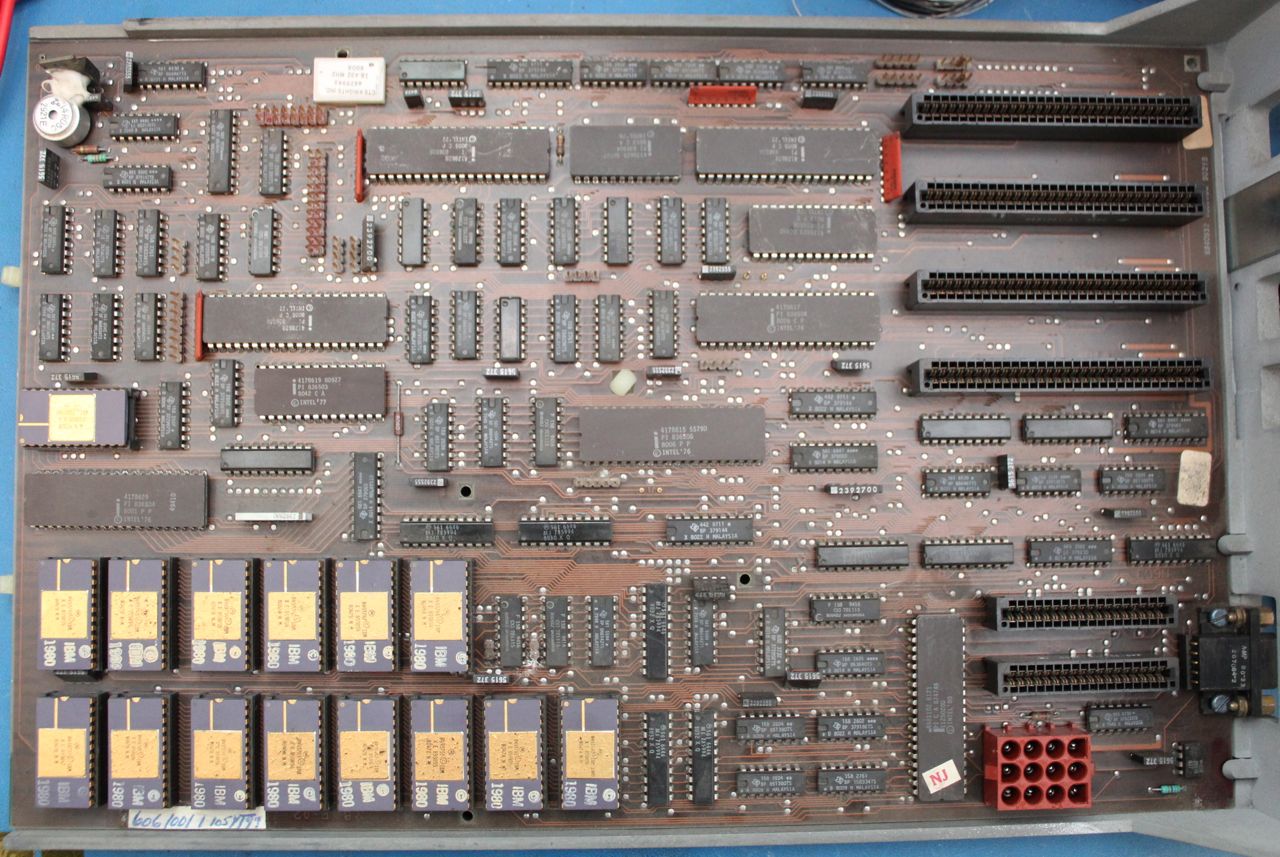
#12The interesting thing I recently noticed about the Datamaster is that I believe this system's motherboard inadvertently (or deliberately) became the very first informal motherboard layout standard, a predecessor to the original IBM PC format. The Datamaster and PC are different architectures so it's not an architectural link, but it's clear that the same engineering group that designed the Datamaster's motherboard also had some amount of influence in the PC's motherboard layout. There's nothing magic about the Datamaster's layout, it's just very sensible: power in one corner, I/O slots near the rear edge, BIOS and RAM at the other end, CPU roughly in the middle of everything it has to talk to. But before the Datamaster, systems like the 5100 and System 36 used discrete boards that just plugged into a backplane with minimal logic on it. For the era of those systems that made sense, but those dense card connectors add cost and they add electrical noise to the system. A unified motherboard design was a true improvement in design that matched manufacturing improvements arriving in the late 1970's.
Datamaster motherboard (those are not ISA or "PC bus" slots): https://www.nf6x.net/wp/wp-content/uploads/2014/09/IMG_3121....
Similarly, there were loose standards like LPX in the 1990's which were never a formal design standard, but clearly every PC maker of that era was using the same logical riser-card design. Perhaps it was the same Taiwanese engineering firm doing the actual design work on the back end for everyone that generated LPX, or perhaps it was just working knowledge moving as individual engineers had success with various designs.
Re: The IBM PC, Part 1: Arrival
#13And specifically for the IBM choosing Microsoft: https://nemanjatrifunovic.substack.com/p/why-ibm-turned-to-m...
Re: The IBM PC, Part 1: Arrival
#14Not bad. I don't like its tone of approval, TBH. I much preferred the « raucous bazaar, teeming with variety. » I hate the way the PC « the IBM PC and its successors paved over all of that » I really did not like... « he strange boxes at the electronics store labeled “Amiga” and “Atari ST” (the last gasps of dying giants) » That is not merely unfair, it's wrong. It's a very American viewpoint. I only discovered in re…
And now every mobile phone has a little Acorn DNA in it...
Re: The IBM PC, Part 1: Arrival
#15Not bad. I don't like its tone of approval, TBH. I much preferred the « raucous bazaar, teeming with variety. » I hate the way the PC « the IBM PC and its successors paved over all of that » I really did not like... « he strange boxes at the electronics store labeled “Amiga” and “Atari ST” (the last gasps of dying giants) » That is not merely unfair, it's wrong. It's a very American viewpoint. I only discovered in re…
> That is not merely unfair, it's wrong.
It’s close enough. 1990 was pretty much the start of the end of Commodore and Atari. Their relevance hung on in a couple of niche areas (like Atari with musicians), but outside of hobbyists, neither company mattered much and by 1995 they were both essentially dead from a commercial perspective. The fact that the corpses are kept upright as open source projects doesn’t really change anything.
Re: The IBM PC, Part 1: Arrival
#16Re: The IBM PC, Part 1: Arrival
#17(It's understandable. Microsoft, even if tiny compared to IBM, was a real company with a real business model. SCP was just a couple of guys in one office.)
Re: The IBM PC, Part 1: Arrival
#18If they'd have done that, much like MS, they'd have a piece of every PC sale, not just their own hardware.
That said, I don't think IBM culture could ever have that level of foresight or for that matter hold back the greed to try to own the whole pie. Just watching what became of OS/2. By the time NT4 came out, it was pretty much over... NT4 was leaps and bounds nicer to work with than OS/2 had been, and the software much more plentiful.
Not that MS was much better in terms of monopolistic tendencies, they managed to leverage their position both better, and in many ways have better overall offerings. Then again, MS today is a poor shadow itself of what it could have been had they not tried to start leveraging their own desktop customers for pennies on the dollar. Linux will erode their market share over time, and frankly, I'm surprised that MS doesn't have an AppImage/Flatpak version of MS Office for Linux that they license. They still have relatively nice tools, and though their online versions mostly work, it's not nearly as good and a lot of the integrations are still clunky.
Re: The IBM PC, Part 1: Arrival
#19Not bad. I don't like its tone of approval, TBH. I much preferred the « raucous bazaar, teeming with variety. » I hate the way the PC « the IBM PC and its successors paved over all of that » I really did not like... « he strange boxes at the electronics store labeled “Amiga” and “Atari ST” (the last gasps of dying giants) » That is not merely unfair, it's wrong. It's a very American viewpoint. I only discovered in re…
Re: The IBM PC, Part 1: Arrival
#20Not bad. I don't like its tone of approval, TBH. I much preferred the « raucous bazaar, teeming with variety. » I hate the way the PC « the IBM PC and its successors paved over all of that » I really did not like... « he strange boxes at the electronics store labeled “Amiga” and “Atari ST” (the last gasps of dying giants) » That is not merely unfair, it's wrong. It's a very American viewpoint. I only discovered in re…
The Amiga came later, and always looked like something from ten years in the future. It genuinely had a mid-90s aesthetic and promise in the late 80s.
The PC and Windows were both triumphs of worse-is-better corporate mediocrity and mass marketing over creative engineering.
It wasn't until the 486 multimedia clones arrived that prices became more reasonable and the hardware started to look competitive. But DOS and Windows always remained poor-to-mediocre - buggy, unreliable, messy, not secure, bizarrely user hostile - apart from a brief period downwind of NT when Windows was tolerable.