Earlier quoted context omitted.
No need for IRs if LLMs are all powerful. Just tell them to generate x86 and ARM and let them get on with it.
Niiice ... I'll byte the bullet. Hang on a bit while I register that in my memory . >generate x86 and ARM So that hardly anyone can review the machine language output, I guess. HN users' minds be like: 87.654321 %: JS? yeah. mainhipsterstream. gotta be a part. heart. smaller %: Rust? wannabe. donno how, u c. much smaller %: C? oh no ... numeric underflow. Congrats on moving over to the light side.
Why write code in 2026
311–320 of 321 posts
Re: Why write code in 2026
#312Earlier quoted context omitted.
Claude is perfectly capable of writing assembly. Here's a working (basic) Prolog interpreter that Claude Fable 5 wrote in WebAssembly in 61 minutes for $16.75 in token costs: https://github.com/emk/fable-wasm-prolog/blob/main/prolog.wa... WebAssembly is slightly easier than real assembly, but here Fable used WASM GC extensions, which are poorly documented and not yet super common. Fable didn't even need to debug it;…
Just interesting to see Claude’s hourly rate is around $17. Much cheaper than a human software engineer. But comparable to the wages for some human workers.
Re: Why write code in 2026
#313Earlier quoted context omitted.
It's like math in school. I wasn't good at math in school because I thought that understanding the concepts was enough. But without actually putting pen to paper and drilling through math problems you quickly get lost. It's a skill issue.
I specifically liked math and physics because these were something I didn't have to memorize or repeat constantly. While other subjects felt forced rote memorization. Same with code though. Writing things down feels like a chore mostly, so I am personally glad AI is here.
I am skeptical that you were able to get any good at Maths or Physics without drilling problems.
Re: Why write code in 2026
#314Earlier quoted context omitted.
Burke Holland has a few good videos that helped me. For example this on agents[1]. He uses Copilot but the principles are similar for Claude Code, Codex, OpenCode and other harnesses: So far in the LLM coding revolution I still feel like it's software development. I just work with systems on the level of features and architecture instead of flow control statements. Some day we might lose that too, but I think it will…
> I just work with systems on the level of features and architecture instead of flow control statements. That's kinda at the level I enjoy though - where I get to think-through things when figuring out exhaustiveness and correctness; introducing refinement-types into a codebase that's previously nothing but ints-and-strings; and trying out new and cutting-edge language-features directly. I know I can prompt Claude et…
Anyway I can say this - the free web interface to ChatGPT in 2024 vs what you get with agent harnesses and the latest large models now is like comparing a wombat fetus to a college graduate.
Get one of the 20 or so dollar subscriptions, install Claude code, codex or similar and start by explaining what program you want to make and which language you want to do it in. Have it make a plan first, and do some back-and-forth to refine it until you're ready to let it implement.
If your experience is from ChatGPT two years ago I think you will be floored by the results, even in Haskell.
Re: Why write code in 2026
#315Apparently it's not obvious to everyone, but if you can't write code, you can't review it. I do know people, and companies, that says: "So what, we ask Claude to write the code, Codex will then do the review". The thing that then strikes me as odd is that they still ask for the code in Python, Java, or some other high level language.... Why? Just ask Claude to dump out assembly, or a compiled binary, but no, they don…
just to add to your excellent observation by writing code by hand - you're the author & editor at the same time. if you're skilled enough - you quickly get to the desired state vs the llm which while might produce a lot of code - but it likely won't give the end state you desire. an analogy - Jason Fried gave - producing software by llm's is like bragging you're a photographer by pressing the shutter button on an aut…
Where will you put a line between photography and pressing button?
My point being - tools change with time.
Re: Why write code in 2026
#316Earlier quoted context omitted.
The difference is that you already learned how to write code. New devs that go straight to genai are missing that.
Perhaps new devs should write all their code by hand until they feel comfortable doing that. Then, they can start using LLMs gradually, just a little bit at first, all the way to fully AI generated code. However, that would just make the difference in productivity between junior and senior developers even more pronounced! It’s really difficult to see how things will play out in the future without junior developers di…
Re: Why write code in 2026
#317Earlier quoted context omitted.
I wonder, LLMs have progressed at great speed, because they have learned to duplicate what humans did and recorded in the documents and source-code that became the training materials for the LLMs. But now that humans don't write any more code, there is no new learning materials for the LLMs. There are no new things for them to learn. Therefore I expect they will plateau, the progress is no longer so fast. And maybe w…
They are now paying full-time programmers to write new training data.
Re: Why write code in 2026
#318Earlier quoted context omitted.
Claude is perfectly capable of writing assembly. Here's a working (basic) Prolog interpreter that Claude Fable 5 wrote in WebAssembly in 61 minutes for $16.75 in token costs: https://github.com/emk/fable-wasm-prolog/blob/main/prolog.wa... WebAssembly is slightly easier than real assembly, but here Fable used WASM GC extensions, which are poorly documented and not yet super common. Fable didn't even need to debug it;…
I have a personal game framework that I have LLMs write games in, which is in AssemblyScript. AssemblyScript is certainly closer to TypeScript than it is to WebAssembly, but it's still this thing where the host shares some big chunk of memory with the script and you pick some memory locations to read and write as your means of exposing APIs, and there's not a lot of training data on games written in AssemblyScript an…
Re: Why write code in 2026
#319Earlier quoted context omitted.
Niiice ... I'll byte the bullet. Hang on a bit while I register that in my memory . >generate x86 and ARM So that hardly anyone can review the machine language output, I guess. HN users' minds be like: 87.654321 %: JS? yeah. mainhipsterstream. gotta be a part. heart. smaller %: Rust? wannabe. donno how, u c. much smaller %: C? oh no ... numeric underflow. Congrats on moving over to the light side.
If nobody can review it that's fine since we'll be generating at least 50k LOC per day and nobody could review that anyhow. We can just get every other LLM model to review the output. What can go wrong?
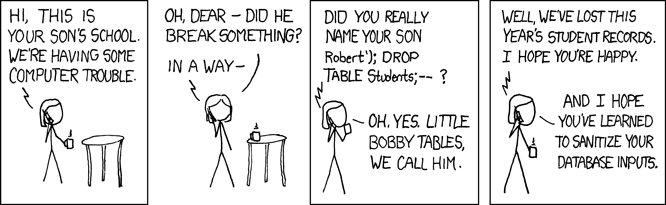
bobby tables, for another.
Re: Why write code in 2026
#320Earlier quoted context omitted.
As soon as human software engineers are Ubered away from the field, the price will ramp up to that of a human software engineer or more, have no doubt. ROI won't make itself up.
Then everyone just starts running open weight models locally.
Chinese models will be enlisted in NATS - the National Terrorism Advisory System.
Can't have the fat, rich big boys who give the campaign contributions fail.