Backtrack-Free Cursive
mmapped.blog
Backtrack-Free Cursive
1–10 of 133 posts
Re: Backtrack-Free Cursive
#2Usually writing small, in all-caps, except code: in lowercase, and the "t" and "i" retain their lower curve. Cursive is difficult; easy to write, but (later) hard to read.
Can see how penmanship there would be appreciated.
Re: Backtrack-Free Cursive
#3You only need 1 backtrack if you do the dots and crosses after you've written the word
Re: Backtrack-Free Cursive
#4> Only й and э require two strokes
Wouldn't the ф as well?
> [for the x], I draw two mirrored c’s
Isn't that what everyone is doing, or are we Frenchmen the exception?
For reference if the author reads this, we write the latin x exactly like the cyrillic х, i.e. reverse c, bottom-left to top-right diagonal, normal c.
Re: Backtrack-Free Cursive
#5> Only й and э require two strokes Wouldn't the ф as well? > [for the x], I draw two mirrored c’s Isn't that what everyone is doing, or are we Frenchmen the exception? For reference if the author reads this, we write the latin x exactly like the cyrillic х, i.e. reverse c, bottom-left to top-right diagonal, normal c.
> Wouldn't the ф as well?
Not if you write it as qo for lower case and oJo for capital.
Re: Backtrack-Free Cursive
#6> Only й and э require two strokes Wouldn't the ф as well? > [for the x], I draw two mirrored c’s Isn't that what everyone is doing, or are we Frenchmen the exception? For reference if the author reads this, we write the latin x exactly like the cyrillic х, i.e. reverse c, bottom-left to top-right diagonal, normal c.
> Wouldn't the ф as well? Not if you write it as qo for lower case and oJo for capital.
Oh nice, I was taught to write it first a “barless small-case f”, then an “infinite” in the middle.
Re: Backtrack-Free Cursive
#7You only need 1 backtrack if you do the dots and crosses after you've written the word
Right, but multiply that by half the total number of words, and it's a lot.
Re: Backtrack-Free Cursive
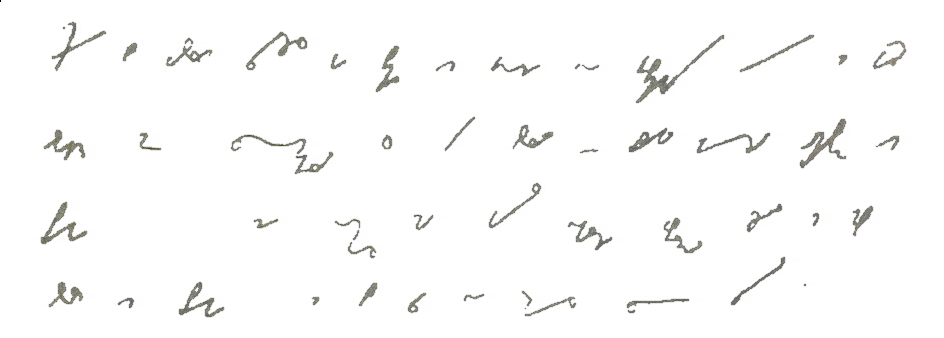
#8For anyone interested in optimising this further, orthographic (letter-based) cursive shorthand systems are the answer. I personally only know part of the Melin system[1], but there are variants designed for English as the primary language too. (Melin is of course perfectly usable with English also.)
The flow of a cursive shorthand system is unmatched by anything else. I highly recommend learning enougnh to experience it.
(The drawback with more phonetic systems like Gregg is that one has to learn entirely new ways of spelling words. But normal English spelling is so complicated that tradeoff can be worth it for heavy usage. Orthographic systems often also contain phonetic components, but they tend to be optional extensions that improve efficiency, rather than required like with purely phonetic systems.)
Re: Backtrack-Free Cursive
#9You may want to look into Sütterlin script. It's a bit harder to learn than standard cursive, but it's very pretty, and a level-0 encryption since few people can read it nowadays.
Re: Backtrack-Free Cursive
#10Huh, I just indirectly learned from this article that the way I write a lower-case "t" in cursive is a Dutch way of doing so (edit: sollniss' comment implies it was a common style in Germany too). A quick search suggests it has been replaced with an English style of "t" in the last decades too.
I wonder if that makes my handwriting harder to read for anyone who isn't Dutch and over 40 years old.
Anyway, just bringing it up because you don't need to lift up your pen to write that kind of "t".
Search for "koordschrift" on https://primarium.info/countries/the-netherlands/ to find the illustration showing how I was taught to write it in the late 80s. It's the letter vaguely shaped like a pine tree.