The choice of pi as a number whose sequence of digits is random is a bit of a weak point of the argument in the post. It is not even known whether every digit 0-9 appears infinitely many times in pi (a weak version of the normal number conjecture). So we do not really know (but strongly believe) that the sequence of pi digits would truly appear random. This of course does not detract from beautiful arguments and the…
Connections in Math: the two kinds of random
21–30 of 39 posts
Re: Connections in Math: the two kinds of random
#22This is under-taught in comp sci so I'll say it in all caps for visibility. THERE IS NO KNOWN GENERIC WAY TO MEASURE INFORMATION ENTROPY!!!! Seriously. There isn't. You might say 'but measure the number of 1's vs 0's' and i'll just reply with '101010101010 repeated'. So you up it and start saying ok maybe measure frequencies of pairwise bits then and i just reply by cycling 00,01,10,11 endlessly etc. Frequency counts…
> This is under-taught in comp sci so I'll say it in all caps for visibility. THERE IS NO KNOWN GENERIC WAY TO MEASURE INFORMATION ENTROPY!!!! Both your comment and the OP seem to conflate a distribution with a sample from a distribution. A distribution over strings has entropy. A single string can have a Kolmogorov complex but does not have entropy in the Shannon sense per se. When you write a compression algorithm,…
You have to limit yourself to each string being independent for that to be true which is a limitation that leads to the impossibility of calculating entropy generically.
Re: Connections in Math: the two kinds of random
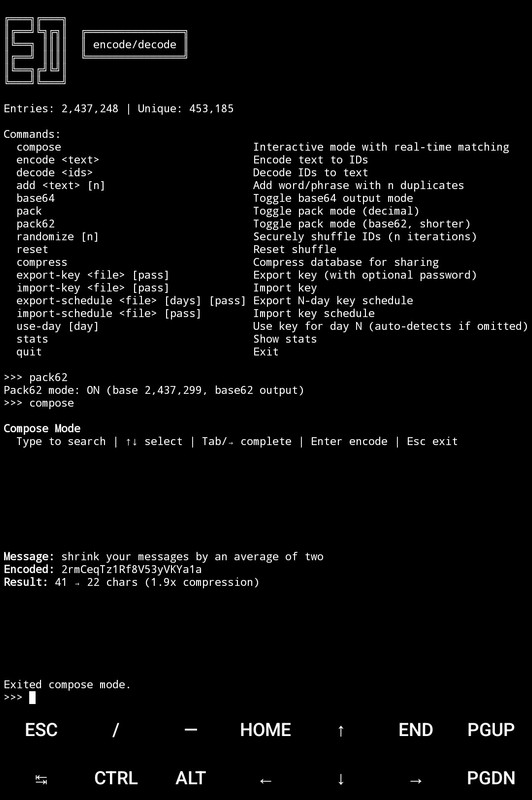
#23I tried to make a codebook of everything. You can get surprisingly good compression by assigning words and phrases to numbers.
My particular attempt had phrases up to 12 words.
No grammar or anything...to test the program, when I had a random thought, I tested to see if I could encode that thought. I could and on average the thought/message was compressed by 2. There was very few times where I wasent able to encode the idea into the available building blocks or language model of the database.
Re: Connections in Math: the two kinds of random
#24there are many instances of claude in here, so not sure what that disclaimer was about.
how do you know?
Apparently, the disclaimer was "put as a joke". Must be an eclectic sense of humor.
Re: Connections in Math: the two kinds of random
#25Re: Connections in Math: the two kinds of random
#26I don’t understand the claim that Kolmogorov lower bounds are uncomputable. Three digit strings are unlikely to run as a program so surely 3 is a lower bound on Kolmogorov of the first million digits of pi, no? To tighten bound, one would need to try out every 4-digit program, every 5-digit program, and so on. Either these produce the first million digits of pi or they don’t when the program is run, so each possibili…
Re: Connections in Math: the two kinds of random
#27there are many instances of claude in here, so not sure what that disclaimer was about.
Maybe the author has been overly influenced by Claude's writing style?
Re: Connections in Math: the two kinds of random
#28> So you can never close the case on even one candidate, let alone all of them at once, which means the lower bound stays sealed.
Which is simply not true. The specifics depends on what language you use, but let's take Turing machines as an example. Many candidates are easily disproven: ones that halt immediately, ones that have no rule for writing a "1", ones that have no rule for halting and so on. It's impossible to write a program that can handle every possible candidate though.
And if your string is short enough, let's say the string you are investigating is "0011" then you CAN sit down and check all Turing machines of size 4 and lower. This is essentially what the https://bbchallenge.org/ project did.
For Turing machines we have determined if they halt or not for all machines up to 5 states. It is very computationally hard to push this limit further, but we don't know where the theoretical limit is. We have some large upper bound where a Turing machine computes something that we know is independent of ZFC (see Scott Aaronson for more details), but many suspect that the limit is way lower.
Re: Connections in Math: the two kinds of random
#29I don’t understand the claim that Kolmogorov lower bounds are uncomputable. Three digit strings are unlikely to run as a program so surely 3 is a lower bound on Kolmogorov of the first million digits of pi, no? To tighten bound, one would need to try out every 4-digit program, every 5-digit program, and so on. Either these produce the first million digits of pi or they don’t when the program is run, so each possibili…
Re: Connections in Math: the two kinds of random
#30See https://forwardscattering.org/page/Kolmogorov%20complexity
And no, the invariance theorem doesn't save you.