Live data from Hacker News

“Beyond the limit”: Satellites and mirrors in space pose threat to the night sky

eso.org

91–100 of 334 posts

Re: “Beyond the limit”: Satellites and mirrors in space pose threat to the night sky

#91
post #24

Earlier quoted context omitted.

Or defense.

Defense is just a polite term for war.

There is this mistaken idea out there that if the U.S. were to disarm, then other nations would also disarm, and the whole world would live in peace. But history tells us over and over that power abhors a vacuum, and were the U.S. to leave the world, another would take its place, probably Russia or China. If we disarmed, then another nation with arms will inevitably invade the U.S.
Re: “Beyond the limit”: Satellites and mirrors in space pose threat to the night sky

#92

>SpaceX plans to send one million more satellites into orbit, for space-based data centres, ... I think we should wait to see how the first satellite data centre works out. It seems fairly unlikely that it could be practical. It seems kind of nuts... >Reflect Orbital, a US start-up, aims to launch a constellation of very large mirror-like satellites to provide sunlight at night, with reflected beams that span at leas…

I can think of several practical uses. It would be very useful immediately after a disaster. Lighting up the night would make search & rescue much more effective. It would also allow for more solar power generation in an area, reducing pollution. Extra light at high latitudes in the winter would reduce seasonal depression.

Are they worth the cost/tradeoffs? I don’t know. But there is practical value to lighting up the night.

Re: “Beyond the limit”: Satellites and mirrors in space pose threat to the night sky

#93
post #15

Earlier quoted context omitted.

Who is we? Certainly not amateur astronomers who made important discoveries with their telescopes

If the cost to orbit does get low enough as is the assumption in this article, I would be shocked if we didn't start to see amateur space based telescopes.

Or services where you can buy some photos, like we have for the telescopes pointed at earth

Re: “Beyond the limit”: Satellites and mirrors in space pose threat to the night sky

#94

Earlier quoted context omitted.

AI is not going to give us a star trek utopia, AI is an attempt by the bourgeoise to alienate the average person from the capital that has previously always come free with their human life. AI promises a feudalist future where there is no capital that isn't owned by the ruling class. Its power is not democratized, it is concentrated in the hands of those building the data centers. That is why I'm against the data cen…

> Its power is not democratized, it is concentrated in the hands of those building the data centers. That is why I'm against the data centers If you really believe this (and I’m not saying I don’t, I just don’t have confidence in it), blocking domestic. datacenters doesn’t preserve that labour value. It just ensures whoever builds those datacenters controls production from afar. Like, if AI really replaces human labo…

Sorry, do Memphis residents get to control xAI's production? I think we're already in this situation.

Re: “Beyond the limit”: Satellites and mirrors in space pose threat to the night sky

#95
post #40

Earlier quoted context omitted.

I think that "Africans should not have access to high-speed satellite Internet" is something you've just made up; the article you link talks about African people turning to Starlink because of local infrastructure issues, and the original article notes that the current satellite count is currently around 14k satellites. 100k is more than enough satellites to provide high-speed satellite internet globally. The article…

Not to mention starlink is not a solution for internet for everyone on the planet: it cannot serve everyone in a densely populated area, no matter how many satellites they have in their constellation. It's a useful piece of infrastructure, but it's far from the panacea people seem to think it is.

> it cannot serve everyone in a densely populated area,

I also suspect that to be the case but in order to be more objective I wonder. What's the theoretical maximum bandwidth per square meter (or other unit area) that it can deliver?

Re: “Beyond the limit”: Satellites and mirrors in space pose threat to the night sky

#96
post #20

Earlier quoted context omitted.

They hinder the view on asteroids coming our way. The purpose of most of these satellites is internet access where we already have less limited possibilities with less maintenance costs like constant replacement

No they don't. It's more of an issue for long-exposure galaxies and nebula. And asteroids are an extremely rare threat in the first place. It's literally a once-in-a-million-years kind of event.

Dinosaur killers? Yes.

City killers? That size hits more often

> Asteroids with a diameter more than 30–50 metres (100–150ft) are large enough to make it through our atmosphere intact, however, and the chance of this happening is estimated to be around once in every 100 years.

> The damage from an impact of this size would be wide-ranging, and could wipe out an entire city if they were to impact a heavily populated area.

https://www.skyatnightmagazine.com/space-science/chances-ast...

Re: “Beyond the limit”: Satellites and mirrors in space pose threat to the night sky

#97

Of course this comes from a European organisation.

I really wanted to downvote this because I hate the constant EU bashing, but I just have to agree. So we can’t see the stars from Munich anymore? Yes, that’s depressing, but we’re not trying to reduce light smog in Munich right now, are we? Because all the buildings that have been build, all the streets and trains, also make it hard to see the stars. More light is one of the things progress has always brought, and ev…

> we’re not trying to reduce light smog in Munich right now, are we

we aren't?

Bavarian Regulation on Light Pollution, Federal Nature Conservation Act, etc

Municipal lighting is regulated with light pollution in mind and allegedly you get fined over bright commercial lights at night

Re: “Beyond the limit”: Satellites and mirrors in space pose threat to the night sky

#98

How much CO2 does launching a million satellites produce? Is is significant compared to other sources of CO2?

Compare it to air planes, which are already at a much more significant scale. Accounting for fuel type and combustion efficiency seems relevant.

I recall around SpaceX 100th landing, that a day of just transatlantic flights was more than everything SpaceX had done to that point

Re: “Beyond the limit”: Satellites and mirrors in space pose threat to the night sky

#99
post #13

These kinds of caps have for years been a dampener on human flourishing. My observation has been that those in stagnation or decline tend to attach themselves to these desires to hold the status quo. Anti-energy, anti-housing, anti-industry and so on because they've reached a local maxima in their ability to live and have chosen to spend their life in leisure. But there is the rest of the world, and if I'm told that…

I didn't understand what these satellites were really like until I visited Zion National Park two weeks ago. Zion is an International Dark Sky park, and so I was really looking forward to seeing the stars. Instead we sat outside and watched dozens and dozens of fast-moving stars zip around on all sorts of trajectories. I'm not saying it ruined the experience (I'm not an astronomer, and it was kind of fun.) But it rea…

How can anyone see what is happening in Ukraine and not realize the future is not just 1 starlink, but also a Chinese one and a Europe at a minimum. Probably many other countries will make sure to have at least a regional one as well though.

Re: “Beyond the limit”: Satellites and mirrors in space pose threat to the night sky

#100

Earlier quoted context omitted.

I think that "Africans should not have access to high-speed satellite Internet" is something you've just made up; the article you link talks about African people turning to Starlink because of local infrastructure issues, and the original article notes that the current satellite count is currently around 14k satellites. 100k is more than enough satellites to provide high-speed satellite internet globally. The article…

The article doesn’t consider that in a world with a million satellites in orbit, launching space-based telescopes—including into deep space—becomes an order of magnitude cheaper.

Currently writing a draft blog post on all the issues (and non-issues) with these things, it is now long enough (7k words) I'm slightly wondering if it's less "a blog post" and more "one section of a decent sized book on why we can't have nice things".

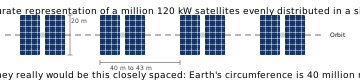
Here's a visual to consider the implications of things you can do with actually one million satellites of the kind of size scale being discussed:

https://raw.githubusercontent.com/BenWheatley/blog/refs/head...

Post reply on HN