Almonds producers in California use roughly 60-85 times more water annually than all US data centers combined, depending on the exact figures and whether indirect power-plant water is included. Wake up, people! Stop the evil producers of almonds!
I can't eat data centers. Almond milk, OTOH, is a great non-dairy substitute for my cereal.
AI Data Centers Use More Water Than Most Tech Giants Report
51–60 of 71 posts
Re: AI Data Centers Use More Water Than Most Tech Giants Report
#52Earlier quoted context omitted.
> When you're using water in a open-loop data center, you get in cool/cold water, add biocides and other chemicals to protect your infrastructure, then heat it and pump it back to the body of water (i.e. river, lake or an underground hole, or somewhere). These are not power plants, there are zero data centers using open loop cooling that discharge loop water back into a waterway. It’s unnecessary when you’re cooling…
I'm not sure, because of two reasons. First, I don't see the banks of dry coolers or chillers required to cool that amount of water in many of the data center photos. Second, our closed loop data center is not losing that amount of water, so losing 10 billion gallons of water to evaporation across that many data centers seems unrealistic, even with evaporation for humidity balancing and dry-cooler boosting reasons. S…
Adding evaporative cooling towers to a chilled water loop that uses chillers can double the efficiency.
A power plant that draws water from an intake, uses it to reject heat, cools it down, and then discharges it back to the stream/lake/ocean is once-thru cooling.
Re: AI Data Centers Use More Water Than Most Tech Giants Report
#53Google’s just-released 2025 sustainability report is an instructive example. The company said it consumed 10.9 billion gallons of water—a 34% increase from 2024—almost all for data-center cooling. … Google consumes around three times as much water indirectly as directly, according to a paper published earlier this year by Alex de Vries-Gao, a researcher at the Netherlands-based university VU Amsterdam. — My take: the…
Desalination, turning unlimited sea water into fresh water which is one of the most expensive sources of fresh water, is ~0.50 $/m^3. They can literally manufacture the water they use with zero impact on the water table for ~20 million dollars.
Re: AI Data Centers Use More Water Than Most Tech Giants Report
#54Earlier quoted context omitted.
The water isn’t destroyed, though, is it? It evaporates, right? So it isn’t lost?
It’s infused with biocide and other chemicals which can’t be separated by processing plants. It’s not evaporated, but dumped if the system is open loop. It becomes unusable for consumption and farming. It becomes waste. Closed loop systems and ordinary humidifying doesn’t and can’t “use” that amount of water.
Re: AI Data Centers Use More Water Than Most Tech Giants Report
#55I feel like we've already had this discussion with respect to Crypto; crypto used more energy than banks (which proved to be false, but whatever); and water. Now AI uses magnitude more energy than crypto (or humans) and somehow they're now saying it's okay?
> crypto used more energy than banks (which proved to be false, but whatever) The true accusation was that crypto used more energy than banks per transaction . Your framing is very dishonest.
Re: AI Data Centers Use More Water Than Most Tech Giants Report
#56Google’s just-released 2025 sustainability report is an instructive example. The company said it consumed 10.9 billion gallons of water—a 34% increase from 2024—almost all for data-center cooling. … Google consumes around three times as much water indirectly as directly, according to a paper published earlier this year by Alex de Vries-Gao, a researcher at the Netherlands-based university VU Amsterdam. — My take: the…
To add on, that is just ~40 million m^3 of water. Desalination, turning unlimited sea water into fresh water which is one of the most expensive sources of fresh water, is ~0.50 $/m^3. They can literally manufacture the water they use with zero impact on the water table for ~20 million dollars.
Of course location matters a ton in the water usage argument but I'm not sure how relevant this actually is when it comes to winning over hearts and minds.
Re: AI Data Centers Use More Water Than Most Tech Giants Report
#57Google’s just-released 2025 sustainability report is an instructive example. The company said it consumed 10.9 billion gallons of water—a 34% increase from 2024—almost all for data-center cooling. … Google consumes around three times as much water indirectly as directly, according to a paper published earlier this year by Alex de Vries-Gao, a researcher at the Netherlands-based university VU Amsterdam. — My take: the…
Not sure how legit it is, but there is certainly more nuance to water usage.
I prefer the golf course analogy, which uses 2-3x the water of data centers and has dubious benefit to society beyond the entertainment for those who can afford the "green" fees
Re: AI Data Centers Use More Water Than Most Tech Giants Report
#58Re: AI Data Centers Use More Water Than Most Tech Giants Report
#59Earlier quoted context omitted.
It’s infused with biocide and other chemicals which can’t be separated by processing plants. It’s not evaporated, but dumped if the system is open loop. It becomes unusable for consumption and farming. It becomes waste. Closed loop systems and ordinary humidifying doesn’t and can’t “use” that amount of water.
You’re all over this comments section with “biocides” but what the hell even is a biocide? It sounds pretty scary (“life kill! Yikes!”) but a quick search tells me it’s meant to kill harmful things like viruses and mold. Add to that the fact that I’ve never heard it used in the context of pollution, let alone datacenter-based pollution, and I’m inclined to believe you’re not being serious. Also, what processing plant…
Biocides in terms of datacenter cooling is used to prevent moss and algae to take over your pipe systems and clog them. In inner loops, even though isolated, any small contamination creates serious clogging and flow issues (the pipes are pretty narrow to begin with).
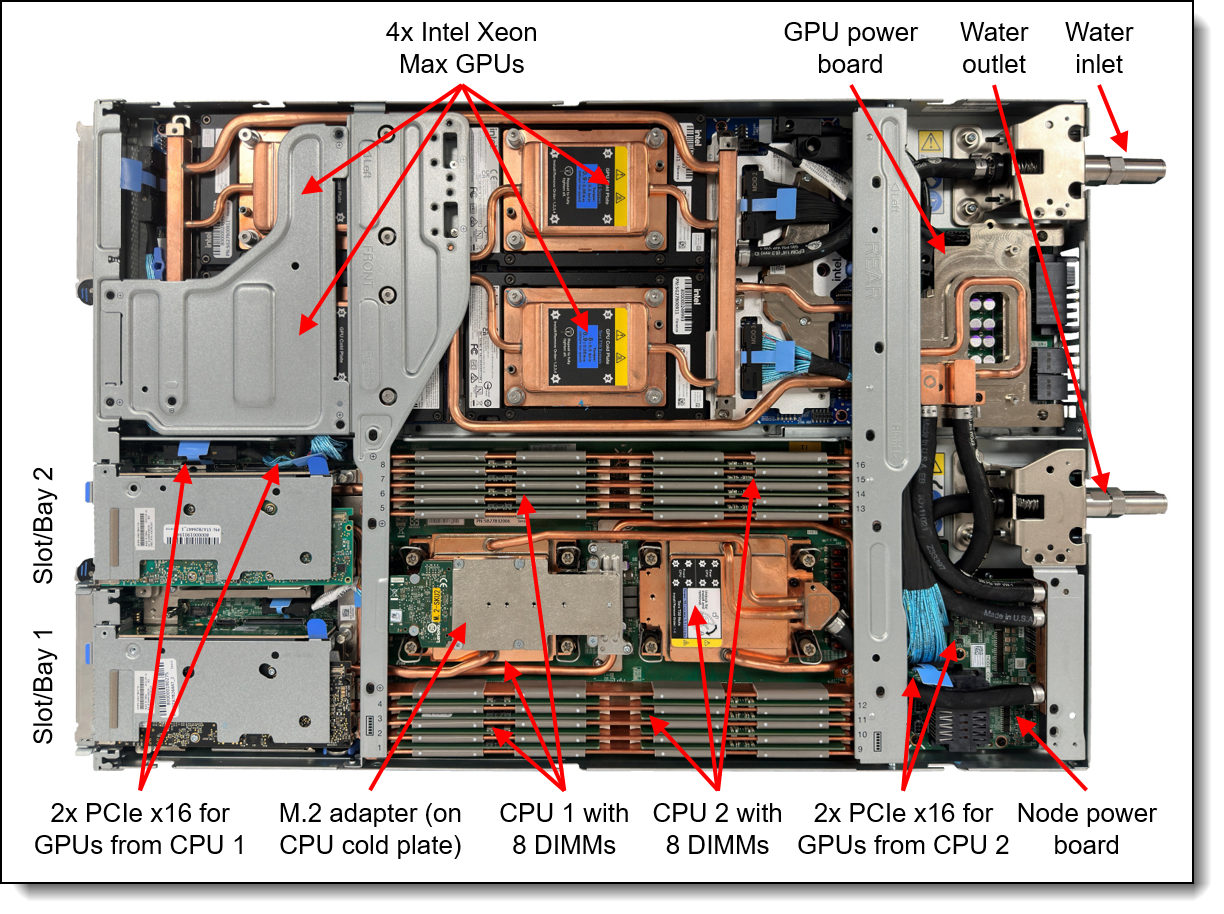
Inside a typical DLC server: https://lenovopress.lenovo.com/assets/images/LP1602/SD650-I%...
In outer loops, coolant hygiene is equally important since any layers of algae or moss creates clogs and reduces thermal conductivity in heat exchangers.
> It sounds pretty scary (“life kill! Yikes!”)
Since biocides prevent "living organisms" being present in water, it basically sterilizes it. You can't use biocide contaminated water to grow anything or to feed anything and anyone. I mean, we use similar materials to kill weeds. If you're exposed to them, after a certain dosage you'll experience nasty illnesses.
> Add to that the fact that I’ve never heard it used in the context of pollution, let alone datacenter-based pollution
See: https://h2ocooling.com/closed-loop-vs-open-loop/#How_Open-Lo...
Excerpt: Maintaining water quality demands robust chemical treatment programs. Scale inhibitors, biocides, corrosion inhibitors, and pH adjusters require careful monitoring and frequent adjustment to prevent system damage.
Biocides specialized for open-loop cooling systems: https://www.dober.com/water-treatment/cooling-tower-biocides
> I’m inclined to believe you’re not being serious.
It's your call. I work at a team for two decades which maintains a couple of Top500 systems. We still handle everything from unpacking to cabling to installation and software side (i.e. Full Stack) for most of our servers. DLC systems need their specialized installation teams on the ground, so we let them do their work, but for conventional systems we still do everything.
> Also, what processing plants are supposed to be separating water from “biocides and other chemicals”?
Your water treatment plant removes many harmful things to create potable water, but not all chemicals can be removed by them. US tap water frequently tests positive for antidepressant and other drugs' traces. Also treatment plants generally use bacteria (i.e. bugs) to remove harmful stuff, not chemicals (except gases like ozone) to treat water IIRC.
> Are you saying that in an open loop system, none of the water makes it back into the water cycle?
What I say is, in an open loop system, you use much more water and poison your environment during the process. Closed loop systems doesn't waste much water and certainly doesn't leak nasty chemicals around. You forcefully remove heat from the water with drycoolers and/or chillers and you can use the heat for secondary purposes if you want/can, too.
Re: AI Data Centers Use More Water Than Most Tech Giants Report
#60Earlier quoted context omitted.
> It’s by far not the biggest problem! Yeah, you're right. Some parts of the world is running out of fresh/clean water. We can drink coke instead.
The water isn’t destroyed, though, is it? It evaporates, right? So it isn’t lost?
I mean, who has ever seen a cloud move?