Live data from Hacker News

AI boom risks global financial crash, warn central bankers

telegraph.co.uk

111–120 of 228 posts

Re: AI boom risks global financial crash, warn central bankers

#111

Earlier quoted context omitted.

Just to be clear: you're talking about federal and state non-military spending. And about 10% of this is interest. So over the course of a year, the US is paying about $1.25 trillion in interest at the federal and state level.

Why wouldn’t you include state spending? That’s the level of government primarily responsible for infrastructure and education.

I wasn't making a judgment about including or not including state spending. It's just that "US governments" is not a common way for Americans to describe federal and state. People think federal when they see "US government".
Re: AI boom risks global financial crash, warn central bankers

#112

Is there any comprehensive list of historical warnings from central bankers?

I just checked 2007 and 1999 reports [1] a a bit and doesn't seem like they made such obvious warnings at those times. I don't know much about economy and I just did some ctrl + f skimming, but this new 2026 warning is obviously more clear to me. [1] https://www.bis.org/annualeconomicreports/index.htm?annualec...

I think we also would need to know how many of these warnings they gave where nothing bad happened

Re: AI boom risks global financial crash, warn central bankers

#113

I'm not usually for arguments of "this money could have been better spent elsewhere", but here's a thought experiment. Lets say instead of injecting $2 trillion and counting into a few AI companies, we instead injected $2 trillion dollars into things like infrastructure (real infrastructure, not GPU warehouses), education, helping out communities ravaged by globalization (I doubt most people on Hacker News venture ou…

It won't make much difference. The US has a lot of problem, but "not spending enough money" isn't one.

The US government spend a lot on healthcare ($5.3 in 2024)[0]. More than most European countries per capita. But many people still feel that the US hardly has healthcare at all. Pouring more money without a full structural overhaul will likely make things worse.

And the $2T you mentioned is investors' money, which means that your plan is actually to increase tax by $2T and pour it into a system proven inefficient.

[0]: https://www.healthaffairs.org/doi/10.1377/hlthaff.2025.01683

Re: AI boom risks global financial crash, warn central bankers

#114
post #81

I'm not usually for arguments of "this money could have been better spent elsewhere", but here's a thought experiment. Lets say instead of injecting $2 trillion and counting into a few AI companies, we instead injected $2 trillion dollars into things like infrastructure (real infrastructure, not GPU warehouses), education, helping out communities ravaged by globalization (I doubt most people on Hacker News venture ou…

> we instead injected $2 trillion dollars into things like infrastructure (real infrastructure, not GPU warehouses), education, helping out communities ravaged by globalization Even excluding military spending, US governments spend $2 trillion every 10 weeks.

Not to mention that data centres are infrastructure!

Other nations are falling behind and will be at a real disadvantage soon.

Re: AI boom risks global financial crash, warn central bankers

#115
post #98
post #83

Earlier quoted context omitted.

Well yes, you have to spend the money wisely. How could we construct a system so that we have 2x as many teachers (thereby halving the classroom size)? That would have a lot of good second-order effects beyond test scores.

So why has per-capita student spending doubled since 1990 (adjusted for inflation) without any increase in test scores? Why haven’t we been spending the money wisely? Student to teacher ratios have continuously decreased and are about half of what they were in 1960. Data on the results is mixed: https://www.brookings.edu/articles/class-size-what-research-...

Because we have also increased the spending in "un-education" (entertainment, social media, college sport...) ?

What's your own theory ?

Re: AI boom risks global financial crash, warn central bankers

#116

Earlier quoted context omitted.

Why wouldn’t you include state spending? That’s the level of government primarily responsible for infrastructure and education.

I wasn't making a judgment about including or not including state spending. It's just that "US governments" is not a common way for Americans to describe federal and state. People think federal when they see "US government".

Gotcha. Was being lazy and typing on my phone, sorry.

Re: AI boom risks global financial crash, warn central bankers

#117
post #72

Earlier quoted context omitted.

I don't think we don't really know how to do many of these things you list even if we have infinite funds. There is a real chance that we will mess things even more if we have infinite funds...

Of course we do, we were doing them until about the mid-70s and then the ultra-wealthy figured out how to game the system and we got “Greed is Good” Geckos running things since.

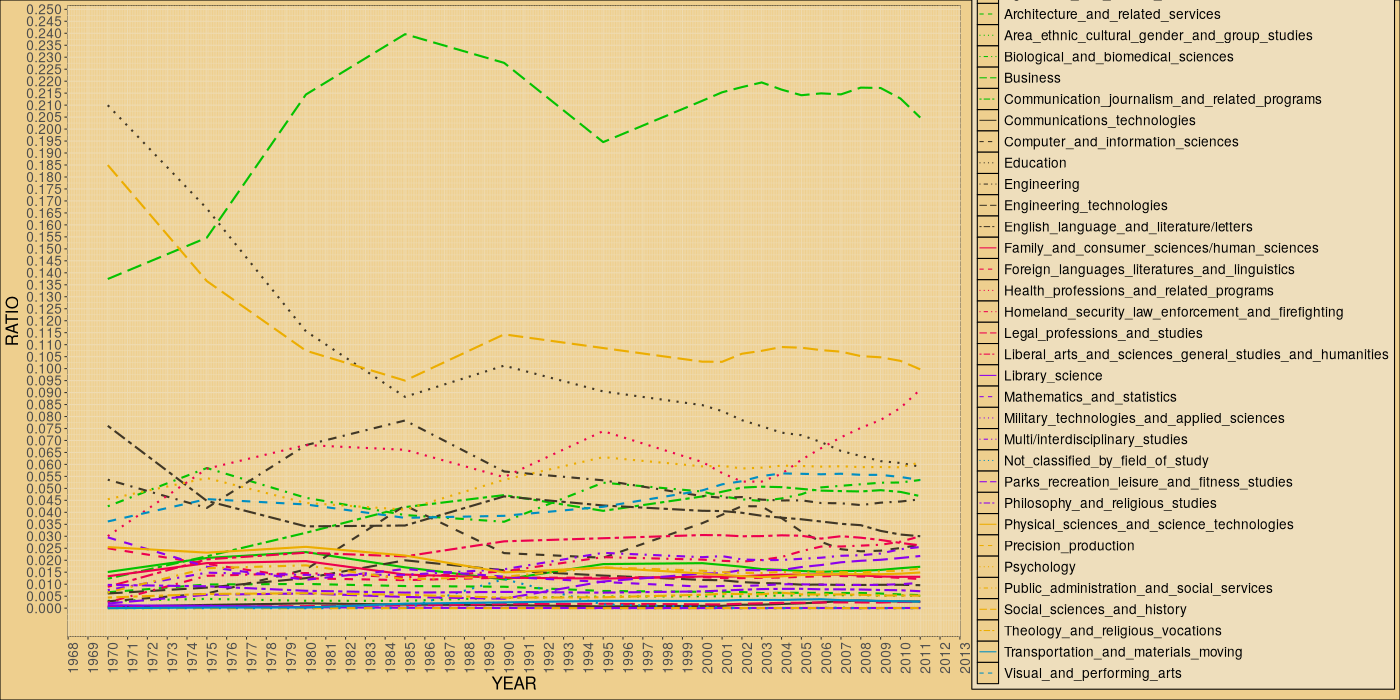
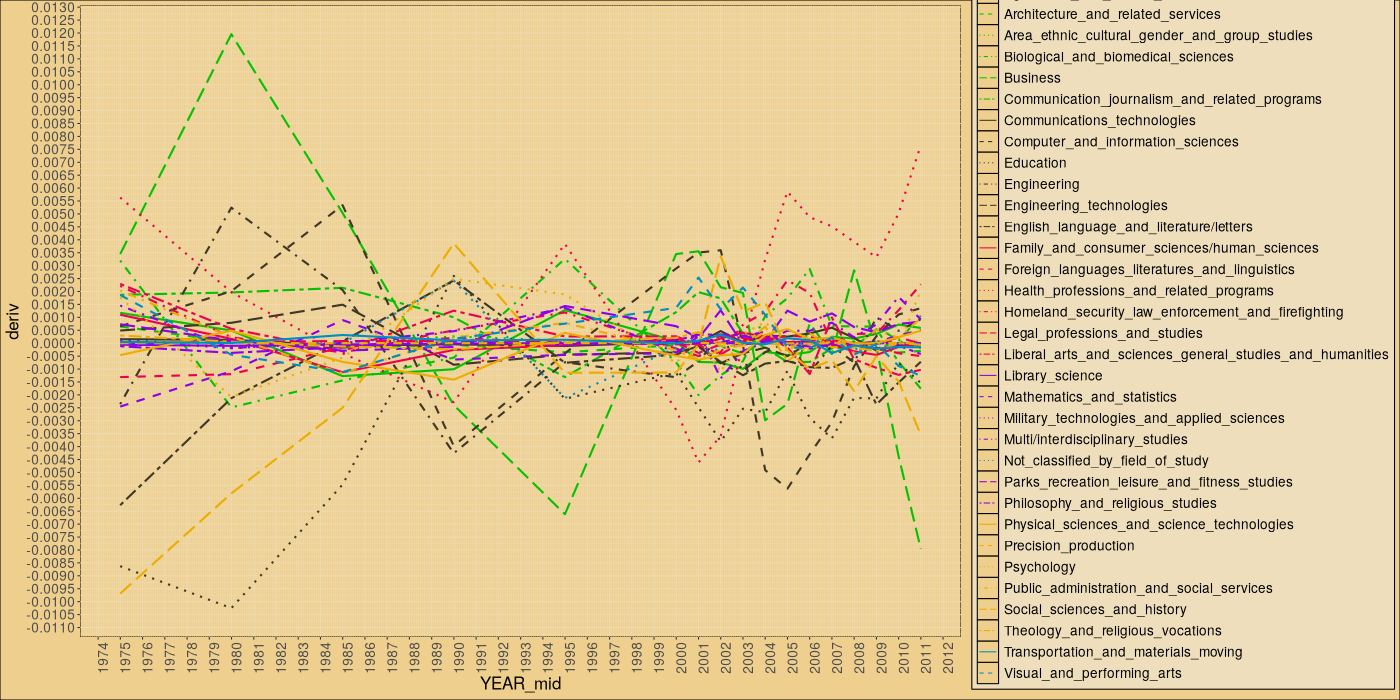
And, in case anyone needed proof, this is reflected in the US degree-completion-data, when measured as a percentage (https://galacticbeyond.com/two-percent-programmer/plots/over...), and when measured as a derivative of percentage (https://galacticbeyond.com/two-percent-programmer/plots/deri...). That green top-line, is business-majors, and those two lines that declined from top to average are social-sciences and education (all data from 1970 to 2011). In 1970 1 in 10 graduates were in business, 1 in 5 were in education and in social sciences. By 2011, 1 in 5 (or 2 in 10) were in business, and 1 in 10 were in social sciences and 1 in 20 were in education. Healthcare went from 3 in 100 to 1 in 10.

> and we got “Greed is Good” Geckos running things since

This phrase is the opposite of an exaggeration. It sounds like it should not be true, but it really, really is. To be fair though, if you told me in 2015 what the headlines for the 2020s would look like, I would assume you are some kind of satirist or comedian.

Re: AI boom risks global financial crash, warn central bankers

#118

Earlier quoted context omitted.

because that's not how this world works, and neither it should. most people figure that out in their early teens. and fyi, that 2t is not tax money, it's someone's money.

“This is how the world should work” I say once I read that the handful of entities engineering global economic calamity are privately held. I interrupt my chat bot girlfriend’s detailed but deeply incorrect summary of yesterday’s news to type “Only a literal child would want to go to a school.” “That is so true! You’re really on to something brilliant there! To get a head start before we drill down on this further I’…

>my chat bot girlfriend

you may think she's just your gal but she may be everyone's pal.

Re: AI boom risks global financial crash, warn central bankers

#119

Earlier quoted context omitted.

How? The annual federal budget is roughly $7T.

You have to include state and local spending too. We’re at 40% of GDP which works out to almost $13 trillion: https://fred.stlouisfed.org/graph/?g=1CFpQ . Subtract $1 trillion in defense, and we’re spending about $1 trillion a month on government.

Does that chart double-count state transfers to municipalities? When I was in local government, about half our school budget came from the state, so there would be entries on both ledgers.

Re: AI boom risks global financial crash, warn central bankers

#120
post #12

Earlier quoted context omitted.

Yeah but the investments arent aiming for churning out SaaS apps. Its to automate large swathes of intellectual labour. Of which only SWE has been cracked yet. There is a question mark as to if the others will crack. If they arent then these investments will collapse from speculation down to reality. That possibility is what is being discussed here As to whether that will happen, I think that risk is real. Because cl…

you mentioned a very good point about scalability. we're seeing alot of productivity gains, but only from SWEs, which are but a very small segment of the global economy. all other economic use cases require thorough last-mile development and iteration that is not too different with current automation tools.

We aren't seeing productivity gains in software either. What we are seeing is a lot of people who claim to be more productive, but in fact are building piles of tech debt that will fall over before long. But hey, they're building that tech debt really fast!
Post reply on HN