Live data from Hacker News

Long Wave radio era set to end with switch-off

economist.com

131–140 of 170 posts

Re: Long Wave radio era set to end with switch-off

#131

Earlier quoted context omitted.

You only need the license if you watch live TV (on any service) or use BBC iPlayer. If you only watch DVDs, or stream movies etc, you don't need a license

When did they change it from if you could watch to if you actually watch?

Technically the rule never changed. If a licence inspector sees a TV connected to an ariel socket then you're breaking the law.

But there's virtually no inspections any more. There were a lot of bad newspaper headlines about poor single mothers going to prison for getting caught (and refusing to pay the fine, but that bit usually got left out), so enforcement basically ended.
Re: Long Wave radio era set to end with switch-off

#132

Earlier quoted context omitted.

> Is that emitted power, consumed power, or effective radiated power? Going by [1], emitted power. [1] https://www.bbceng.info/Operations/transmitter_ops/Reminisce...

I can't edit my previous comment (which incorrectly implied that the 3 stations at Droitwitch are going out of the same antenna), but I've done more research and have more information. Droitwitch LW's antenna uses a T-aerial suspended between two 210m steel masts acting as massive capacitive top-loaded vertical monopole. The signal isn't beamed or shaped, it propagates omnidirectionally and this style of antenna offe…

> so for peak loudness (someone shouting or the loudest spike in music) it can take an extra 50% power to create the upper and lower sidebands

Some people save energy by turning their appliances off at the plug rather than leaving them on standby. Clearly Radio 4 chose to avoid having Brian Blessed on too frequently instead ;)

Re: Long Wave radio era set to end with switch-off

#133

Earlier quoted context omitted.

> it doesn't degrade gradually as signal gets worse That has a lot more to do with the dated implementation and less to do with digital radio. There are a number of digital broadcasting techniques which can minimize and compensate for noise, including a slight delay with a signal correction and fault tolerant codecs. DAB was implemented using the old MPEG2 audio codec. DAB+ uses the now 15 year old codec HE-AAC which…

DAB+ uses EEP (and RS) which was deliberately chosen to give better signal quality all the way to the point of losing reception. Old DAB used UEP which degrades faster, but instead of having no signal, it went to a muddier / warbling kind of sound that characterised early DAB receivers. And technically while some people do call it MPEG2, it's actually MP2, also known as MPEG-1 Audio Layer 2, an audio codec in the sam…

> I imagine that today they'd probably use something like Opus and a fountain code or similar, yes... But you can't expect everyone to replace their radio every 10-15 years ;)

Certainly not, which is why I believe DAB (no plus) is still floating around. And I'm not really suggesting that they made a bad choice.

I'm mostly pushing back on the notion that digital means all or nothing audio. If broadcast audio stays alive (which it may not) then I hope the next standard is opus, fountain codes, and QAM-64 or similar so we can stuff a bunch of bits into error correction while still having graceful degradation, better than analog, when the signal degrades.

Re: Long Wave radio era set to end with switch-off

#134
post #50

Earlier quoted context omitted.

I hope they update their protocols

I hope you mean updated... Otherwise we're about to find out what's in the letter of last resort they have onboard! ;)

No worry because the missiles don't work

Re: Long Wave radio era set to end with switch-off

#135
post #134

Earlier quoted context omitted.

I hope you mean updated... Otherwise we're about to find out what's in the letter of last resort they have onboard! ;)

No worry because the missiles don't work

... Did you replace them with pringles tubes?

Re: Long Wave radio era set to end with switch-off

#136

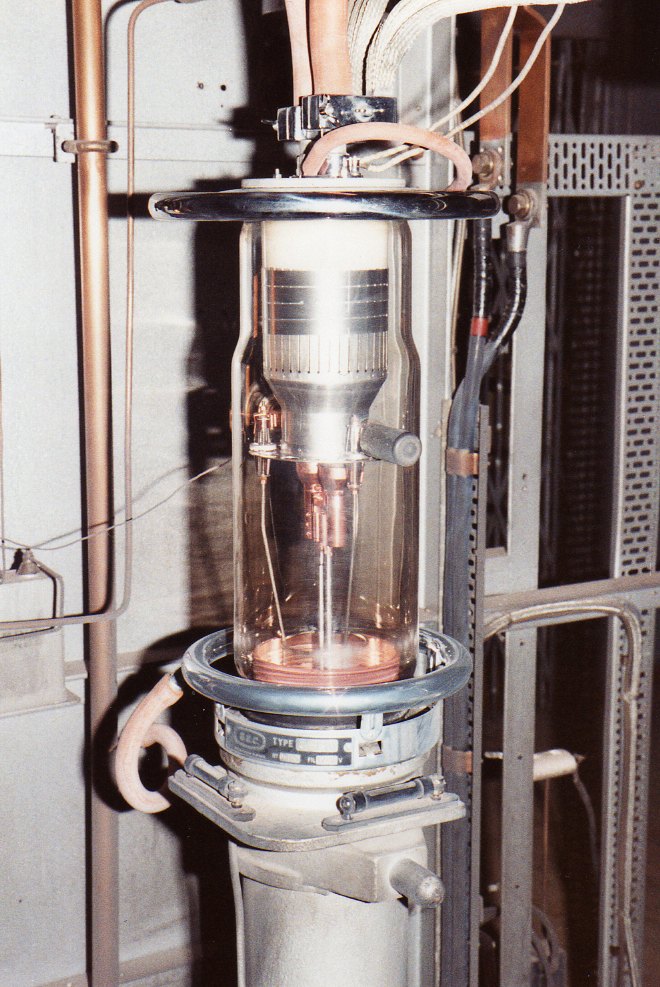
     Droitwich uses two metre-high ceramic and metal valves, 
     which are no longer made.
said valves: https://www.radiorewind.co.uk/images/1983027.jpg https://www.radiorewind.co.uk/images/1983023.jpg

from: https://www.radiorewind.co.uk/radio1/droitwich.htm

https://i0.wp.com/www.richardmudhar.com/blog/wp-content/uplo...

Re: Long Wave radio era set to end with switch-off

#137

Earlier quoted context omitted.

DAB+ uses EEP (and RS) which was deliberately chosen to give better signal quality all the way to the point of losing reception. Old DAB used UEP which degrades faster, but instead of having no signal, it went to a muddier / warbling kind of sound that characterised early DAB receivers. And technically while some people do call it MPEG2, it's actually MP2, also known as MPEG-1 Audio Layer 2, an audio codec in the sam…

> I imagine that today they'd probably use something like Opus and a fountain code or similar, yes... But you can't expect everyone to replace their radio every 10-15 years ;) Certainly not, which is why I believe DAB (no plus) is still floating around. And I'm not really suggesting that they made a bad choice. I'm mostly pushing back on the notion that digital means all or nothing audio. If broadcast audio stays ali…

I could be wrong, but I think DAB uses DQPSK (which can be thought of as a special version of QAM 4 if you squint a bit) and not anything like the higher QAM constellations because it's deliberately designed for mobile (road, train etc) where you don't have a steady signal, it can vary a lot with motion, so QAM 64 wouldn't really be possible.

Though I did a quick check and apparently DRM+ uses QAM-16, so perhaps my knowledge is far too out of date :S

Re: Long Wave radio era set to end with switch-off

#138
post #82

Earlier quoted context omitted.

Best we can do is privatisation and selling it to a party donor.

LW-HFT all the wayyyyy! - some cryptobro /s

That'd be quite a challenge!

From a quick Google I see that HFT carries out trades in an average of 700ns, which is close to the cycle time of a 150kHz carrier, so you'd have to come up with some really clever phase modulation scheme that could carry meaningful data in *one single cycle*.

You're definitely going down the SDR route for that.

Re: Long Wave radio era set to end with switch-off

#139

IMO, when the last LW transmitter shuts down, the whole band needs to be reallocated to hams. Realistic small-ish antennas are shockingly doable with a capacitance hat, loading coil, and counterpoise.

"Longwave" has no universally agreed defintion, but good news, amateur radio already has usage of 135.7 kHz to 137.8 kHz. Building equipment that works on frequencies this low, and avoiding natural interference, can be extremely difficult.

Building aerials that work efficiently at 136kHz is difficult (although I have a croft that's approximately long enough for a half-wave dipole in NW Scotland, close to the sea for a good groundplane).

Actually generating the signal you could do with a moderately expensive USB soundcard, directly synthesizing it with simple VST-like plugin. Mad to think about, really.

Re: Long Wave radio era set to end with switch-off

#140
post #50

Earlier quoted context omitted.

I hope they update their protocols

I hope you mean updated... Otherwise we're about to find out what's in the letter of last resort they have onboard! ;)

It is still on air, playing a message that they stopped broadcasting on that freq. (at least 30 minutes ago)
Post reply on HN