Earlier quoted context omitted.
This presumes that federal spending is a bad thing.
Spending more than you have is bad. Inflating the currency making everyone poorer to pay for it is worse. This is basic economics. Yes, excessive federal spending is bad.
Alan Greenspan has died
231–240 of 274 posts
Re: Alan Greenspan has died
#232I'm not a gold bug but Alan was a proponent of the gold standard. He wrote about how the gold standard created responsible spending and more equality in the world: https://ritholtz.com/2008/11/gold-and-economic-freedom-by-al... The world we are in now, especially in the US, is one where there is near unlimited government credit but it is, according to many, papering over deep structural problems. At some point, these…
> He wrote about how the gold standard created responsible spending and more equality in the world: The Gilded Age, which had quite high levels of inequality, occurred when the gold standard was active: * https://en.wikipedia.org/wiki/Gilded_Age It should also be noted that the gold standard did not bring any kind of price stability: * https://archive.is/https://www.theatlantic.com/business/arch... Further, sticking…
I feel like the existence of endless almost-free credit rewards gamblers, and when they win, they win big.
Re: Alan Greenspan has died
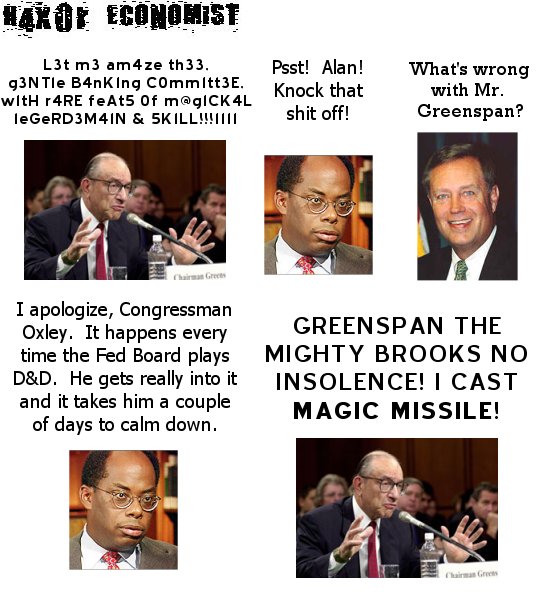
#233Greenspan was also the subject in the weird comics "h4x0r economist"/"haxor economist", which thankfully still live on since its early internet days https://www.rdwarf.com/users/kioh/ (NSFW language)
I don't get this comic at all but I really miss when random stuff like this got published online!
After going through I came back to this tame comic which was the one I remember I actually got a kick out of as really funny back then: https://www.rdwarf.com/users/kioh/haxorec47.jpg (Theme: Greenspan n DnD)
Re: Alan Greenspan has died
#234Earlier quoted context omitted.
I am aware of today's inequality (e.g., I read Piketty back when he was making a splash). But the critique is that Greenspan argued gold standard = less inequality and that fails on the historical record. If we want to talk about the causes of the 'New Gilded Age' that's something else. As a general starting point I'd begin with: * https://en.wikipedia.org/wiki/Friedman_doctrine * https://en.wikipedia.org/wiki/Reagan…
Gold Standard is probably a force that acts against inequality but the forces pushing inequality today are just much stronger. Technology that creates winner take all markets and incredible leverage with few people being one.
Re: Alan Greenspan has died
#235My favorite bit of Greenspan lore: Texas Senator Phil Gramm (pretty sure it was him) was a prominent GOP member of the Senate Banking Committee. Of course, Greenspan often testified there. Gramm would always ask Greenspan, along with his other questions, “Mr. Chairman, what’s the ideal capital gains tax rate?” Greenspan never missed a beat: “Zero.” Agree or disagree, you always knew where he stood!
> Agree or disagree, you always knew where he stood! This is always such a weird phrasing to me. We collectively praise politicians for this (and admittedly, many of them will just say anything to get elected), but the phrase discourages the idea that learning and changing your mind is valuable. (Not trying to single you out, just writing about how we collectively do this. I'm sure I've done it in the past.)
The anecdote was intended to highlight the directness of his answer rather than the constancy of his position.
Re: Alan Greenspan has died
#236Earlier quoted context omitted.
> 1) Deflation causes debt to become more expensive. Inflation causes your money to become worth less. There's a simple solution to debt becoming more expensive, but no practical solution to you getting a pay-cut every year, especially when a sizable chunk of people don't even realize they're getting a pay-cut and don't want to be unthankful for a "raise." That issue alone already causally explains much of the rise i…
You're engaging in a pretty common fallacy by taking the contemporary standard, in a world full of wild inflation and funny money, retroactively applying it backwards, seeing [correctly] that it wouldn't work, and thus concluding that funny money is needed. But you need to consider the impacts of the funny money itself. One fundamental difference is that inflationary systems incentivize the hoarding of 'things', like…
It would incentivise the hoarding of currency instead. Holding or investing in anything else is, on average, a losing bet in a sustained deflation.
By definition, deflation is people choosing not to contribute to production obtaining increasing returns on doing and risking absolutely nothing at the expense of those who do contribute to production working harder or taking more risks to serve them. You're accusing me of "engaging with a pretty common fallacy" whilst arguing against a tautology.
> So you can see a visible impact of this in housing prices. In the 50s a typical house used to cost about 2 median salaries. [1] Go further back in time and you're down to 1 median salary. In modern times, we're at historic highs of a median home costing 5x a median salary, and in desirable locations like western California it even gets up to 12x local median salary for a median home. [2] That's median, not Beverley Hills.
That's the supply and demand of housing, as well evidenced by the large disparity of house price changes. Deflation does not incentivise building more houses (quite the opposite actually). In practice, it just means you pay higher mortgage rates and end up with a house that isn't worth anywhere near as much as your mortgage repayments, or you rent - both of which involve more of your lifetime income being transferred to richer people.
> Real wages are up 14% over the past 47 years [3], and we now have a trillionaire.
The trillionaire is arguing the same position as you on currency. I'm sure he and the other billionaire funded think tanks attacking "fiat money" almost as strongly as they attack tax and regulation on billionaires and services for the poor do so because they care about giving the little guy more...
Re: Alan Greenspan has died
#237Earlier quoted context omitted.
This presumes that federal spending is a bad thing.
Spending more than you have is bad. Inflating the currency making everyone poorer to pay for it is worse. This is basic economics. Yes, excessive federal spending is bad.
Re: Alan Greenspan has died
#238Earlier quoted context omitted.
39 trillion in debt with no Congressional stomach for... - spending cuts - stopping fraud - figuring out how the net worth of people in Congress increases from hundreds of thousands of dollars to 10s or 100s of millions of dollars - addressing wasteful and ineffective programs Given those issues, the only solution will be inflation. The circling the drain moment will hit with the associated welfare programs get a dir…
From what I observe from fraud and corruption witch-hunts, they are nothing more than that. The real fraud is that government that is supposed to serve the people who elected it serves everyone else first.
Re: Alan Greenspan has died
#239Earlier quoted context omitted.
You're engaging in a pretty common fallacy by taking the contemporary standard, in a world full of wild inflation and funny money, retroactively applying it backwards, seeing [correctly] that it wouldn't work, and thus concluding that funny money is needed. But you need to consider the impacts of the funny money itself. One fundamental difference is that inflationary systems incentivize the hoarding of 'things', like…
> One fundamental difference is that inflationary systems incentivize the hoarding of 'things', like housing, as a means of escaping inflation. This is because the price of 'things' will always increase with inflation. But in stable or deflationary systems there's no inflation to hide from and the price of 'things' is stable or can even decrease over time, so there's no longer a hoarding incentivization for 'things.'…
Deflation results from not printing money. When the growth in the amount of stuff in the economy exceeds the growth in the amount of money in the economy - each dollar becomes worth more over time. That is deflation. Yeah you can sit on it and take it as passive gains. You can also use those gains in your spending power to achieve even greater things. It's up to the person.
As for the past having higher mortgages, this provides data on such from 1950. [1] "...the typical monthly mortgage payment [of] $54.31 for principal, interest, FHA mortgage insurance premium, hazard insurance, taxes and special assessments, and any miscellaneous items such as ground rent." 1950 median personal was $3300, so a house mortgage cost 20% of that. Current median personal income is $45k, so that'd be a mortgage on a new house of about $750 with tax/insurance/assessment/etc included in that. We can safely reject the claim that mortgages were higher.
However, your critique that your house would not be worth as much as you paid is 100% true. When things do not endlessly increase in value, going into debt to purchase them comes with a real cost. That is one of the many reasons prices were able to be kept in check. Housing becoming a vessel for speculation just inevitably drives their prices endlessly up while people actually trying to find a place to live and raise a family suffer for it all. This is all only magnified when you add the surplus of funny money. It being speculation or supply and demand are not somehow different things as you seem to be implying.
---
Basically I find most of all arguments about the past tend to be false or exaggerated, and not at all intentionally. We're all taught that economic policy in the past primitive and misguided, as true as the sky is blue and grass is green. Yet when you look at what people could buy in the past on a typical median salary, or the lifestyle it could provide - it almost sounds like make believe, and is way more than enough to make one wonder what went wrong? And I think currency policy is largely the answer to that question.
[1] - https://www.huduser.gov/portal/sites/default/files/pdf/Housi...
Re: Alan Greenspan has died
#240Earlier quoted context omitted.
> Discretionary spending is a misnomer that assumes all of the other spending levels just have to be maintained as is, are without fraud, run efficiently and impossible to reform. We disagree on the fundamental problem, and I believe your solution is wildly irresponsible to "just keep cutting 20%." You say fraud; prove the fraud. DOGE couldn't find any, so "extraordinary claims require extraordinary evidence." Fraud…
Of course it’s popular. Lots of policies that make no economic sense are popular.