I am already seeing the uptake on Spec-Driven Development as the Rational Unified Process revenge.
Formal methods and the future of programming
11–20 of 129 posts
Re: Formal methods and the future of programming
#12I wonder how formal methods can help us move faster with GenAI. Is it that they can help write formulas faster? That they can help ensure formulas match the system they're modeling faster? If the problem you think formal methods will help with is sloppy code, isn't the verification code going to be sloppy as well, unless some (not sloppy) intelligence carefully confirms that the specification matches the target syste…
> isn't the verification code going to be sloppy as well The beauty of formal methods is it doesn't matter if your proof is sloppy. As long as it passes verification, it is correct. And unlike in pure math, the proof that a software system is correct is usually a huge mess of special cases, loop invariants, proofs by induction, and boilerplate that requires a large amount of human labour while providing no insight. P…
So, formal methods produce runnable systems, but communication remains the challenge.
If a formal spec is messy, then it's a proof of ... what, exactly?
A formal specification that bridges tech and product, that lets non-technical contributors read and discuss all the logical nuances, directly as operational code, at product's level of abstraction of interest, would transform a lot.
It's no longer a challenge to create code, it's a challenge to create business requirements and translate them into systems.
Re: Formal methods and the future of programming
#13I wonder how formal methods can help us move faster with GenAI. Is it that they can help write formulas faster? That they can help ensure formulas match the system they're modeling faster? If the problem you think formal methods will help with is sloppy code, isn't the verification code going to be sloppy as well, unless some (not sloppy) intelligence carefully confirms that the specification matches the target syste…
The general idea is that formal methods are self-verifying, up to a point. Sloppy formal methods simply won't prove. The point up to which formal methods stops is: do the formally encoded requirements actually encode what I want to be true? One can make the argument that the requirements is a much smaller surface to verify than that of the entire program. The counter argument is that figuring out what you want the pr…
> One can make the argument that the requirements is a much smaller surface to verify than that of the entire program.
This argument is unfortunately empirically false for any program of any meaningful complexity (>1000 lines, probably even as low as >100 lines ignoring well-defined algorithms and data structures) using current formal methods.
Complete formal specifications are usually multiple times larger than the corresponding source code and encode esoteric propertys necessary for the proof, but which are largely even more impenetrable than a undocumented codebase.
So, it is both harder to figure out if you encoded the desired requirements and it is more complex. Your only advantage is confidence that what you wrote down is proven.
Re: Formal methods and the future of programming
#14As usual, this paean to deductive reasoning (“formal methods”) leaves out its fundamental limit: how closely do the postulates and definitions fit the domain they purport to map? (“In theory, there is no difference between theory and practice. In practice ...”) My guess is that Jane Street maintains large code bodies where the mapping is 1:1, because the purpose of the code is to implement a deterministic algorithm. Many other coders work in such areas. But millions of us don’t: most UIs, most exploratory work, etc.
There is a movement parallel to formal methods to define acceptance criteria at high resolution but not logico-mathematically, which at least grapples with the mapping problem but can’t resolve it where the map isn’t the territory, which is most places. Has Google’s results page, with its extremely evolved internal optimization frameworks really hit an optimum? Could that prototype you whipped up to capture a hazy idea have better illustrated it? These questions are best answered by looking outside the system to what the system serves.
Re: Formal methods and the future of programming
#15Whenever I read about formal specs it always seems to me like “write the same tests just in a different way”, or worse, “write the same implementation but in a different way”.
I guess doing things twice can help catch errors, but I fail to see what’s so special about formal specs if they can suffer from the exact same bugs as the tests/implementation.
I guess the root of the problem is if you want to formally prove that a program does something, you have to be very specific (heh) about what that something is, at which point you are basically just writing tests/implementation all over again.
I have been looking into this on and off for years now, and I keep feeling like I’m missing something, but I don’t know what it is.
Can anyone enlighten me?
Re: Formal methods and the future of programming
#16I wonder how formal methods can help us move faster with GenAI. Is it that they can help write formulas faster? That they can help ensure formulas match the system they're modeling faster? If the problem you think formal methods will help with is sloppy code, isn't the verification code going to be sloppy as well, unless some (not sloppy) intelligence carefully confirms that the specification matches the target syste…
> isn't the verification code going to be sloppy as well The beauty of formal methods is it doesn't matter if your proof is sloppy. As long as it passes verification, it is correct. And unlike in pure math, the proof that a software system is correct is usually a huge mess of special cases, loop invariants, proofs by induction, and boilerplate that requires a large amount of human labour while providing no insight. P…
The problem is that generating either code or proofs with LLMs is very expensive, and generating good proofs (I don't mean elegant, I mean proving the most important properties) is probably not very fast, either. Reducing the verification time of a program from 100 years to 10 years or the cost from $1bn to $100m is still not practical enough to become truly mainstream.
Things can be improved when people help guide and focus the LLMs, but these people still need to be formal methods experts.
Re: Formal methods and the future of programming
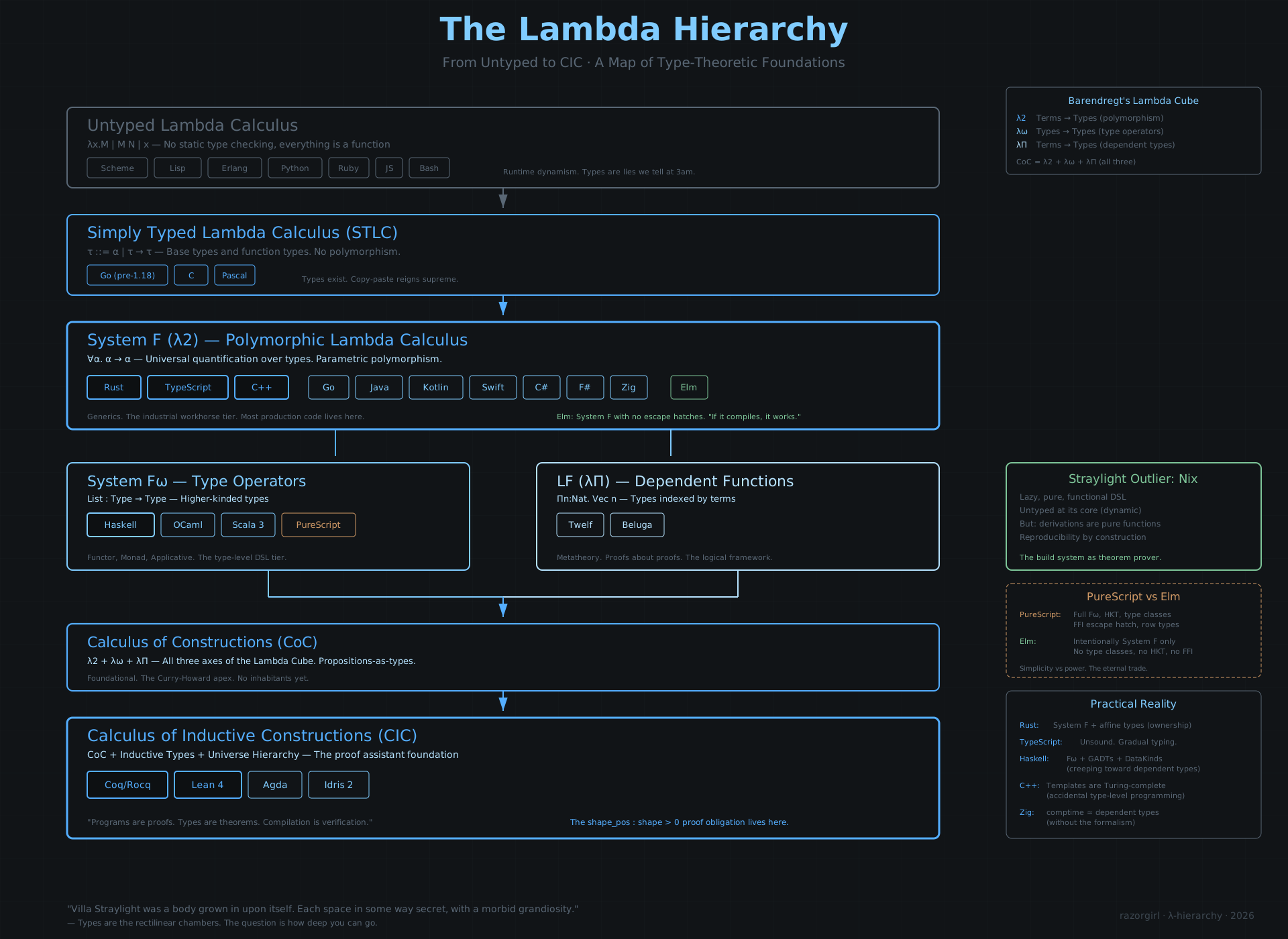
#17I caught the religion on using types in conjunction with LLMs about eighteen months ago, but I only really got serious about `lean4` like six to eight months ago and now I wouldn't even consider using AI assist in software work with a `CIC` proof substrate that has practical C/C++ (and therefore, everything) FFI.
We've banned everything from JSON to Python, rewritten `nix` to have a compiler, and almost everything we write is not only property tested and multiply fuzzed to within an inch of it's life, but we have proofs in `lean4` that at a minimum drive property tests via `.olean` linkage, and when we have the bandwidth we prove exhaustiveness over the domain and property test that.
We skip the whole C++/Rust thing because all of the fast stuff is generated from `lean4` and so it doesn't really matter (C++ has advantages when bugs in it are actually bugs in `lean4` code, but you could go either way).
This is a big departure, and I certainly don't blame anyone who is skeptical: "ban JSON and Python wtf?!?!", but we've done millions of lines (checked) of this stuff and AI + formal systems is a dramatically bigger leap than no AI -> AI and Python. The latter in our experience is not monotone in progress, the former is almost always monotone in progress.
And you can do wild shit, this is a formal proof of the polyhedral tensor calculus that is modeled by things like ISL and CuTe, and using that we can get swizzling and tiling using `mdspan` in C++23 on device and prove it's right (up to some L'Hopital arugment about the coverage which this example doesn't demonstrate well: https://github.com/b7r6/mdspan-cute
That in turn, well, it goes real fast. On the first try.
Re: Formal methods and the future of programming
#18Whenever I read about formal specs it always seems to me like “write the same tests just in a different way”, or worse, “write the same implementation but in a different way”. I guess doing things twice can help catch errors, but I fail to see what’s so special about formal specs if they can suffer from the exact same bugs as the tests/implementation. I guess the root of the problem is if you want to formally prove t…
> Whenever I read about formal specs it always seems to me like “write the same tests just in a different way”, or worse, “write the same implementation but in a different way”. [...] Can anyone enlighten me?
A big difference is that formal methods allow you to use the "for all" quantifier.
For example, you might write a unit test that says "foo('abc') returns a string with no trailing whitespace".
But with formal methods, you can prove that "for any input x, foo(x) returns a string with no trailing whitespace".
This is a trivial example, but you could imagine something more complicated, such as "for any program P, compile(P) has the same behavior as P".
Of course, you have to define what "has the same behavior as" means!
Re: Formal methods and the future of programming
#19Whenever I read about formal specs it always seems to me like “write the same tests just in a different way”, or worse, “write the same implementation but in a different way”. I guess doing things twice can help catch errors, but I fail to see what’s so special about formal specs if they can suffer from the exact same bugs as the tests/implementation. I guess the root of the problem is if you want to formally prove t…
I don’t write software, but in asic and fpga design, formal method specifications enable the use of things like SAT solvers to determine if the underlying test article meets the specification.
You specify properties of the design and the tooling tests the design in a variety of ways to see if it can violate those properties.
Let’s say you have a system that controls turn signals. You can specify properties that say things like lanes that cross each other can’t both have a green light at the same time or even within some period of time of each other.
The tooling can exhaustively check the design for this and surface code traces that violate it.
Re: Formal methods and the future of programming
#20Whenever I read about formal specs it always seems to me like “write the same tests just in a different way”, or worse, “write the same implementation but in a different way”. I guess doing things twice can help catch errors, but I fail to see what’s so special about formal specs if they can suffer from the exact same bugs as the tests/implementation. I guess the root of the problem is if you want to formally prove t…
It's more than just "write the same tests just in a different way", because each test is largely independent, or grows to unmanageably large, and you have to do the work of figuring out the completeness of your test suite by e.g. branch coverage or other relatively crude overlap methods.
Statically proven type systems let you do this in a way that each contributing piece is checked in advance against all the other pieces, guaranteeing not just "this test passes" but, in combination, "all these tests create a reasonable, coherent whole", and it disallows incoherent models from being implemented in the code. An example of this is like Rust's match, which requires complete coverage of all the possible branches, but writ large across an entire codebase.
You're right that it does nothing for you if you make a fundamental logic or theory error, it can't catch that kind of error, but you'd be surprised how much more robust it is than "merely" e.g. Haskell's type system + ad hoc functional testing + property testing - which I would consider a quite strong system overall, but formally proven e.g. cryptography is a much higher bar.